iFeeling Daily
Daily curated AI insights you can't miss.
Search article by Theory Ventures: no substantive content

The source is a copyright notice with only the title 'Search' from Theory Ventures. No technical content is available, so the article's insights on search in AI or business cannot be summarized.
Nexus SDV: Securing the software-defined vehicle with AI agents

This article announces Nexus SDV, an open-source, AI-enabled connected vehicle platform built on Google Cloud in partnership with Valtech. It explains how the platform uses Arm-based compute, Bigtable-optimized storage, and Gemini models to reduce TCO while securely managing up to 100 million devices with defense-in-depth security.
LeRobot v0.6.0: Closing the Robot Learning Loop
LeRobot v0.6.0 introduces world model policies, reward models, a deployment CLI with DAgger corrections, and nine simulation benchmarks to close the robot learning loop, making it easier to iterate from data collection through fine-tuning and evaluation.
Claude Code usage data shows domain expertise, not coding skill, drives success

Anthropic analyzed ~400,000 Claude Code sessions and found that domain expertise, not coding skill, is the strongest predictor of success. Experts achieve verified success more than twice as often as novices, and every major occupation succeeds at nearly the same rate as software engineers when using the tool.
Project Fetch Phase Two: Claude Opus 4.7 Outpaces Humans on Robot Tasks

Anthropic's follow-up to Project Fetch shows Claude Opus 4.7 completing robotics tasks up to 37 times faster than human teams from eight months earlier — without any human assistance. While closed-loop physical control remains a challenge, the rapid general scaling of LLMs is closing the gap between helpful assistant and autonomous physical agent.
Claude Science: An AI Workbench for Scientists

Claude Science is a new AI workbench that integrates the fragmented tools scientists actually use—PubMed, Jupyter, R, clusters—into one auditable, reproducible environment with over 60 pre-configured skills for genomics, proteomics, and structural biology.
Inside GeneBench-Pro: A Genomics Benchmark for Real-World AI Reasoning

GeneBench-Pro is a benchmark that exposes how current AI models struggle with the multi-step, confounding-aware reasoning needed for real genomics tasks like somatic oncology decisions or single-cell eQTL analysis. Each case study provides full datasets and requires models to correct technical artifacts before drawing conclusions.
Looker 2026: Agentic BI via Governed Semantic Layers and Gemini Reasoning

Google frames its 2026 Gartner MQ Leader recognition around Looker's shift from passive dashboards to agentic BI. The core insight is that autonomous agents need a governed semantic layer (LookML) and deep reasoning (Gemini 3) to act on trusted metrics at scale, as demonstrated by PayPal's 3,000+ user rollout via Looker's Managed MCP.
Hugging Face and Cerebras Build Real-Time Voice AI with Gemma 4
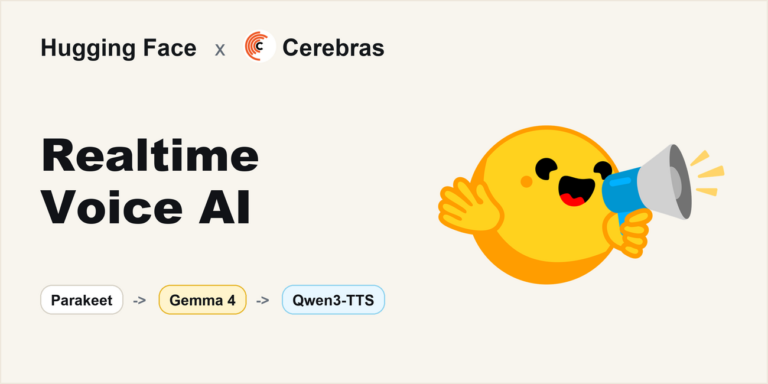
This article shows how Hugging Face and Cerebras pair an open, modular speech-to-speech pipeline with fast, stable inference from Cerebras to solve the latency bottleneck that still plagues voice AI, enabling much more natural conversational flow.