iFeeling Daily
Daily curated AI insights you can't miss.
So You Want to Sell Inference: Pricing vs Value in AI
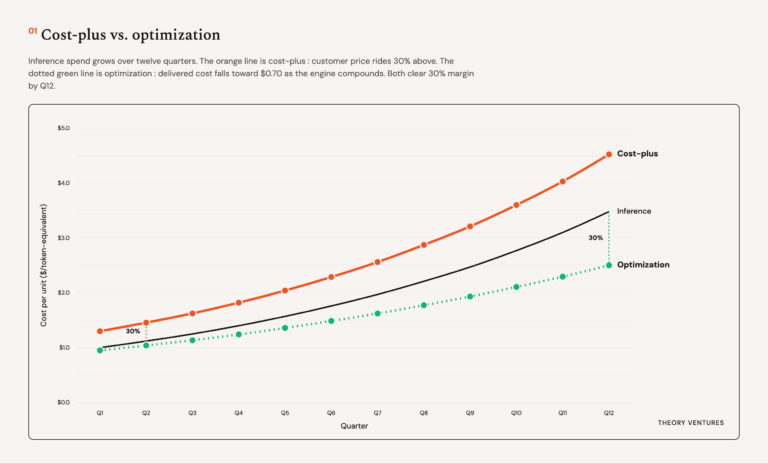
If you're reselling inference, cost-plus pricing caps your margins at zero as commodit drives prices down. The article explains how value-based pricing (charging per outcome, not per token) and optimization (distillation to proprietary small models) keep gross margin above 30%, and why bring-your-own-key kills markup entirely.
Daybreak: Tools for Securing Every Organization in the World
OpenAI's Daybreak initiative tackles the new cybersecurity bottleneck of patching at scale, with Codex Security automating fixes across 30,000 codebases, GPT-5.5-Cyber setting state-of-the-art CyberGym scores, and Patch the Planet pairing expert researchers with open-source maintainers to land fixes faster.
MosaicLeaks: How Deep Research Agents Leak Private Information Through Queries

A new benchmark called MosaicLeaks reveals that deep research agents frequently leak private enterprise information through their web query logs, and training for task performance alone makes it worse. The authors propose PA-DR, a reinforcement learning method that trains agents to construct safer queries, cutting leakage by over 3x while preserving task success.
The AI Frontier: from FLOPs to Megawatts — Anjney Midha, AMP

Anjney Midha argues the AI race is shifting from buying more GPUs to building a compute grid that makes FLOPs flow like megawatts, modeled on independent system operators rather than hyperscaler monopolies.
Using AI to Reanalyze Unsolved Rare Disease Cases and Find New Diagnoses

Researchers used OpenAI o3 Deep Research to reanalyze 376 unsolved rare-disease cases, yielding new diagnoses in 4.8% after experts confirmed findings—demonstrating how AI-assisted periodic reanalysis can uncover answers buried in fragmented genomic data and evolving scientific knowledge.
Chinese Threat Actor UNC6508 Targets Medical REDCap Servers for Espionage
A sophisticated PRC-linked espionage campaign compromised medical research REDCap servers for over a year, using a custom malware called INFINITERED to harvest credentials and then abusing enterprise email compliance rules for silent data exfiltration. A detailed breakdown of the attack chain, malware mechanics, and defensive takeaways for any organization running shared research platforms.
Near-autonomous AI improves challenging Chan-Lam coupling for sulfonamides

OpenAI and Molecule.one connected GPT-5.4 to an autonomous chemistry lab to improve Chan–Lam coupling of primary sulfonamides. Across 10,080 reactions, the system identified TEMPO as an effective additive, raising yields significantly. Human chemists validated results at bench scale, confirming the AI-driven finding holds in practical workflows.
MolmoMotion: Language-guided 3D motion forecasting from video

MolmoMotion predicts future 3D point trajectories from a single video frame, language instruction, and query points, using a class-agnostic, view-stable representation. It outperforms existing forecasting methods on a new benchmark, accelerates robot policy learning (76.3% vs 56% pick-and-place success), and improves video generation motion quality. The model, 1.16M-video dataset, and benchmark are openly released.
GLM-5.2: Open 1M-Context Model for Long-Horizon Agent Tasks
GLM-5.2 is the first open-source model to make 1M-context genuinely usable for long-horizon coding agents, trailing only Opus 4.8 on FrontierSWE and Terminal-Bench 2.1 while beating GPT-5.5 and Gemini 3.1 Pro. Its IndexShare architecture cuts per-token FLOPs by 2.9× at 1M context, and the anti-hack RL training stops reward hacking without crashing rollouts.