iFeeling Daily
Daily curated AI insights you can't miss.
Formal Proofs, Not Vibes: Erik Meijer’s Automind for Safe AI Agents

Erik Meijer argues that AI agent failures like database deletion or rogue tool calls are predictable consequences of acting on unchecked intent. Automind enforces safety by requiring machine-checkable proofs in Universalis before any action executes, shifting trust from the agent to a small auditable checker.
OKF v0.2 adds trust signals for agent-generated knowledge

OKF v0.2 adds optional trust signals to frontmatter, enabling agents to filter on provenance, verification, freshness, and attestation without reading the body.
RayRoPE: Projective Ray Positional Encoding for Multi-View Attention

RayRoPE introduces a positional encoding for multi-view transformers that uses predicted points along rays instead of directions, achieving SE(3)-invariant, geometry-adaptive attention. On CO3D, it improves LPIPS by 15% over alternatives and naturally handles RGB-D input, making it a practical upgrade for novel-view synthesis and stereo tasks.
Neil Rimer on the coming redistribution of AI wealth

Neil Rimer of Index Ventures predicts AI wealth will be redistributed voluntarily or by force, as philanthropy declines and wealth concentration hits Gilded Age levels. With California's wealth tax looming and OpenAI considering equity stakes for government, builders should watch the shifting balance between giving back and having it taken.
Hugging Face discloses AI-driven intrusion and AI-assisted response
Hugging Face disclosed a real AI-vs-AI intrusion where an autonomous agent breached their dataset pipeline, executing thousands of actions over a weekend. Their own AI-driven forensics—switching from blocked frontier APIs to an open-weight model on their infrastructure—revealed a critical asymmetry: attackers face no guardrails, but defenders using hosted models can be locked out by safety filters.
AlloyDB AI: Solving CJK Full-Text Search with In-Database Gemini Segmentation
AlloyDB AI uses Gemini models to segment Chinese/Japanese/Korean text directly in the database, solving the whitespace problem for full-text search. Combined with RUM indexes and ScaNN vector search, it provides hybrid search without external pipelines or data movement.
Model Routing Is Simple. Until It Isn’t.
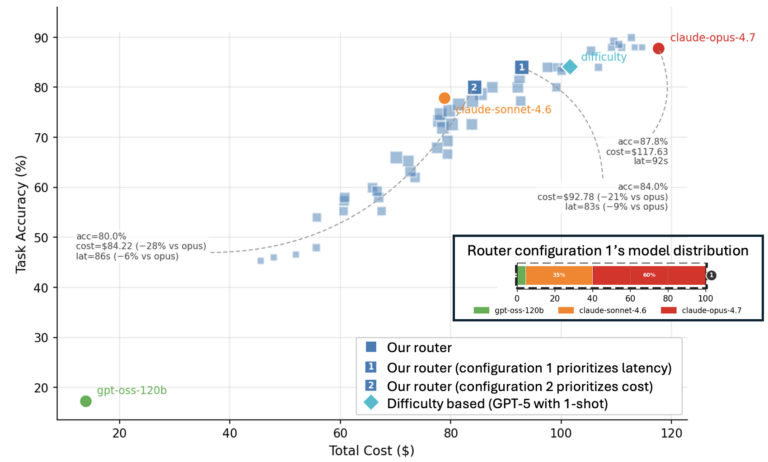
路由成本受缓存命中率影响远超定价表,Sonnet在AppWorld测试中实际成本仅为GPT-4.1一半。将路由视为系统优化问题,用轻量级多目标优化器替代分类器,才能找到成本、延迟、准确率之间的真实平衡点。
How Claude Performs on Robotics Tasks

This extensive evaluation reveals that frontier language models can now complete basic robotics tasks when paired with pretrained controllers, but direct motor control remains unreliable. The key insight: a model's real-world capability depends more on its control interface than on the model itself, with clear safety implications for deploying AI with physical world access.
Behavioral Privacy Leakage in Agentic Negotiation

Autonomous negotiation agents are increasingly deployed in high-stakes settings like insurance and procurement, where cryptographic techniques protect explicitly disclosed constraints. However, this paper exposes a subtler threat: behavioral privacy leakage, where an adversary infers private constraints from observable negotiation dynamics—concession trajectories, timing, and convergence patterns. The tension is that even if the agent never reveals its reservation price directly, its behavior during rounds of bargaining leaks enough information for inference attacks.