iFeeling Daily
Daily curated AI insights you can't miss.
Verifiable Trust in AI: Google Cloud’s Confidential Computing Advances

Google Cloud announces Confidential G4 VMs with NVIDIA RTX PRO 6000 Blackwell GPUs, open-source Prompt Encryption SDKs, and expanded Confidential Space support, making hardware-rooted privacy protection available globally for AI inference and fine-tuning with minimal performance impact.
Query logs and traces with SQL in Google Cloud Observability Analytics

Google Cloud unifies logs and traces under a single BigQuery-backed SQL analytics surface called Observability Analytics, letting you JOIN span and log data for aggregate queries across millions of events — especially useful for debugging AI agent tool calls, finding flaky microservices, and correlating latency with business metrics.
Cross-Origin Storage API: Ending duplicate downloads for browser AI

If you've ever watched your browser re-download 177 MB of Whisper model weights just because a second site lives on a different origin, this article explains exactly why that happens—and how the proposed Cross-Origin Storage API fixes it using cryptographic hashes instead of URLs. Transformers.js already supports it experimentally, and you can test the whole thing today with a Chrome extension.
Build real agentic apps using CUGA: lightweight harness, two dozen examples
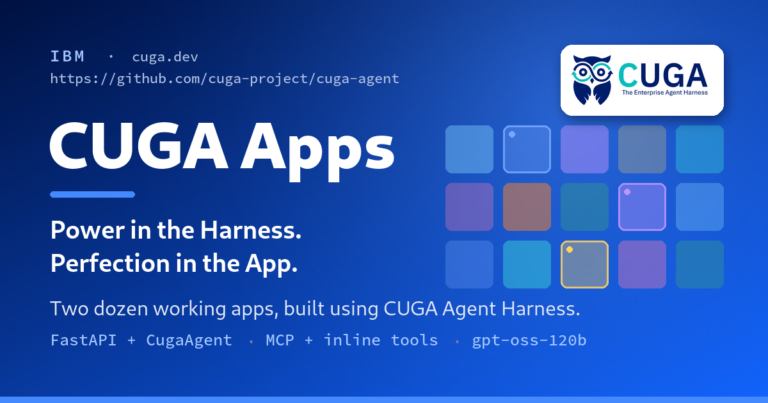
CUGA (Configurable Generalist Agent) is an open-source harness from IBM that strips away the repetitive plumbing of agentic apps, letting you focus on tools and prompts. With two dozen single-file examples and built-in governance, it shows how to build agents that scale from a laptop to a governed production deployment without rewriting.
Local Model Triage for OpenClaw: Real-Time, Cost-Free PR Classification
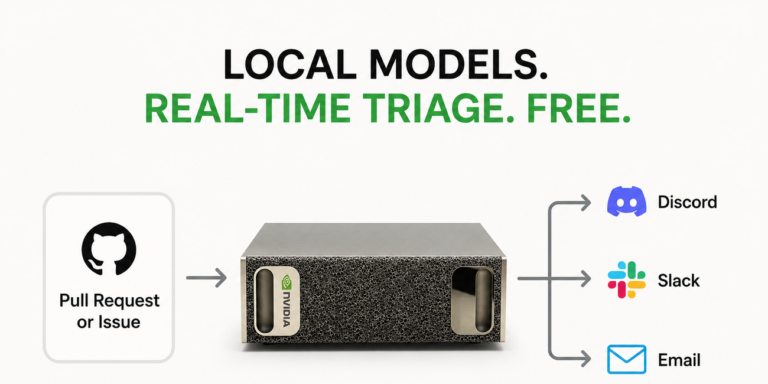
If you own a powerful local machine like the NVIDIA GB10, using models like gemma-4-26b-a4b or qwen3.6-35b-a3b in an agent harness can give you real-time, cost-free triage of open-source contributions. The article provides concrete numbers on precision, recall, and throughput tradeoffs, plus a practical hybrid architecture that uses a cheap cloud audit loop ($9/month) to catch misses.
Shipping weekly releases with AI, open tools, and a human in the loop
Hugging Face cut their release effort from half a day to 15 minutes by using an open-weight AI to draft changelogs, wrapped in deterministic checks that verify every PR is included, and a human review before shipping. The full pipeline is open-source and costs about $0.25 per run.
Codex as a persistent workspace for long-running AI workflows
A practical look at treating Codex as a persistent workspace for long-running work—breaking projects into verifiable steps, preserving context across sessions, and deciding when to delegate vs. keep human oversight. Essential reading if you're building workflows that span more than one chat.
BigQuery Python UDFs Now GA: Run NumPy, Pandas, and More Directly in SQL
BigQuery Managed Python UDFs are now generally available, letting you run NumPy, SciPy, pandas, and scikit-learn directly in SQL without managing containers. It supports vectorized PyArrow processing for up to 10x performance gains and configurable memory up to 16 GB.
Every Future Product Will Be a Living System: Ronak Malde on Continual Learning
Ronak Malde, CEO of Trajectory.ai, argues that static AI models are insufficient for enterprise use cases like legal or finance—every future product must be a living system that learns continuously. He details how they achieve this with concurrent training jobs, Self-Distillation Policy Optimization, and open-sourced infrastructure.