Local Model Triage for OpenClaw: Real-Time, Cost-Free PR Classification
The article exposes the tension between relying on powerful but potentially removable closed-source models and the need for a self-owned AI stack, especially for time-sensitive production tasks. The authors, maintainers of the OpenClaw repo, wanted to build a real-time notification system for P0 issues and PRs, but hitting API quotas or batching with a cloud model like GPT-5.5 would either cost too much or introduce delays. Their specific hardware—an NVIDIA GB10 with 128 GB unified memory—made local inference free in terms of API cost, but it raised the question of whether local open-weight models could match the accuracy needed for reliable triage without false positives flooding their Discord feed.
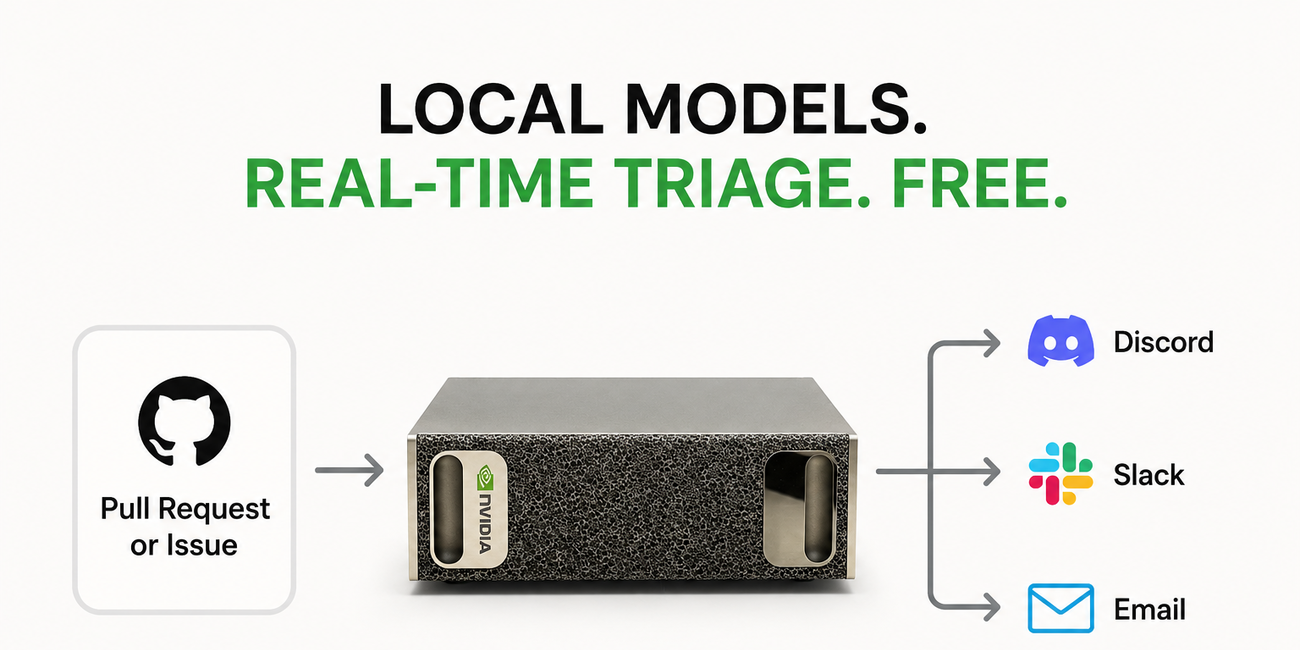
The concrete technical path uses an agentic classification pipeline. The team runs local models like gemma-4-26b-a4b and qwen3.6-35b-a3b through a harness called Pi, which hands the model the PR title, body, and diff excerpt, then lets it use a restricted read-only shell (reposhell) to inspect the repo before outputting a structured classification via final_json. The orchestration layer uses a SQLite database and a worker queue: new items are normalized, classified agentically, and then deterministic rules send filtered notifications to Discord. On the 330-row evaluation set, Gemma achieved higher recall (0.905) and faster wall-clock time (1.41 sec/row at concurrency 16), while Qwen had higher precision (0.831) and fewer false positives (105.7 vs 227.0), making the choice a tradeoff between catching everything and reducing noise.
The serious takeaway is that medium-sized local models are already practical for high-throughput triage tasks without fine-tuning, as long as you accept the tradeoffs in precision versus recall. The authors also built a cost-effective audit loop using GPT-5.5 every two hours (roughly $9/month) to catch false positives and negatives, showing that a hybrid approach can bridge the gap during calibration. For builders, the key operational insight is that agentic classification—letting a model fetch its own context via a restricted shell—can outperform simply feeding the full body upfront, and is secure enough to deploy on public repos without risk of prompt injection hijacking the pipeline.