Build real agentic apps using CUGA: lightweight harness, two dozen examples
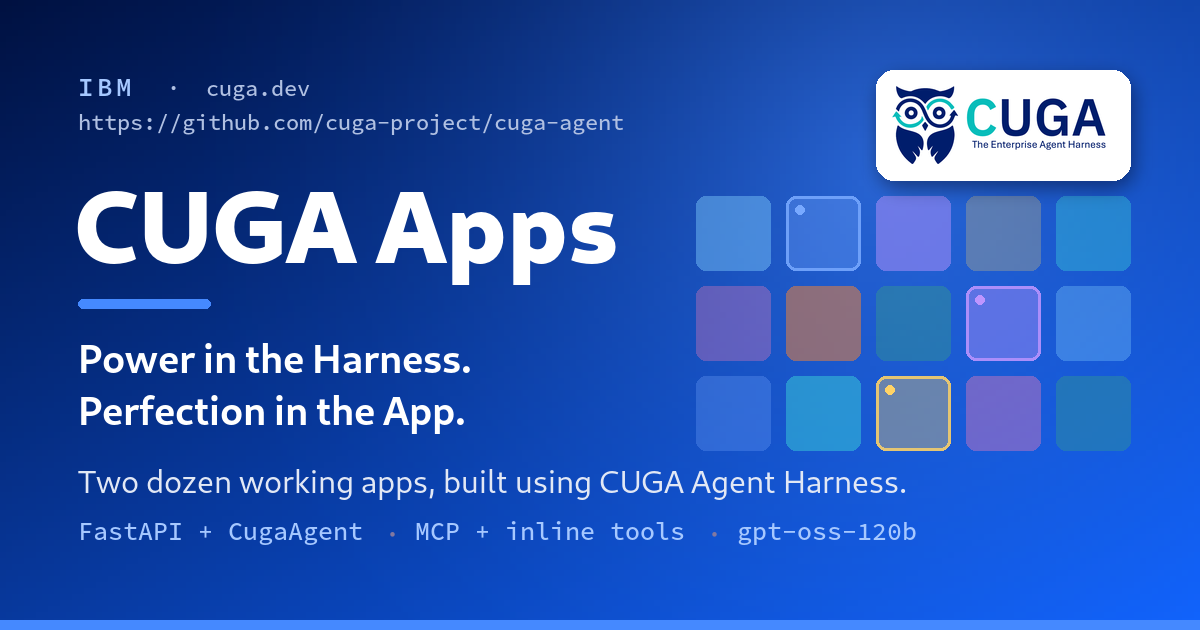
Most agentic apps start with a week of plumbing before the agent does anything useful: a model client, tool adapters, state streaming to a UI, and so on. CUGA (Configurable Generalist Agent), an open-source agent harness from IBM, inverts that by handling the orchestration—planning, execution loop, tool calls, state, and reflection—so you only write the tools and the prompt. The article walks through two dozen single-file apps (e.g., an IBM Cloud advisor) to prove that an agent can be one file you hold in your head, and the same code runs from a laptop to production without rewriting.
The technical path is concrete: CUGA plans before acting, uses CodeAct (mix of tool calls and generated code), tracks variables across long runs, and runs a reflection step that can catch bad calls and re-plan. It offers Fast/Balanced/Accurate reasoning modes and a policy system (Intent Guard, Tool Approval, Tool Guide, Playbook, Output Formatter, CustomPolicy) that governs agents at runtime—not retrofitted later. Tools are split between inline Python functions and shared MCP servers (web, knowledge, geo, finance), so you borrow generic capabilities and only write what’s specific to your app. The same CUGA agent scales to multi-agent delegation via A2A and can deploy inside IBM Sovereign Core with boundary isolation, OpenTelemetry tracing, and fully air-gapped models like gpt-oss-120b.
The takeaway for builders is clear: you don’t need a new framework or a frontier model to build serious agentic apps. CUGA‘s harness lets smaller open-weight models perform well because the harness carries the cognitive load (planning, reflection, variable management). Governance is built into the runtime from the first line, so production deployment is about tightening sandbox controls, not retrofitting safety. The two dozen apps in the repo are a catalog of starting points you can clone, edit, and run with a single environment variable swap for the LLM provider.