iFeeling Daily
Daily curated AI insights you can't miss.
Local Model Triage for OpenClaw: Real-Time, Cost-Free PR Classification
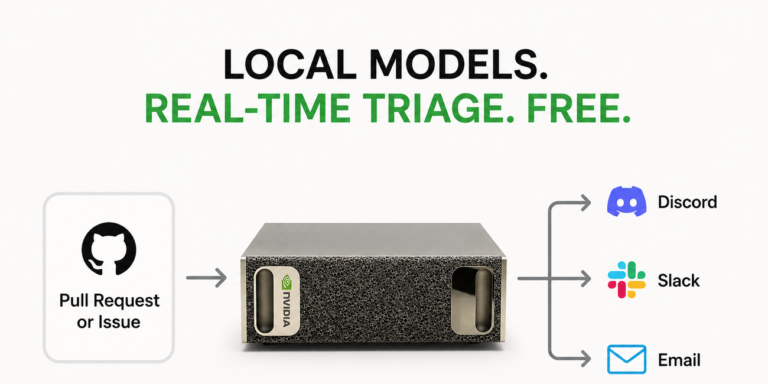
If you own a powerful local machine like the NVIDIA GB10, using models like gemma-4-26b-a4b or qwen3.6-35b-a3b in an agent harness can give you real-time, cost-free triage of open-source contributions. The article provides concrete numbers on precision, recall, and throughput tradeoffs, plus a practical hybrid architecture that uses a cheap cloud audit loop ($9/month) to catch misses.
Shipping weekly releases with AI, open tools, and a human in the loop
Hugging Face cut their release effort from half a day to 15 minutes by using an open-weight AI to draft changelogs, wrapped in deterministic checks that verify every PR is included, and a human review before shipping. The full pipeline is open-source and costs about $0.25 per run.
Codex as a persistent workspace for long-running AI workflows
A practical look at treating Codex as a persistent workspace for long-running work—breaking projects into verifiable steps, preserving context across sessions, and deciding when to delegate vs. keep human oversight. Essential reading if you're building workflows that span more than one chat.
BigQuery Python UDFs Now GA: Run NumPy, Pandas, and More Directly in SQL
BigQuery Managed Python UDFs are now generally available, letting you run NumPy, SciPy, pandas, and scikit-learn directly in SQL without managing containers. It supports vectorized PyArrow processing for up to 10x performance gains and configurable memory up to 16 GB.
Every Future Product Will Be a Living System: Ronak Malde on Continual Learning
Ronak Malde, CEO of Trajectory.ai, argues that static AI models are insufficient for enterprise use cases like legal or finance—every future product must be a living system that learns continuously. He details how they achieve this with concurrent training jobs, Self-Distillation Policy Optimization, and open-sourced infrastructure.
Patch the Planet: OpenAI and Trail of Bits’ Initiative to Secure Open Source

Patch the Planet combines frontier AI models like GPT-5.5-Cyber with dedicated security engineers to find, validate, and patch vulnerabilities in open-source software. It addresses the maintainer burden by filtering false positives and developing patches, turning AI's speed into tangible security improvements for projects like cURL, Python, and the Linux kernel.
The AI Frontier: from FLOPs to Megawatts — Anjney Midha, AMP

Anjney Midha argues the AI race is shifting from buying more GPUs to building a compute grid that makes FLOPs flow like megawatts, modeled on independent system operators rather than hyperscaler monopolies.
Improving Ray Serve LLM on GKE: 5x Throughput, 8x Latency
If you've ever struggled with the performance tax of using Ray Serve for LLM inference on Kubernetes, this article details three concrete architectural fixes—HAProxy integration, direct token streaming, and a v2 vLLM executor—that deliver up to 5x higher throughput and 8x lower latency on GKE, closing the gap with native vLLM without sacrificing developer experience.
Choice, Compliance, and Collaboration: Europe’s Path to Open Digital Sovereignty

Google argues that Europe's Tech Sovereignty Package risks market isolation by imposing rigid geographic criteria for sovereign cloud certification, while offering a path forward through 'Made with Europe' partnerships, open-source contributions, and technical controls like Cloud External Key Manager.