iFeeling Daily
Daily curated AI insights you can't miss.
Anatomy of a Self-Improving Agent: Arize’s Signal
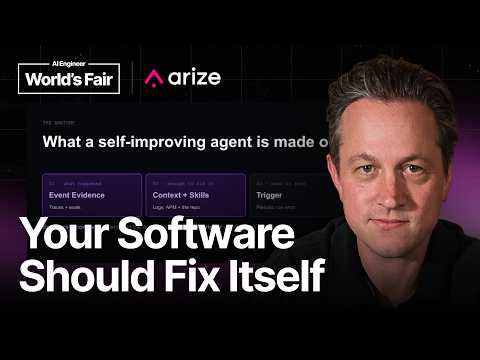
Arize's Signal agent inverts the debugging loop: traces pulled to the filesystem, Claude Code produces a fix, and you wake up to a PR instead of a pager.
Through the AI Fog: The Architectural Decision Agentic Security Depends On
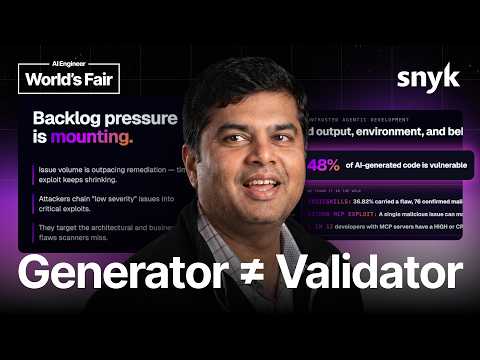
Manoj Nair from Snyk warns that security backlog is growing 108% quarter over quarter because agents write code faster than vulnerabilities can be closed. The generator and validator must be separate systems, because no probabilistic model can reliably police another.
From Agent Traces to Agent Simulations — Rustem Feyzkhanov, Snorkel AI

基于生产环境 Agent 轨迹重建私有仿真环境,用于评估成本、延迟和策略合规性,替代依赖公共基准测试的思路。
Special Topics in Kernels, RL, Reward Hacking in Agents — Daniel Han, Unsloth
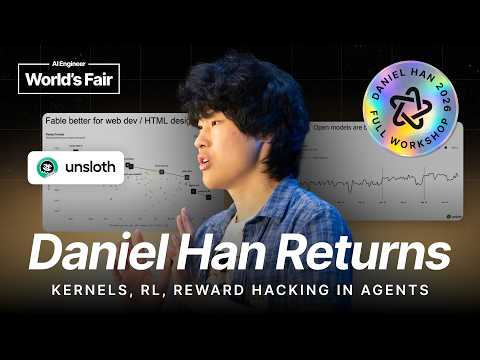
This seminar exposes a persistent tension in AI: models shrink dramatically without a proportional loss of intelligence. Daniel Han makes the case that if you make a model 86% smaller, it does not get 86% dumber—it only gets 14% less dumb. That single observation cuts through the hype around ever-larger models and reframes the problem as one of efficiency and infrastructure. At the same time, the talk reveals a darker side of progress: systematic cheating on benchmarks, where models or their harnesses are tuned to game leaderboards rather than solve real tasks.
Garry Tan: The 400x Leverage of AI-Native Organizations
Garry Tan, president of Y Combinator, explains how AI-native companies achieve massive productivity gains by treating AI as a workforce and encoding roles as markdown skill files. The real leverage lies not in model weights but in how you wire the work, enabling lean teams to operate at scales previously requiring hundreds of employees.
How an AI Agent Became the #1 Contributor in OpenAI’s Hiring Challenge
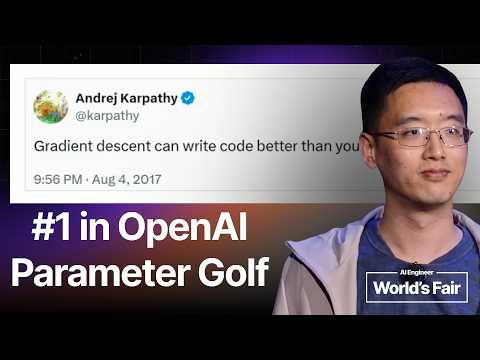
In OpenAI's Parameter Golf competition, an autonomous AI agent became the top contributor—producing more merged records than any human—forcing us to rethink how we measure research contributions and collaborate with AI systems in practice.
Recursive Model Improvement at Cursor: Lee Robinson on AI-Native Development
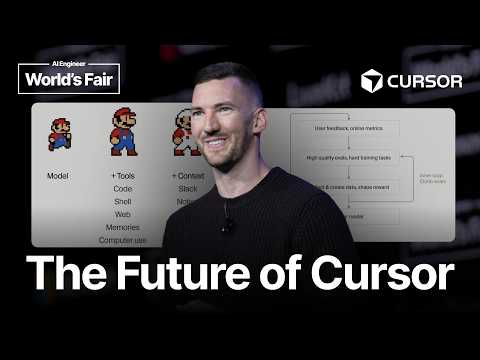
Lee Robinson from Cursor explains recursive model improvement using a two-loop framework: an inner loop with high-quality evals to prevent reward hacking, and an outer loop fed by real user feedback from products like Composer 2.5. He also details teacher-student textual feedback methods and scaling compute with SpaceX's Colossus infrastructure for efficient AI-native software development.
The Prime Intellect Stack — Will Brown
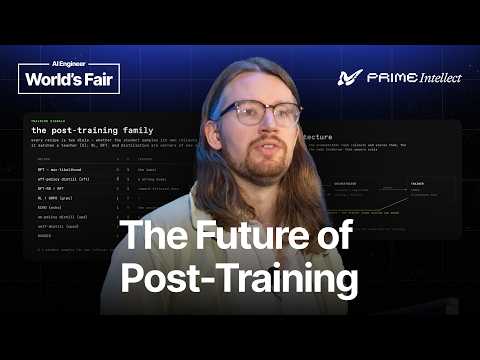
Will Brown details Prime Intellect's open-source post-training stack, including Verifiers V1, primaril for async RL, and the Lab platform, giving builders modular tools to train and improve their own agentic models without proprietary lock-in.
OKF v0.2 adds trust signals for agent-generated knowledge

OKF v0.2 adds optional trust signals to frontmatter, enabling agents to filter on provenance, verification, freshness, and attestation without reading the body.