iFeeling Daily
Daily curated AI insights you can't miss.
PP-OCRv6: Lightweight, Multilingual OCR from 1.5M to 34.5M Parameters
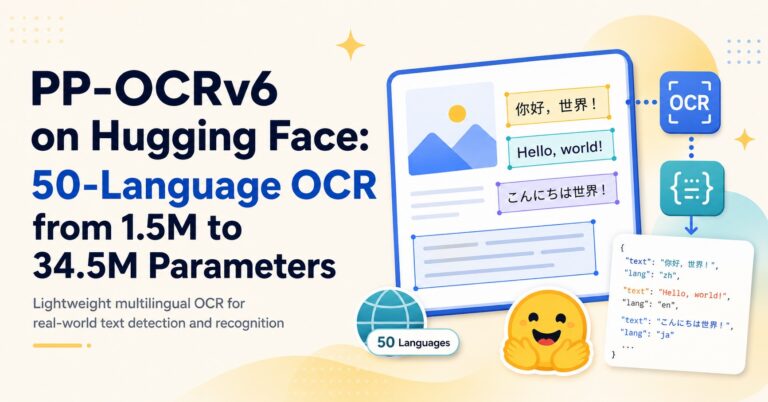
PP-OCRv6 is a practical, tiered OCR model family from 1.5M to 34.5M parameters that improves detection and recognition accuracy over its predecessor while supporting 50 languages in a single architecture. It's worth reading if you need a lightweight, deployable OCR pipeline that integrates with Paddle Inference, Transformers, or ONNX Runtime backends.
Using AI to Reanalyze Unsolved Rare Disease Cases and Find New Diagnoses
Researchers used OpenAI o3 Deep Research to reanalyze 376 unsolved rare-disease cases, yielding new diagnoses in 4.8% after experts confirmed findings—demonstrating how AI-assisted periodic reanalysis can uncover answers buried in fragmented genomic data and evolving scientific knowledge.
LifeSciBench: A Realistic Benchmark for AI in Life Science Research

Current life science benchmarks fail to capture the messy, iterative reality of real research work. They tend to ask clean fact-recall or prediction questions with neat reference answers, but practicing scientists spend their time interpreting incomplete evidence, reconciling conflicting results, designing difficult experiments, and making decisions under uncertainty. **LifeSciBench** was built to close this gap by measuring whether AI systems can actually support the workflows that matter in applied biotech and pharmaceutical research, not just answer biology trivia. It was designed by 173 PhD-level scientists with direct drug-discovery experience, and every task reflects a realistic request a scientist might make to a knowledgeable collaborator.
Google Cloud Network Insights: Active monitoring for cross-cloud visibility

Google Cloud has launched Cloud Network Insights in partnership with Broadcom AppNeta, a native observability tool that uses active synthetic probing to monitor network performance and digital experience across multi-cloud and hybrid environments. It integrates directly with Cloud Monitoring and Gemini Cloud Assist, helping teams pinpoint bottlenecks rapidly.
Near-autonomous AI improves challenging Chan-Lam coupling for sulfonamides

OpenAI and Molecule.one connected GPT-5.4 to an autonomous chemistry lab to improve Chan–Lam coupling of primary sulfonamides. Across 10,080 reactions, the system identified TEMPO as an effective additive, raising yields significantly. Human chemists validated results at bench scale, confirming the AI-driven finding holds in practical workflows.
MolmoMotion: Language-guided 3D motion forecasting from video

MolmoMotion predicts future 3D point trajectories from a single video frame, language instruction, and query points, using a class-agnostic, view-stable representation. It outperforms existing forecasting methods on a new benchmark, accelerates robot policy learning (76.3% vs 56% pick-and-place success), and improves video generation motion quality. The model, 1.16M-video dataset, and benchmark are openly released.
OpenAI Supports EU Code of Practice on AI-Generated Content Transparency

This article explains why OpenAI supports the EU's new Code of Practice on AI-generated content transparency, detailing their multi-layered provenance approach using C2PA metadata and SynthID watermarks. It's a concise look at the practical challenges and ecosystem-wide cooperation needed to build trustworthy AI content.
How Preply uses AI to personalize language learning with human tutors

Preply's Lesson Insights, powered by OpenAI APIs, generates personalized feedback after each tutoring session, cutting tutor prep time and giving learners clear progress tracking. The result: 75% of English learners actively use it with a 4.7/5 satisfaction rating.
Looker Dashboard Agents 预览:对话式 BI 直接嵌入仪表板

Traditional dashboards provide static views that break down when users need to ask follow-up questions or explore beyond pre-built metrics. This forces business users to either interrupt their workflow or queue requests for data analysts, creating a bottleneck in agile decision-making. Looker dashboard agents tackle this tension by embedding an intelligent conversational layer directly inside the dashboard interface, letting users ask natural-language questions without leaving the tool.