iFeeling Daily
Daily curated AI insights you can't miss.
Lessons in Accelerating Foundation Model Upgrades
Google Cloud's Applied ML team shares three lessons for accelerating foundation model upgrades using an agentic workflow built on Gemini Enterprise Agent Platform and Antigravity. By moving from manual toil to intelligent automation, teams can cut migration time from months to hours while improving quality, as demonstrated by a video translation partner team.
Why Teens Need Safe AI: OpenAI’s Approach
OpenAI argues that denying teens AI access until adulthood would leave them unprepared—just like withholding internet access from previous generations. They detail practical safeguards: age-appropriate defaults, learning-focused tools like Study Mode, parental controls, and partnerships with organizations such as the Family Online Safety Institute to ensure responsible, safe access.
Why 95% of AI prototypes fail in production and how YouTube fixed it

The article exposes why 95% of AI prototypes die in enterprise validation loops, using YouTube's infrastructure to show a concrete fix: decouple data via read-only proxy servers, inject experiments via isolated UI wrappers, and embrace throw-away code instead of polishing AI-generated scripts for production.
IDC: Networking Infrastructure Is the Key Bottleneck for Agentic AI

IDC's survey reveals that networking infrastructure, not AI models, is the primary bottleneck slowing agentic AI production deployments. With 32.6% of enterprises citing security concerns and 26.8% struggling with automation, the article argues for an infrastructure-level networking approach that provides consistent policy, observability, and governance across fragmented multi-cloud environments.
How state and federal actions are converging on a US AI safety framework
The core tension this article exposes is the gap between a patchwork of state-level AI safety laws and the need for a coherent federal framework that can also scale internationally. Without a unified national standard, frontier AI risks being governed by inconsistent state regulations that confuse consumers, strain regulator resources, and divert developer attention, especially at startups.
How Canada leads in Claude adoption per capita
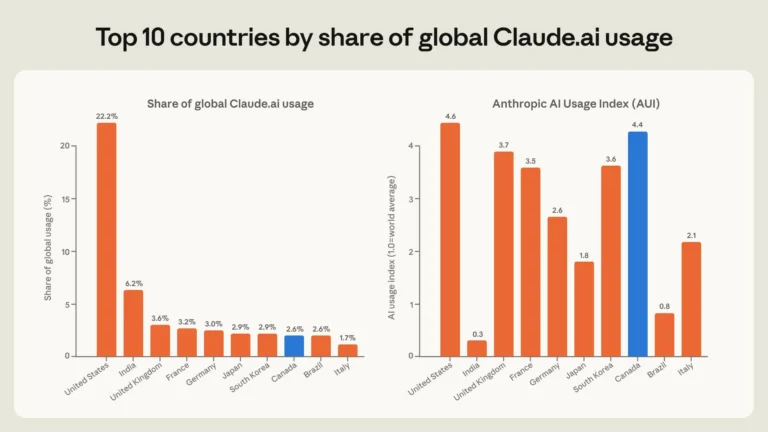
Canada is the second-largest adopter of Claude per capita among top countries, with usage 4.4x above expected from population alone. Adoption is driven by workforce composition rather than income, with professional, scientific, and technical services sectors showing the highest usage. Translation requests track public administration employment shares, reflecting Canada's bilingualism policy.
Anthropic commits $10 million CAD to Canadian AI research institutions
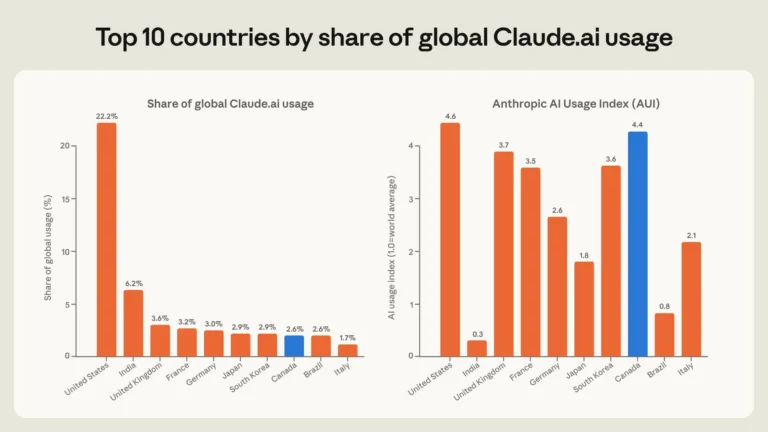
Anthropic commits $10 million CAD to eight Canadian AI research institutions via Claude API credits and startup funding, targeting areas from reinforcement learning to low-resource language modeling. The economic data reveals Canada ranks second globally in per-capita Claude.ai usage, with translation-heavy patterns tied to federal bilingualism requirements.
How Apple’s big lawsuit could disrupt OpenAI’s IPO plans

Apple's trade secrets lawsuit against OpenAI, alleging misconduct and over 400 former employees hired away, threatens the company's hardware ambitions and IPO timeline. The episode forces a hard look at how much trust AI companies deserve with proprietary data and talent from incumbents.
When Unlearning Is Free: Cutting Costs by Skipping Negligible Data Points
This paper shows that not all data points need expensive unlearning—by using influence functions to identify low-impact points, you can cut computational costs by up to 50% while maintaining privacy guarantees. A practical insight for anyone building privacy-preserving AI systems.