NVIDIA’s $108B Quarter: Record Guide, Slower Hyperscaler Growth, Rising DSO
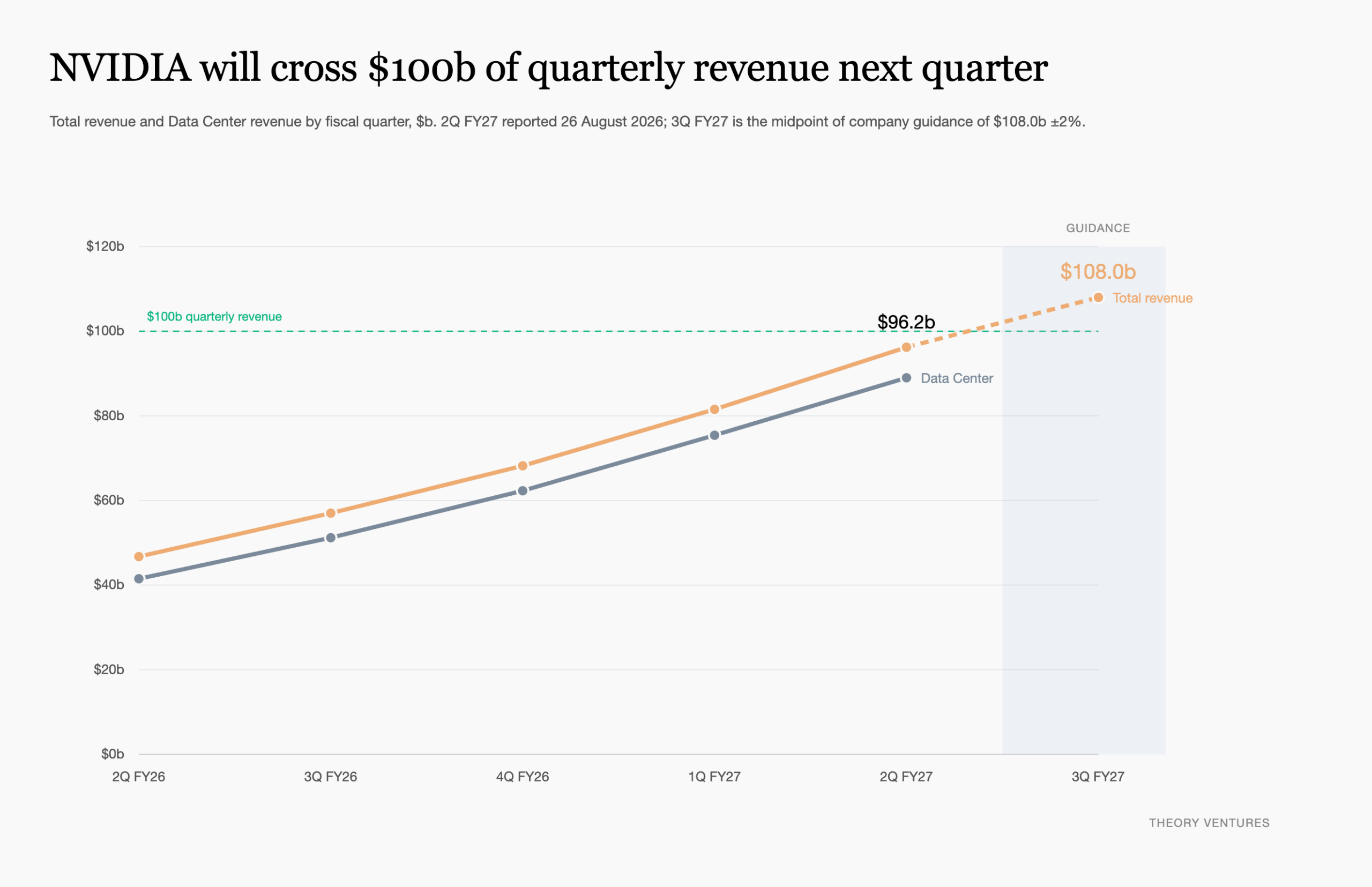
Semiconductors crossed a new threshold: NVIDIA reported Q2 FY27 revenue of $96 billion, up 106% year over year and 18% sequentially, and guided Q3 to $108 billion ±2%. That guide marks the first time any semiconductor company has projected a $100 billion quarter, and the article notes no company of any kind has reached that mark while still growing triple digits. At the guided run rate, NVIDIA annualizes to $432 billion in revenue, putting it ahead of Apple, McKesson, and Alphabet and behind only Amazon, Walmart, State Grid, UnitedHealth, and Saudi Aramco. At 75.0% gross margins, the $108 billion quarterly run-rate produces $324 billion of annual gross profit, second in the world.
Revenue contribution is shifting underneath those numbers. CFO Colette Kress split the growth: hyperscale revenue more than doubled from a year ago but rose only 13% sequentially, while ACIE revenue increased 138% year over year and 25% sequentially on demand from AI natives, enterprises, and sovereign customers. For the first time, neoclouds contributed the majority of net-new Data Center revenue. The source frames this as healthier diversification but also raises the question of whether hyperscaler custom silicon — Google TPUs, Amazon Trainium, and Meta MTIA — will eventually slow Big Tech’s demand for NVIDIA chips.
The mix change also changes credit risk. Non-hyperscalers generally have weaker balance sheets and smaller cash flows than Big Tech, so NVIDIA is likely to provide more supplier financing to sustain their growth. Evidence is already on the balance sheet: days sales outstanding jumped from 45 to 60 days in a single quarter after eight quarters between 43 and 46 days. Revenue grew 18% sequentially while receivables grew 64% to $63 billion. Kress attributed the increase to “extended payment terms on large, multi-quarter agreements with certain investment-grade customers.” The article also points to a $581 billion stack of supply commitments, power guarantees, leases, and $101 billion of equity in the AI startups and neoclouds buying its chips.
The key metric to watch next quarter is DSO. If 60 days holds or falls, it was a one-time reset from new payment terms. If it climbs, it signals NVIDIA is extending more credit to sustain demand from buyers that cannot fully self-fund their growth. Jensen Huang described the demand backdrop as a “golden age” of new AI labs, multiple frontier labs scaling in parallel, an open-model ecosystem, and physical AI, but the financing structure behind that demand is becoming an increasing part of NVIDIA‘s business.