When Models Learn: Test-Time Training Economics
The article explains test-time training (TTT) through the analogy of a GPS learning a persistent shortcut around daily traffic rather than a one-time reroute: the model takes a gradient step on the prompt it’s answering, so its weights change as it works. This contrasts with every standard model that froze the day its training ended.
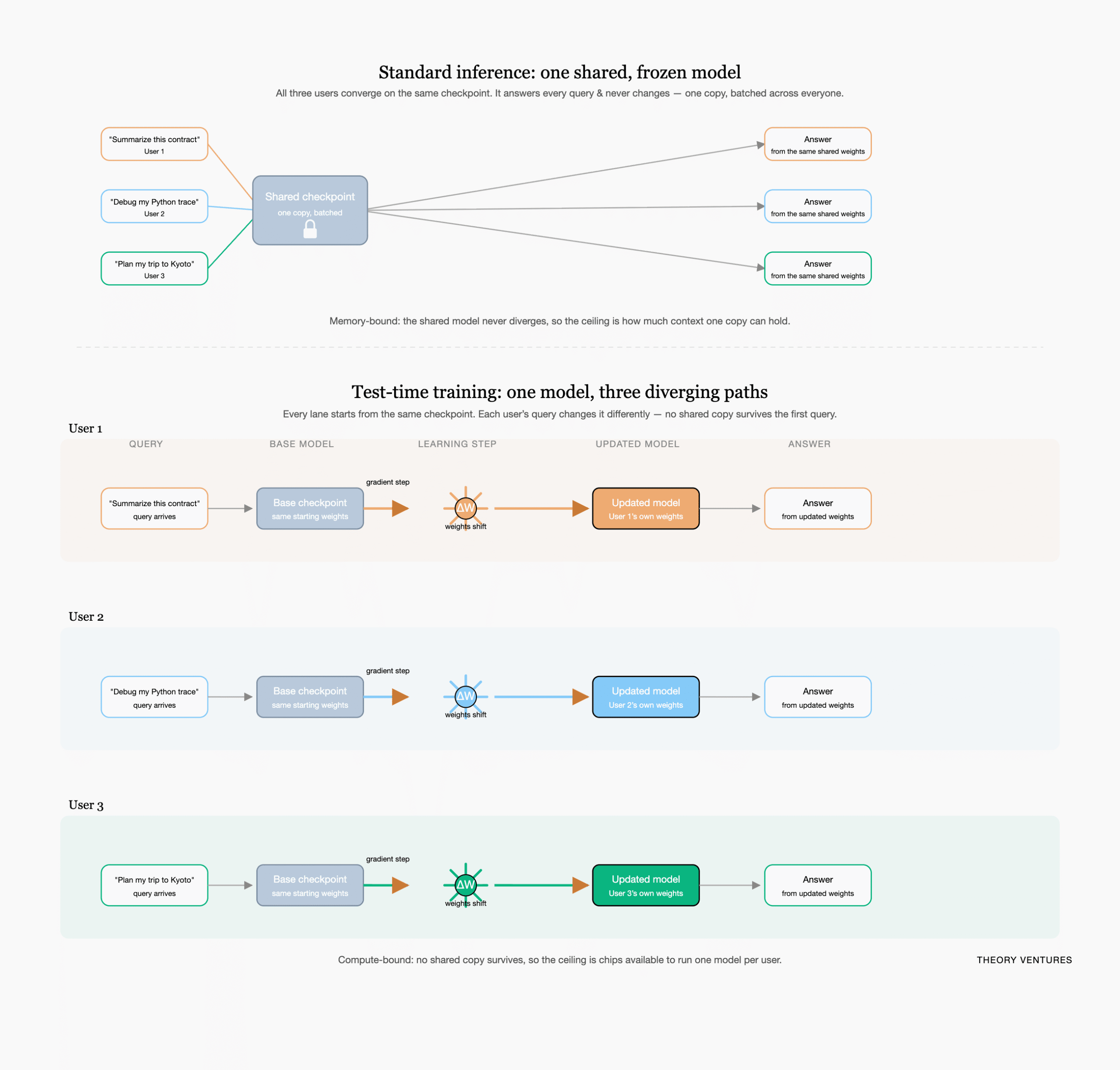
Three implications are traced. First, memory requirements plummet because TTT folds history into a fixed-size set of weights instead of a linearly growing KV-cache, so memory stays flat no matter how long the conversation runs. Second, the model provider must now serve a separate model per user since each model updates on its user’s prompts and diverges from the shared checkpoint, requiring a GPU copy per user instead of one shared copy. Third, inference is faster: Stanford research on small models indicates it can be up to 2.7 times faster, with constant inference latency regardless of context length, and In-Place TTT ships drop-in, lifting a 4b model to competitive 128k-context performance with no retraining.
The tension is framed as a tradeoff between serving long context and serving many people. Standard AI is limited by memory, test-time AI is limited by compute and chips. The per-user cost only pays off where personalization earns its keep, such as a coding agent that learns a codebase’s conventions and provides lock-in via memory over a long session. A one-off customer support query is handled just as well by a shared frozen model and costs far less to serve.