Watts in Store for 2027: The AI Ceiling
The article frames 2027 as the year AI hits a hard physical ceiling: roughly 80 gigawatts of powered compute, which would double all the compute built in U.S. history within twelve months. Even at that historic pace, GPU economics are deteriorating. Hourly short-term rental rates have jumped from $3 to $12-13 over the last six months, and Anthropic‘s blended GPU-hour cost rose 82% in just two quarters. Finished server racks are sitting unpowered in staging warehouses because utilities cannot deliver energized power fast enough. When supply doubles and prices still double, demand is outrunning physical reality; the author expects a persistent ceiling on energized compute and structural upward pressure on per-hour GPU prices.
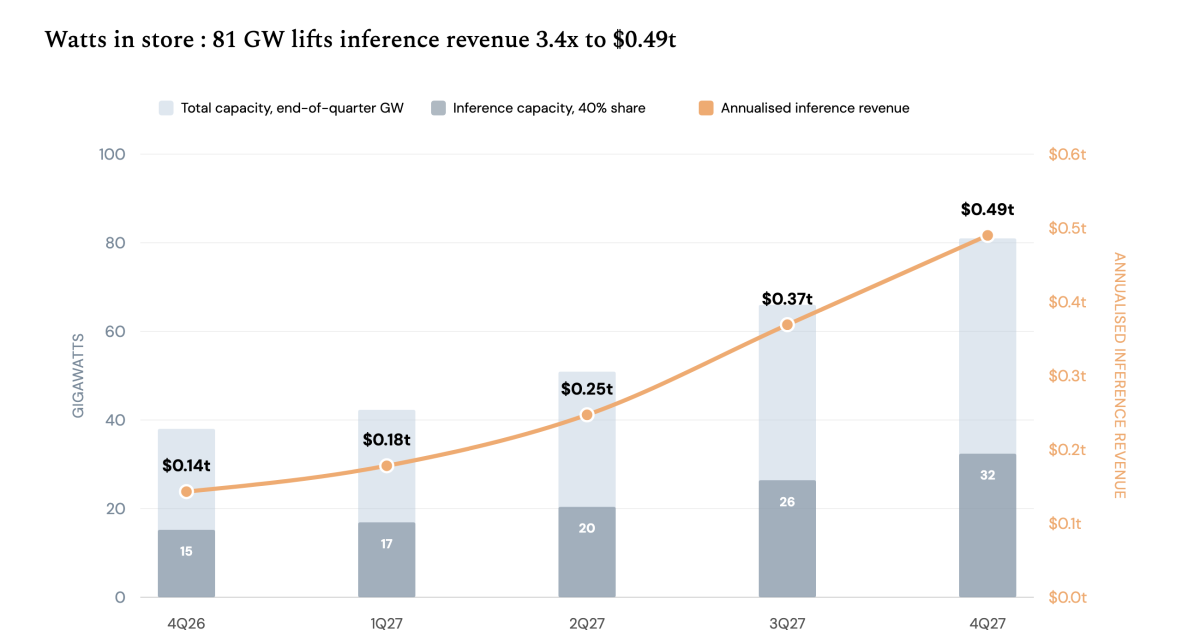
Brad Gerstner, speaking on the All-In election livestream, quantified the buildout: consensus calls for 43 gigawatts online in 2027, against roughly 38 gigawatts cumulative in the U.S. at the end of 2026, with 10-15 gigawatts of the expected build potentially not coming online. The author draws five implications from this ceiling. First, there is a theoretical maximum revenue ceiling for AI. Today 40% of GPU hours go to inference sold to customers and 60% to training models. The current 38GW fleet earns about $140b; the 43GW added in 2027 will run on chips 3-5x more powerful and should add roughly $350b in annualized earnings capability, for a total near $500b. As GPU prices rise, foundation model companies may shift GPU hours from training toward inference, potentially limiting frontier innovation pace.
Second, latency becomes the release valve for excess demand. Internet access is priced by bandwidth and speed, and AI may be priced similarly, a pattern already visible in products focused on low-latency inference versus long-horizon tasks. Third, constrained compute will push algorithmic innovation; Chinese models such as DeepSeek, Qwen, and Kimi have shown architectural advantages that deliver near-state-of-the-art performance on much smaller models and new architectures. Fourth, the software harness around models becomes critical, responsible for more than half of system performance and able to extract large efficiency gains on limited GPU availability. Fifth, the economics of vibe-coding face a reality check: as inference gets more expensive, off-the-shelf software with AI can become cheaper than bespoke internal software that must be built and maintained.
The central forecast for 2027 is that AI’s binding constraint will be access to powered GPUs, not model capabilities or demand. Since rental prices are rising faster than efficiency improvements can offset, efficiency becomes the dominant motif up and down the stack, from hardware and data center power delivery to models and the software harness around them.