ToyBlocks: A controlled world for robot learning and evaluation
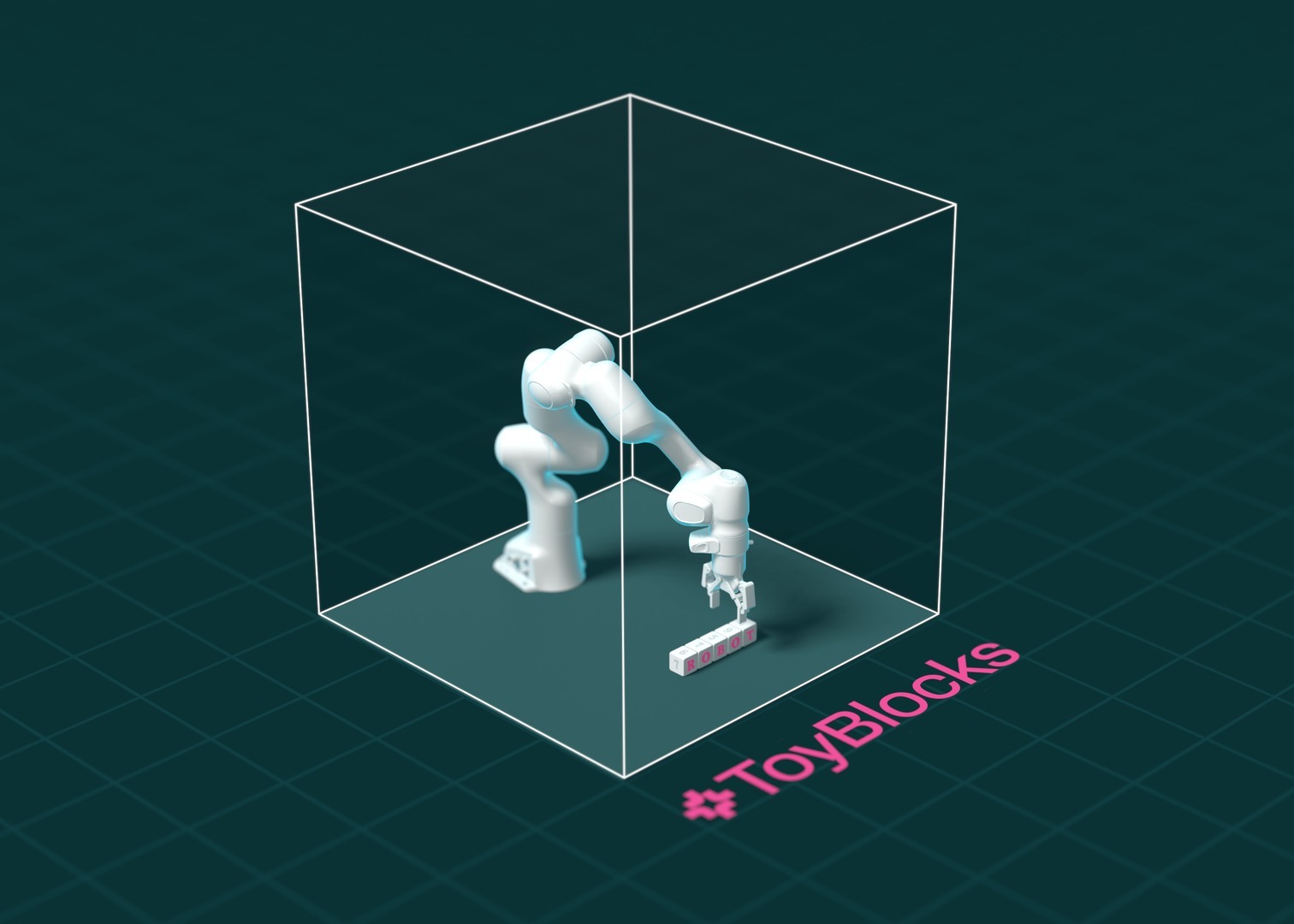
ToyBlocks is an open simulation framework built on earlier robot-learning work including MolmoAct 2, MolmoBot, and MolmoSpaces. It is the first FoundationWorld: a controlled tabletop environment pairing a simulated robot arm and blocks with automatic task/demonstration generation and evaluation metrics. The goal is a petri-dish-like setting where researchers can vary training data or model design, repeat tests, and trace failures. The article argues that the narrow block-domain scope makes it feasible to satisfy four requirements—realistic physics and appearance, automatic large-scale task/demonstration generation, challenges combining reasoning with dexterity, and broad coverage of tasks within the domain—in ways open-ended domains cannot.
Demonstrations are generated without teleoperation. Reinforcement-learning policies trained in Nvidia’s Isaac Lab learn short-horizon skills such as pushing and flipping, using privileged simulator state (for example, exact block pose) rather than estimating pose from camera images. A task-and-motion planner selects and sequences skills to solve tasks, and executing these plans in simulation produces labeled demonstration datasets. Scaling is achieved by running hundreds of plans in parallel on a single GPU, up to 24 times real time. Users can build training mixtures that emphasize particular skills, and evaluation goes beyond success rates to include execution speeds, forces on objects, and task progress from the same specifications used by the planner.
The article reports several initial studies. For low-level vision-language-action models (ManiFlow, π0.5, and MolmoAct 2), spatial generalization tests that vary skill sequences, block letters/colors, and block counts show that popular action models generalize poorly despite large-scale pretraining; the article says generalization remains far from solved and shows how techniques including low-rank adaptation can improve it. For high-level reasoning, hierarchical models using Molmo 2 as planner and ManiFlow as low-level policy are evaluated on three-letter block-spelling tasks, with difficulty varied from upright visible characters to characters hidden at episode start. Agentic experiments use Claude Opus 5.5 through Model Context Protocol tool calls: in search-and-spell tasks, the agent solved or correctly declared infeasible 63% of tasks, with errors mostly from look-alike letters (13%) or incorrect letter orientation (15%). When the agent ran its own experiments and wrote its own skill descriptions, success rose from 24% with default descriptions to 63%, outperforming the 36% achieved with human-expert-written descriptions.
Action-conditioned world models are tested using ToyBlocks‘ ground-truth simulator state. After fine-tuning on 900 trajectories per skill—half successful, half unsuccessful due to small spatial changes—Wan 2.2 predicts block motion and task outcomes most accurately; Astra tracks the gripper well but struggles with contact; LeWM is fast and accurate over short segments but drifts over full trajectories. In an additional experiment, adding 100 model-generated rollouts from the best video-generation model raised a policy’s success in an unseen region from 19% to 78%.
Sim-to-real transfer evaluates models trained entirely on ToyBlocks data, deployed zero-shot on a Franka FR3 arm with a Robotiq gripper across thirty scene configurations. ManiFlow‘s atomic-skill success rates were similar in simulation and the real world (80.0% vs 81.1%). The hierarchical Molmo 2 + ManiFlow system succeeded in 55.5% of simulated episodes (111/200) and 50.0% of real-world episodes (15/30); the article notes that further trials are needed to establish statistical confidence across tasks. Transfer involved system identification (joint friction and armature), domain randomization of physical and visual properties, and generating clean depth maps from RGB images with FastFoundationStereo instead of noisy depth sensors.
The initial data release contains 85,336 long-horizon demonstrations, each comprising about 6–12 skill demonstrations, totaling nearly 1,600 hours of robot execution data and 144 million frames. A second release is planned within weeks with a larger dataset, more skills, and fully integrated RL training. Future directions include bimanual manipulation, dexterous hands with force/touch sensors, and RL-based pile manipulation. The authors position ToyBlocks as a step toward robots that reliably apply learned behavior to unfamiliar tasks and invite researchers to build their own FoundationWorlds.