Scaling Indic Pretraining: 2.8 Trillion Tokens and Open Data Pipeline
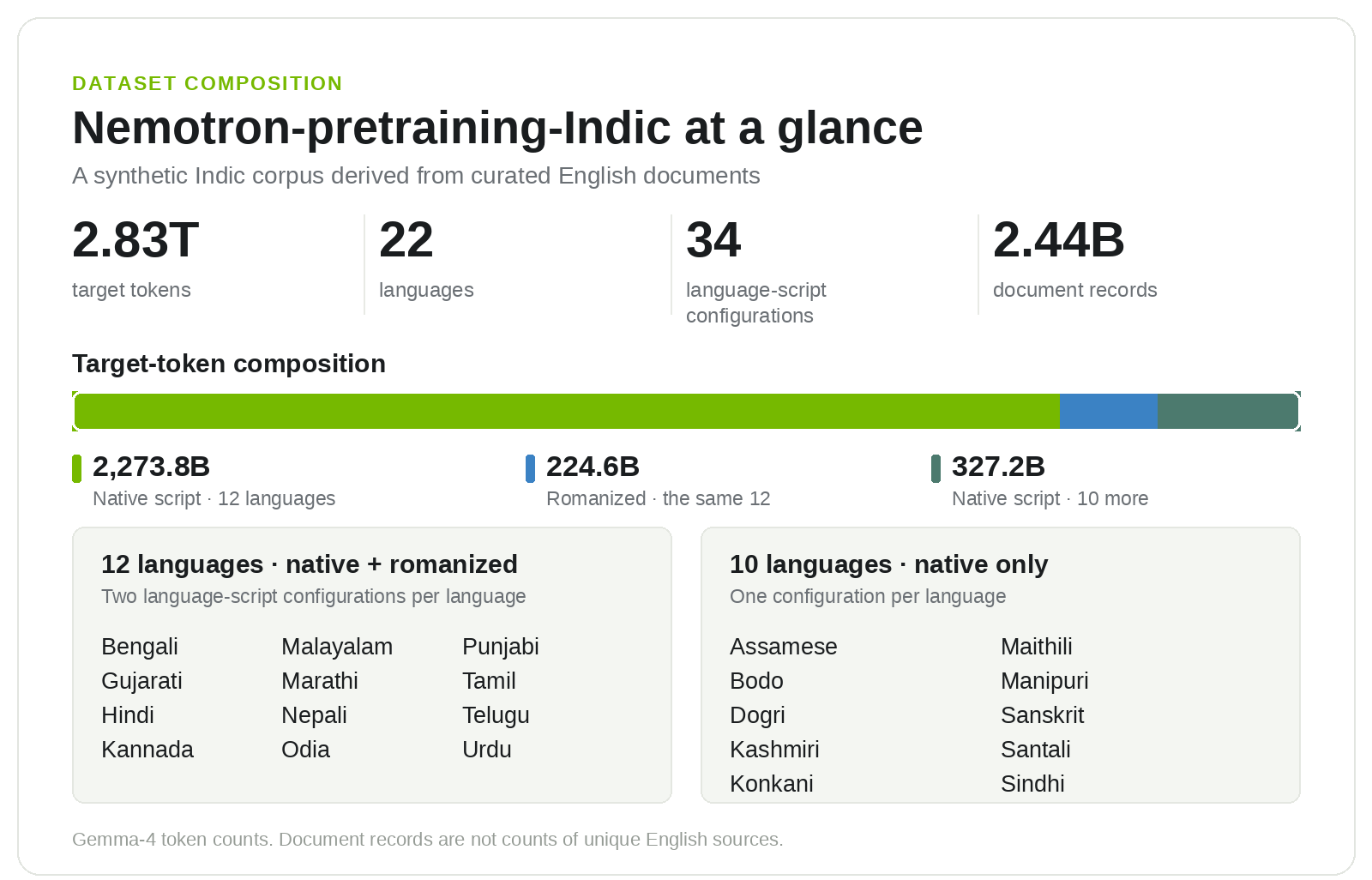
NVIDIA, IIT Madras, and AI4Bharat announced Nemotron-pretraining-Indic-v1, a corpus of approximately 2.8 trillion tokens spanning 22 Indian languages, with an open, GPU-accelerated data generation pipeline. The corpus covers the languages listed in India’s Constitution, which the source notes are the first languages for about 97% of Indians, and includes native-script data for all 22 languages plus romanized text for twelve, for 34 language-script configurations. Token counts are 2,601.0 billion native-script and 224.6 billion romanized tokens using the Gemma-4 tokenizer. The release is meant to address the shortage of Indic training data identified by AI4Bharat‘s Mitesh Khapra, and the open recipe lets teams adapt prompts, quality checks, and source documents to generate additional data.
Every record traces back to a curated source document, drawn from 15 Nemotron-CC-v2 subsets covering web text, question-answer material, mathematics, code, and other content. The pipeline is built on NeMo Data Designer. For twelve languages, documents are translated in full using Gemma-4-31B-it, with prompts that distinguish prose from content to preserve, such as code, equations, URLs, and formatting. The same model assesses each translation against the English source using a rubric inspired by Multidimensional Quality Metrics, covering meaning, fluency, terminology, style, and formatting. Only outputs scoring at least 75 out of 100 are retained; lower-scoring outputs are repaired using assessment feedback and reassessed. This repair process recovered 438.4 billion tokens included in the corpus total. Accepted native-script translations are then converted into Latin script for romanized data, and each result is checked against its native-script input. The source reports that this two-step approach produced fewer hallucinated additions and less residual English than generating romanized text directly from English.
The other ten languages use a separate workflow with Indic Translate, a document-level translation model from Bodhan AI, followed by Gemma-4-31B-it assessment. Whole-document translation is used for eight of these languages, while longer Santali documents are translated in overlapping windows and reconstructed, and Manipuri is translated into Bengali script before being converted to Meitei Mayek. These workflows retain outputs scoring at least 75 out of 100 but do not include feedback-based rewriting.
Continued pretraining for Nemotron 3.5 Super VL used a configured budget of 100 billion training tokens, with 10 billion tokens allocated to a mixture of synthetic and natural Indic text drawn from a twelve-language subset of this corpus. Scores increased on all five reported Indic knowledge and reasoning benchmarks: MILU, Indic MMLU-Pro, Indic ARC-Challenge, Indic ARC-Easy, and Indic GSM8K, with gains ranging from 4.98 to 9.82 percentage points. The source notes this is a stage-level comparison across combined synthetic and natural Indic data, not an isolated evaluation of the synthetic corpus. GSM8K excludes Odia because evaluation exceeded the serving context limit.
Compared with the previous generation, the released Nemotron 3.5 Super VL scores higher on five of six task benchmarks spanning knowledge, reasoning, mathematics, code, and translation, while instruction following on IFEval 1.5 dipped 2.04 points. It also improves across all four IndiVibe dimensions: usefulness, fluency, language and script fidelity, and appropriate verbosity. IndiVibe is described as Sarvam AI’s open benchmark of assistant-style prompts in Indian languages.
The article gives practical guidance for using the corpus: developers should select language and script configurations, stream samples, pin dataset revisions for reproducible experiments, compare mixtures at a fixed token budget, and track per-language results alongside English capability retention. The open-source Nemotron Bharat translation plugin for NeMo Data Designer provides translation and evaluation prompts, optional feedback-based rewriting, document windowing, and script remapping, with configuration options for models, languages, and rewrite parameters. The source recommends starting with a small sample of your own documents and refining prompts with native-language reviewers before scaling up.
Scope and limitations are explicit. Synthetic translation broadens access to English source material but does not replace text originally written in Indian languages or guarantee coverage of local knowledge and culture. Quality assessment is primarily automated, complemented by sampled human review whose coverage varies across languages. In the twelve-language workflow, the translator also serves as the judge, and retained text can still contain errors. The ten-language workflow needs broader native-speaker validation. Source-ID checks remove processing duplicates but are not semantic deduplication. The source also mentions the companion reports Scaling Synthetic Pre-training Data and Evaluation for Indic LLMs and the Nemotron 3.5 Super VL and Lightning technical report, along with AI4Bharat and NVIDIA’s ongoing Indic-LLM-Eval-Suite benchmark collection.