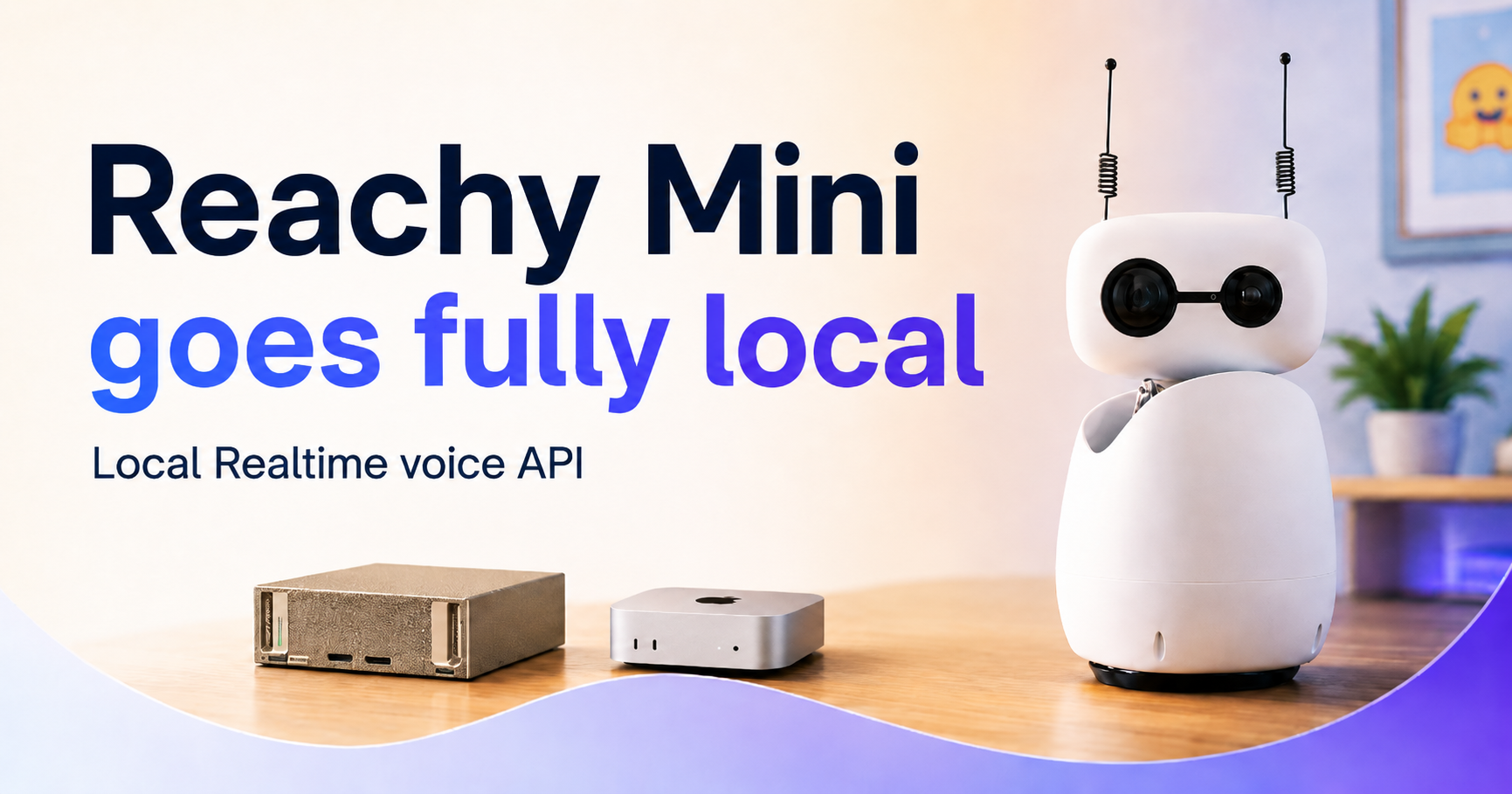
Running Reachy Mini’s voice pipeline fully offline with speech-to-speech
Running a voice-enabled robot like Reachy Mini traditionally meant sending audio to a cloud server, which introduces latency, cost, and privacy concerns. The core tension is that hosted realtime backends are convenient but lock you into paying per-minute or per-token fees and require trusting a third party with your audio. This blog post shows how to break that dependency by running the entire speech-to-speech pipeline on your own hardware, from voice activity detection to text generation back to speech.
The concrete path is a cascaded pipeline using the open-source speech-to-speech library, which exposes a Realtime API-compatible /v1/realtime WebSocket. The recommended defaults are Silero VAD v5 for voice detection, Parakeet-TDT for streaming speech-to-text, a local LLM served via llama.cpp (with Gemma 4) or vLLM (with Qwen3-4B), and Qwen3-TTS for text-to-speech. The LLM layer is the main latency bottleneck, so the library supports decoupling it via the Responses API protocol, letting you run the LLM in a separate process (llama.cpp, vLLM, MLX, or even a cloud endpoint like OpenAI or Hugging Face Inference Endpoints) while the voice loop stays local. The key flags for a low-latency local setup include -np 2 for parallel slots, --swa-full for faster prompt processing on Gemma, and --default-chat-template-kwargs '{"enable_thinking":false}' to avoid reasoning tokens that cause awkward silence.
For a builder, the takeaway is that a fully local voice robot is now feasible with commodity hardware and a carefully chosen cascade. The flexibility to swap any stage (VAD, STT, LLM, TTS) means you can optimize for latency, quality, or multilingual support without changing the robot’s code. Running the engine on a laptop and the app on the Reachy Mini Wireless simply requires binding to a LAN address and using the correct IP. This setup eliminates API costs and keeps all audio on your network, making it practical for privacy-sensitive or offline applications.