Microsoft Resells the Frontier
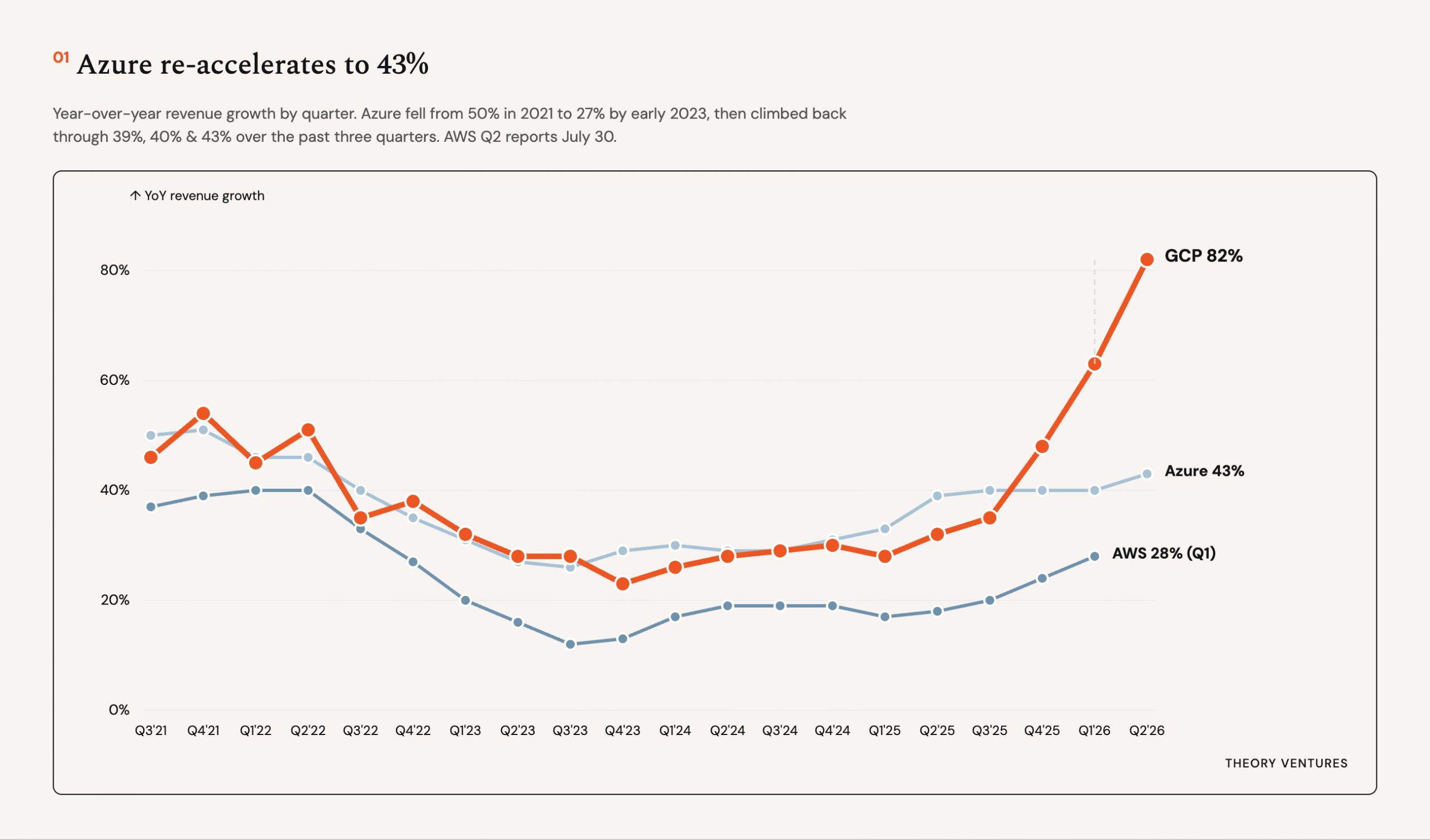
Azure grew 43% last quarter, closing a fiscal year that passed $100 billion in revenue at 41% growth. Google Cloud grew 82%. Eighteen months ago the three clouds grew within a few points of each other; now the smallest (Google Cloud) compounds at nearly twice Azure’s rate and almost three times AWS’s. Alphabet’s $44.9 billion quarterly capex runs at nearly twice Google Cloud’s $24.8 billion of revenue, yet cloud operating margin expanded from 20.7% to 35.6% as operating income tripled. The margin advantage comes from Google owning both the model and the chip, keeping the economics a reseller pays away. Microsoft, by contrast, relies mostly on merchant silicon and rents Nvidia’s roadmap at Nvidia’s margin. Its Maia 200 and Cobalt chips are real but nascent.
Two consequences follow for Microsoft: a thinner margin structure buys less capacity per dollar of revenue, and the exposure behind its contracted backlog argues for restraint. Microsoft will still spend more than $50 billion next quarter, with roughly two-thirds going to CPUs and GPUs rather than land and concrete. CFO Amy Hood frames that as flexibility—if demand changes, slow down hardware purchases. But the likelier reading is capacity bought from cash flow without underwriting a decade of concrete. Concentration is another reason to hold back. Contracted backlog reached $678 billion, the largest of the three cloud providers. Hood disclosed that it increased 25% when excluding OpenAI. Of roughly $310 billion added this year, some $220 billion traces to one customer that has committed to buy $250 billion of Azure capacity. Nearly half of Microsoft’s future book rests on one company that funds its commitments from capital markets rather than profits.
The market sees the risk. Nvidia’s five-year credit default swaps hit a record 82 basis points on Monday, doubling from 40 at the start of the month, after reports it would guarantee $250 billion of OpenAI datacenter leases. The circularity increases: Nvidia guarantees OpenAI’s datacenter leases and finances chip purchases, so the same borrowed dollar shows up as contracted backlog on multiple balance sheets. S&P downgraded Oracle to one notch above junk for the same reason, naming OpenAI a central credit risk against roughly half of its $638 billion book. Microsoft hedges because it resells both layers (models and silicon) and half its forward book depends on one borrower. Google presses because it owns the stack and the ROI is juicy. The three clouds are all accelerating, the circularity is increasing, and spreads are widening.