LFM2.5-DSpark: Up to 3.2x Faster Inference from H100 to MacBook
Liquid AI has released DSpark draft model checkpoints for three models in its LFM2.5 family: LFM2.5-1.2B-Instruct, LFM2.5-2.6B, and LFM2.5-8B-A1B. These add a speculative decoding path that trades a small memory increase for a large decoding speedup without changing output quality: up to 3.18x throughput improvement on a GPU and up to 2.87x on-device, plus a 57% average reduction in function-calling latency for LFM2.5-2.6B. The integration ships with day-one support for llama.cpp and SGLang, both open-sourced upstream.
DSpark works by addressing the fact that the decode phase in LLM inference is memory-bound: most latency comes from streaming weights from DRAM into SRAM, not from compute. A lightweight draft model produces candidate tokens, and the target model verifies them all in a single forward pass, amortizing the cost of loading weights across multiple tokens. DSpark combines three components: a DFlash-style parallel backbone conditioned on the target model’s hidden states, a lightweight Markov-head that models inter-token dependence to raise acceptance rates at later positions, and a confidence-scheduled verifier that prunes low-confidence suffixes when verification would cost more than it saves. The draft models are attention-only with 5 decoder layers and a block of 9, totaling roughly 295-328M parameters depending on the variant. They were trained for 15 epochs on a mix of SFT, code, and function-calling data, with the final epoch selected by acceptance rate rather than loss.
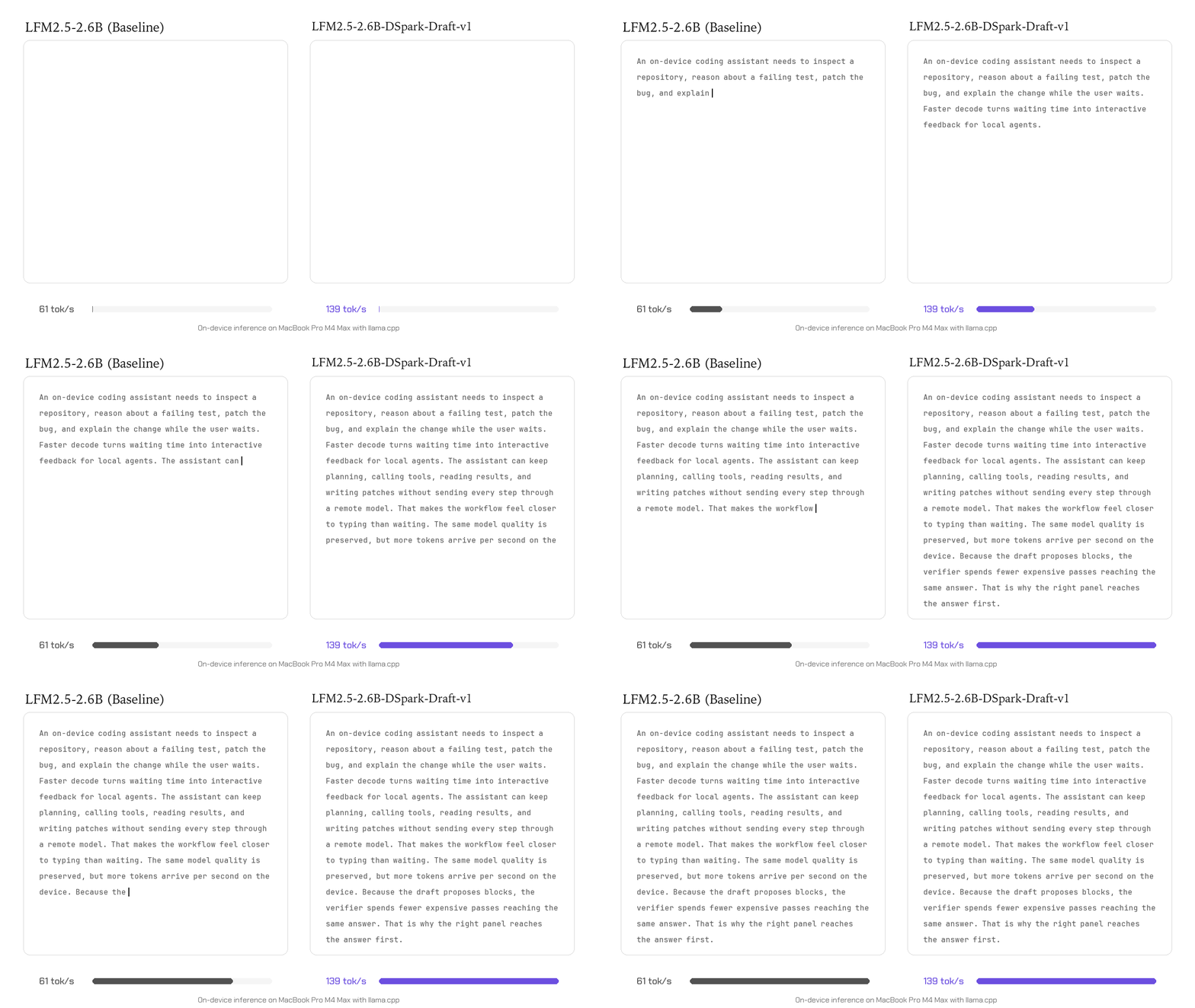
The reported speedups vary by model and hardware. For LFM2.5-2.6B, mean acceptance is 4.81 across five datasets, yielding 2.67x on an H100 (323 to 864 tok/s) and 2.27x on M4 Max (61 to 137 tok/s). LFM2.5-1.2B-Instruct reaches mean acceptance of 5.02 with 2.10x on H100 and 2.54x on-device, though speedup variance is high, up to 52% across datasets. LFM2.5-8B-A1B achieves higher acceptance (mean 7.02-8.52) but only an 18% on-device speedup, because the current llama.cpp Metal MoE implementation and the extra expert traffic from multi-token verification limit the gain. On H100 it reaches 2.1-2.6x. All measurements used batch size 1, temperature 0, and up to 256 output tokens.
Usage requires specific builds: SGLang PR #31041 for the GPU path, and llama.cpp with support for the draft-dspark sidecar for on-device. The block size is read from the draft model’s config or GGUF sidecar, with n-max clamped accordingly. Speculative decoding here is exact: each proposed token is verified by the target model, so greedy output is identical to running the target alone. Checkpoints are available on Hugging Face in both Safetensors and GGUF formats.