IBM Releases Granite Time Series PatchTST-FM-r2 With Permissive License
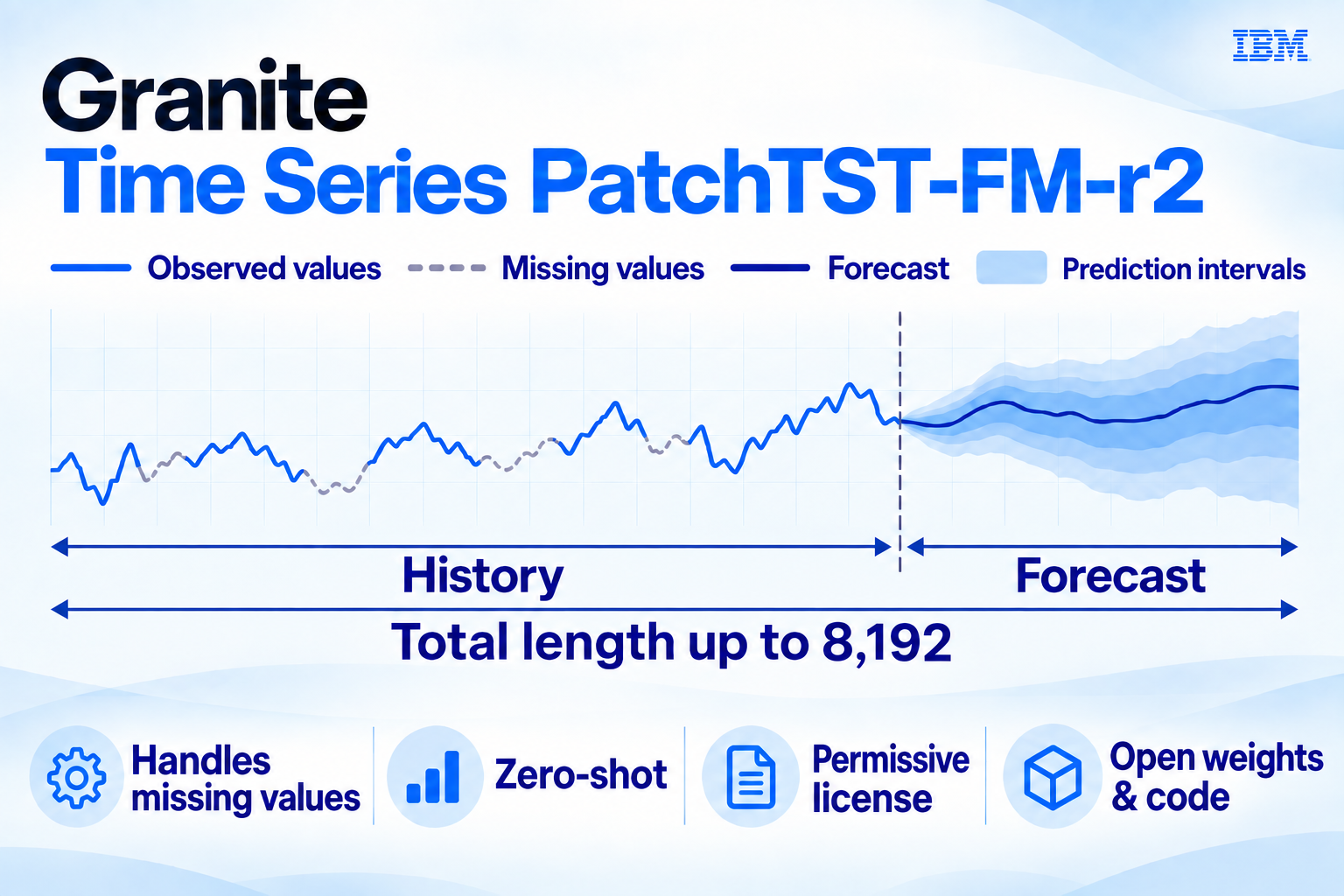
Time-series foundation models aim to replace per-dataset training with a pretrained model that can forecast new series zero-shot. IBM has released Granite Time Series PatchTST-FM-r2, the successor to PatchTST-FM-r1, combining an updated architecture, a larger pretraining corpus, probabilistic forecasting, support for imputation of missing values, and strong zero-shot performance in a ~385M-parameter model. It is positioned for demand, prices, energy loads, traffic, telemetry, and other regularly sampled time series, with context length up to 8,192, flexible forecast lengths, and a 99-quantile prediction head. The model is dual-licensed under Apache 2.0 and OpenMDW 1.0; users may select either. Weights, architecture, inference pipeline, and benchmark reproduction code are available.
On GIFT-Eval, a benchmark covering diverse datasets and forecasting scenarios, the model ranks #2 among replicable zero-shot models evaluated without test leakage, for both CRPS and MASE, as of September 8, 2026. It reports geometric-mean CRPS of 0.467 and MASE of 0.6846, immediately behind TimesFM-3, and is the highest-performing model in that category released under a permissive, commercial-friendly license. Lower values are better on both metrics. When the comparison is expanded to include pretrained models allowed to use GIFT-Eval evaluation training data, PatchTST-FM-r2 remains 3rd for CRPS and 4th for MASE among replicable models, beating several larger pretrained systems including Chronos-2, Timer-S1, and Toto variants.
PatchTST-FM-r2 keeps the patch-based representation from the PatchTST family but replaces the transformer blocks from r1 with conformer-style blocks, a design borrowed from speech processing. Each block has two half-step feed-forward layers around multi-head self-attention plus a temporal convolution layer, giving the model both long-range attention and a local inductive bias. The kernel sizes alternate in the pattern {5,5,3,3}. Attention-pattern examples from ETTh1 show the conformer version spreading attention to far-off-diagonal positions while convolution covers nearby structure. The model also uses 50% overlapping patches with Hamming-window weighting and overlap-and-add forecasting to smooth inter-patch boundaries. It adds normalization for stability, grows from 20 to 30 blocks, supports up to 8,192 context steps, and outputs 99 quantiles for distributional uncertainty.
The pretraining corpus is documented: selected datasets from GiftEvalPretrain; custom synthetic data based on KernelSynth with modified periodic kernels and limited augmentation; a TSMixup corpus generated with the Chronos approach but restricted to datasets outside the GIFT-Eval evaluation set; and approximately 500,000 synthetic CauKer sequences of length 4,096. IBM presents this transparency as useful for enterprise governance, while cautioning that it does not replace an organization’s own model-governance and licensing review. The dual Apache-2.0/OpenMDW-1.0 licensing is intended to let users modify, use, and distribute the model without use restrictions; OpenMDW is a Linux Foundation framework designed for AI models and related materials.
To run it, install granite-tsfm>=0.3.9, load ibm-granite/granite-timeseries-patchtst-fm-r2 from Hugging Face, and pass recent history through TimeSeriesForecastingPipeline. The provided example uses ETTh1 HUFL data with context 512 and prediction length 64, requesting quantiles 0.1, 0.5, and 0.9; no fine-tuning or task-specific fitting is required, and the input can be replaced with demand, telemetry, CPU utilization, energy, transaction volume, traffic, prices, or another regularly sampled series. The architecture implementation in the Granite-TSFM repository is backward-compatible with PatchTST-FM-r1 checkpoints. Separately, IBM and Confluent made several Granite Time Series models available through an Early Access program in Confluent Cloud, including PatchTST-FM-r1, FlowState-r1.1, TTM-r3, and TSPulse. That integration runs foundation-model inference inside streaming applications through Apache Flink on Confluent Cloud, avoiding a separate ML environment for live forecasts and anomaly detection.