Google and Oracle Partner to Bring TPUs to Oracle Cloud Infrastructure
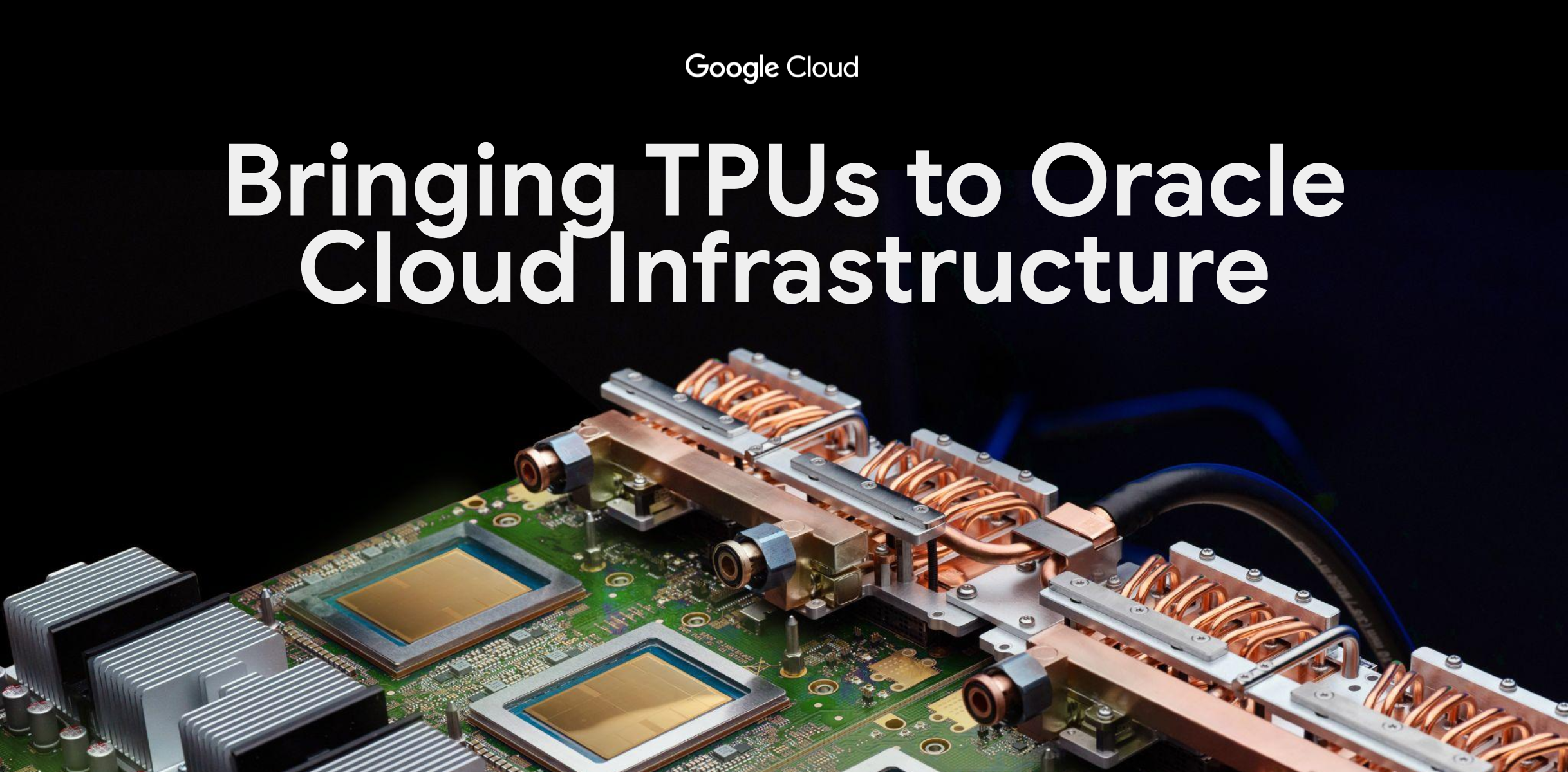
Oracle and Google Cloud are partnering to put Google Tensor Processing Units (TPUs) on Oracle Cloud Infrastructure (OCI), making OCI the first hyperscaler outside Google to offer TPUs. The two companies plan to deploy TPU capacity on OCI starting in calendar year 2027.
The article makes the case that TPUs are not just fast chips but a co-designed system spanning silicon, optical networking, power delivery, liquid cooling, and compiler software. Google’s first TPU delivered 30x the throughput per watt of contemporary processors. The current eighth-generation TPUs deliver up to 12.6 PFLOPS of native FP4 compute per chip, more than 100x TPU v1’s 92 TFLOPS, at up to 2x the performance per watt of the previous generation. But raw FLOPS are not the whole story. For training, the key metric is goodput: the share of time a cluster spends on productive computation. For inference, the key metrics are latency and cost per token.
The post highlights system-level co-design as the way TPUs address those metrics. On-die Inter-Chip Interconnect (ICI) routing is paired with Optical Circuit Switching (OCS), letting the control plane detect hardware or link degradation and dynamically reroute optical paths around faults without restarting jobs. That sustains over 97% goodput across thousands of chips on large-scale training runs and high availability for production serving. The latest TPU generation also benefits from increased on-chip SRAM, more HBM capacity, and a low-diameter interconnect topology that reduces network hops by more than 50%, delivering up to 80% better performance per dollar for low-latency serving.
Developers are meant to benefit from an open software ecosystem. TorchTPU, Google’s native PyTorch stack for TPUs, is now open source on GitHub. Teams can train, serve, and deploy models on TPUs using existing tools such as vLLM, SGLang, llm-d, TorchTitan, Ray, TorchRec, Hugging Face, and LiteRT. The portability lets teams assign each workload to the accelerator that gives the lowest cost per token or fastest time to train without rewriting model code; with this partnership, they can soon choose TPUs on Google Cloud or Oracle infrastructure.
The article closes with four customer benefits of bringing TPUs to OCI. First, OCI‘s next-generation data centers are built for rack-scale direct liquid cooling, matching TPU system design and enabling energy-efficient AI compute capacity at global scale. Second, Oracle Acceleron provides the networking foundation: a SmartNIC with hardware-level tenant isolation, High Performance Fabric, and Zero Trust Packet Routing for high-throughput, low-latency data movement between Oracle databases, storage, and TPU clusters without taxing host compute or weakening security. Third, proximity to enterprise data matters because Oracle databases are often the system of record; running fine-tuning and inference inside OCI avoids costly cross-cloud transfers. Fourth, multi-architecture choice lets teams assign each workload stage to the optimal accelerator, since TPUs sit alongside GPUs in OCI. The partnership is framed as opening more than a decade of purpose-built AI systems engineering to a broader ecosystem of builders.