From Hugging Face Hub to Robot Hardware with Strands Agents and LeRobot
Most robotics workflows today require five separate tools for recording, training, simulation, hardware deployment, and multi-robot coordination. These pieces work in isolation but don’t share a common data format or orchestration layer. Strands Robots — an open source SDK from AWS — exposes the LeRobot stack as AgentTools that compose into a single agent, unifying the pipeline from Hugging Face Hub dataset to physical robot arm.
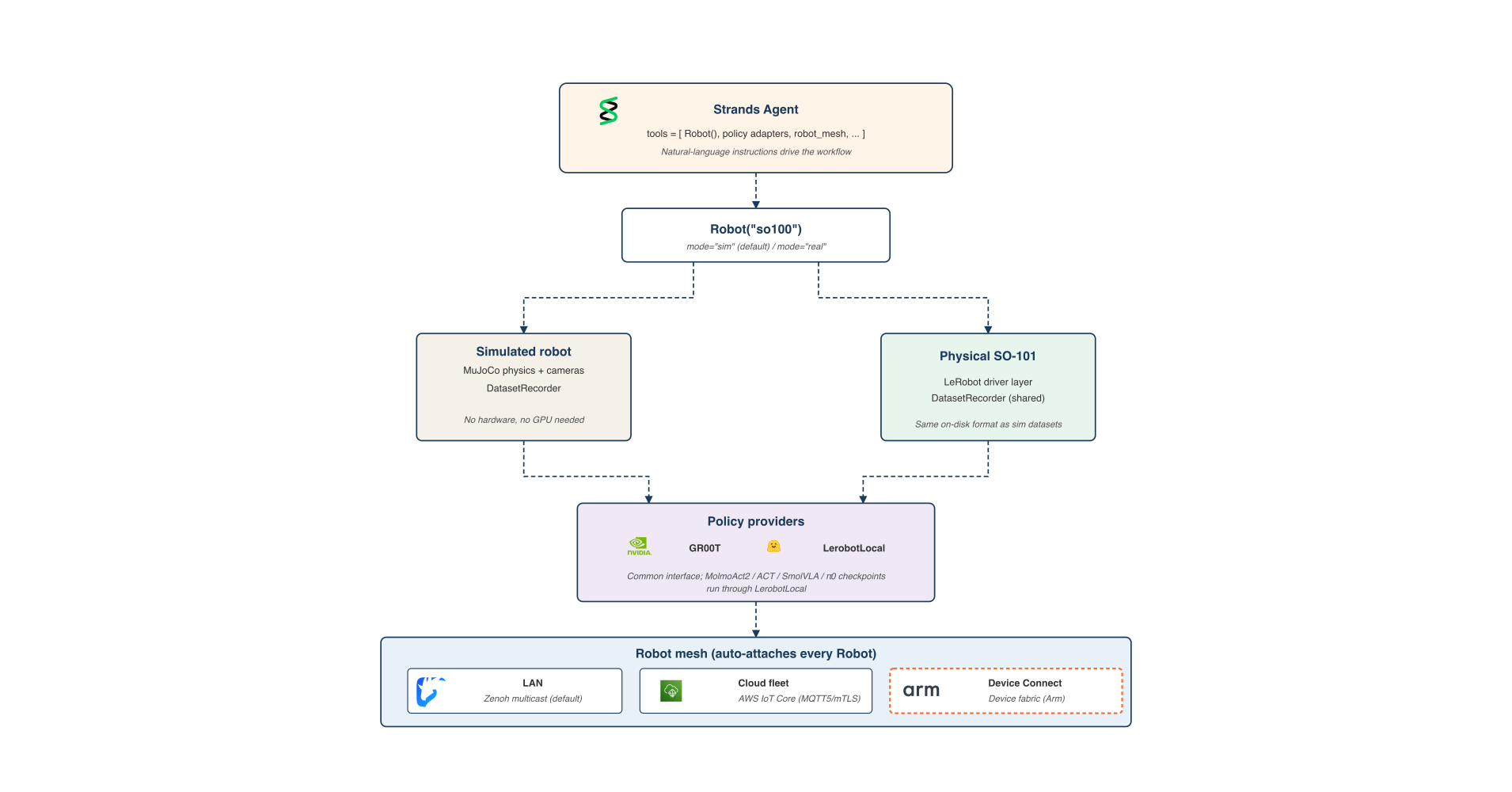
The integration is deliberately thin: LeRobot‘s own CLIs handle hardware recording and calibration, while Strands AgentTools manage everything an agent actually orchestrates. The simulation tool records LeRobotDatasets in the same parquet+MP4 format LeRobot writes on hardware. Robot(“so100”) defaults to MuJoCo simulation; mode="real" returns a LeRobot-driven physical arm with the same agent code. Policy inference runs through GR00T or LerobotLocal behind a common interface, and a Zenoh peer mesh broadcasts commands across a fleet.
For builders, the key takeaway is that sim and real now share a single file format and a single agent loop. A dataset captured in MuJoCo is indistinguishable from hardware-recorded data — training scripts consume both without modification. The same five-line Python script that records in sim deploys to a physical SO-101 by changing one keyword argument. Security considerations like prompt injection gating and mesh HITL approval are built into the runtime, making the abstraction production-ready rather than a toy.