Custom Silicon Fuels Frontier-Model Price War
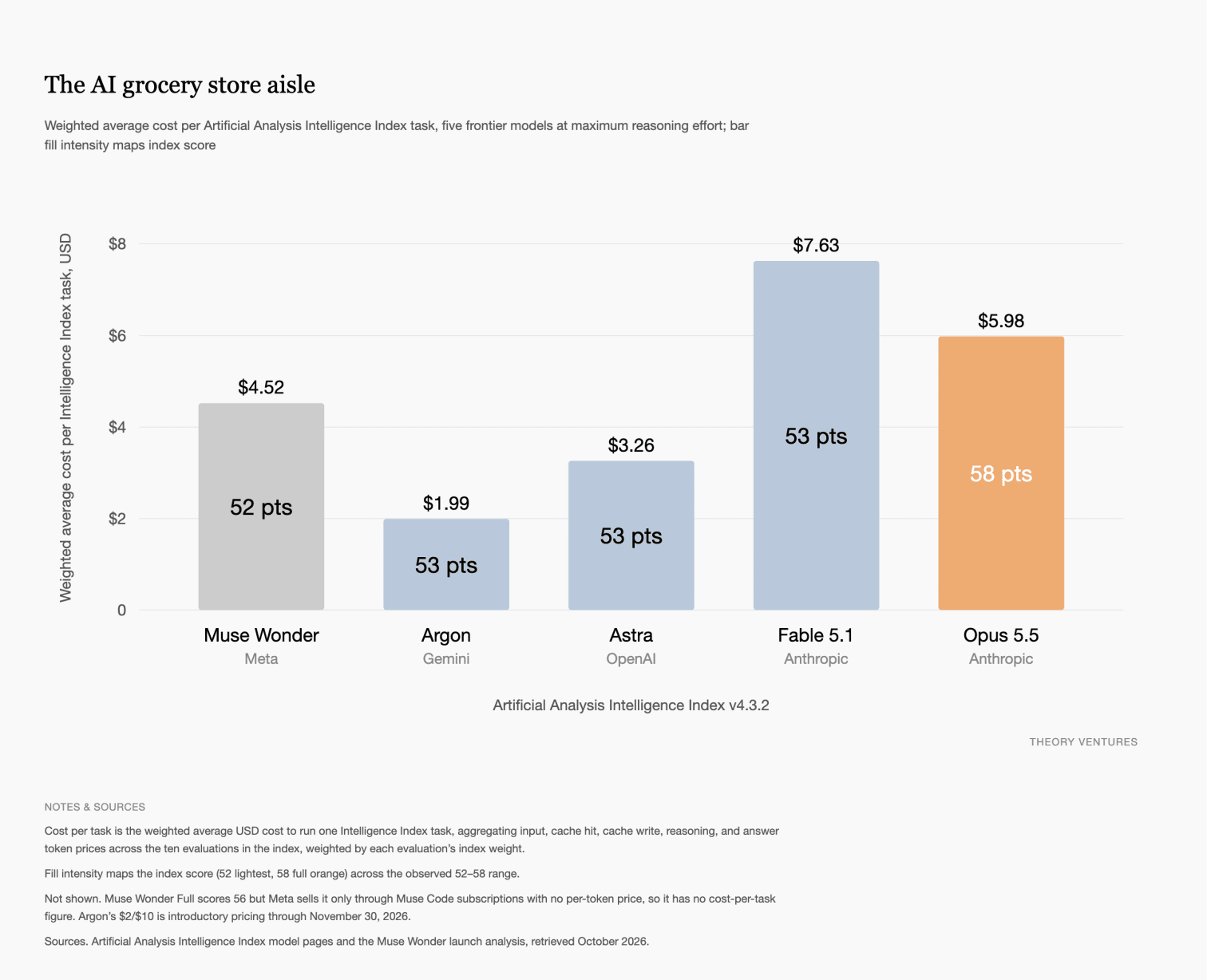
Five frontier models now sit within five points of each other on intelligence, but their cost per unit differs by 3.8x. Google’s Argon prices at the bottom of the cluster at $1.99 per task, 74% below the most expensive model, Fable 5.1, and also 67% below Opus 5.5, 56% below Muse Wonder, and 39% below Astra. Taking Michael Mauboussin’s principle that prices convey information, the article reads those differences as direct evidence that different models, architectures, and different costs of GPUs translate into serving prices.
Google’s likely advantage is that it has built machine learning models in parallel with its chips for more than 15 years, more experience than anyone else on the list. The supporting evidence is Google’s peer-reviewed work on Tensor Processing Units: fourth-iteration TPUs released in 2023 ran 1.2x to 1.7x faster than Nvidia A100s while drawing 1.3x to 1.9x less power. At the low end of the throughput range and the midpoint of the power range, that works out to 80% more tokens for the same serving cost. If the advantage has carried through to today, Google could be serving tokens at 44% less than its peers while operating at similar margins, which would also explain the disproportionate scale of Google’s data center buildout relative to its smaller cloud business.
Google is no longer alone. Every lab that can afford custom silicon is now building it. Microsoft’s Satya Nadella introduced Maia 300 in October 2026, saying the Maia family will scale to multi-gigawatt deployments starting next calendar year and become the primary inference system for Microsoft’s own products and services, with 40% more tokens per watt than leading GPU-based systems. OpenAI’s first inference chip, Jalapeño, was tested on SemiAnalysis’s InferenceX suite against Nvidia GB200 and GB300 and delivered 1.5x to 1.9x more throughput per watt and 1.7x to 3.6x lower end-to-end latency. The article also cites SemiAnalysis’s view that performance per unit of power is the more useful standard than per-chip performance.
With intelligence per watt doubling every six months, pricing should continue to deflate in the world of tokens while margins remain in the 40-70% range, particularly for frontier models.