Crypto’s Quiet Structural Shift: T-Bills, Hyperliquid, and Real Revenue
The venture capital narrative around crypto is that the space is dormant—funding is at multi-year lows and public attention has moved on. But underneath that surface, a structural shift is happening that most people are missing. The article exposes the tension between the quiet funding environment and the actual infrastructure being built, which is quietly generating real economic activity and becoming deeply embedded in legacy financial systems.
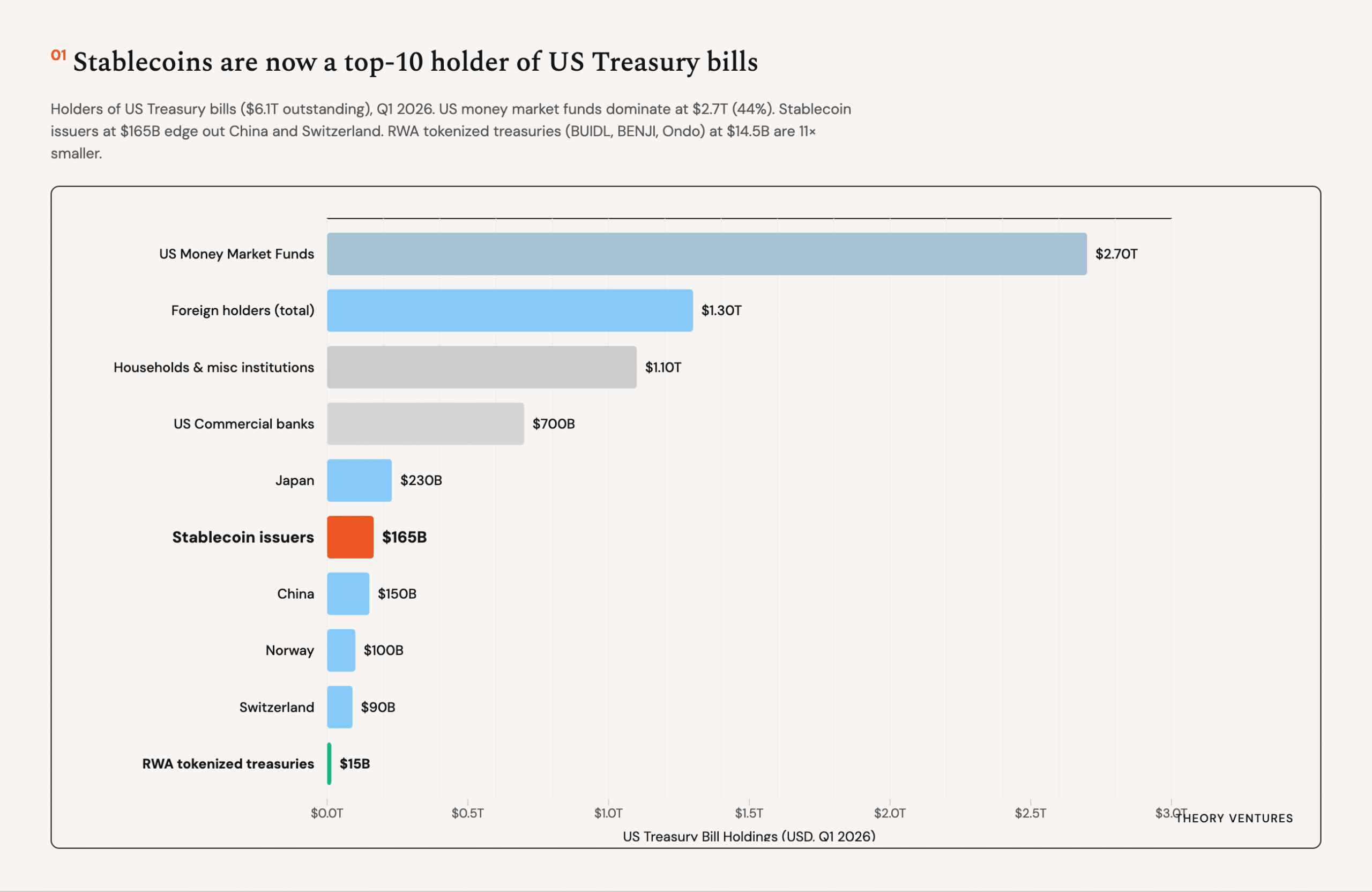
Stablecoin issuers now hold $165 billion in US Treasury bills, making crypto a top-10 holder of US government debt—behind only Japan among foreign holders and ahead of China or Switzerland. That is 2.5% of the $6.1 trillion T-bill market. Then there is Hyperliquid, a four-year-old exchange whose native token HYPE is worth $59 billion. In June 2026, Hyperliquid averaged $1.67 million per day in trading fees, which annualizes to $610 million in real fee revenue. Gold, oil, and stocks now trade 24/7 on crypto perpetual markets, changing how those markets operate. These charts come from Allium, a Theory portfolio company that has achieved 10x revenue growth since Series A, with 150+ enterprise customers and 30+ petabytes of blockchain data.
For the serious builder, the takeaway is that the noise around crypto has faded, but the infrastructure hasn’t stopped scaling. Stablecoins are becoming a core holder of US sovereign debt, and on-chain financial markets are processing hundreds of millions in annual fees from traditional assets. This isn’t speculation about a future use case—it’s existing, operational infrastructure that is quietly integrating with conventional finance. The companies building in this space today, like Allium and Hyperliquid, are demonstrating that real revenue and real adoption are happening regardless of the narrative. The signal is in the data, not the hype.