Claude Cowork Expands to Mobile and Web: The Agentic Coworker Arrives
Anthropic is pushing Claude Cowork beyond the desktop and into mobile and web, a move that signals the coding-agent war is expanding into general office work. The tension here is whether AI tools designed for developers can credibly shift to handling the “work around the work” — the administrative, operational, and content tasks that keep companies running but are rarely anyone’s core job. With Cowork already used by over 600,000 organizations, the data shows that the largest chunk of usage (33.4%) is business process operations like pulling scattered updates into a single report or reconciling spreadsheets, while software development accounts for only 8.7%. The real challenge: will users treat these agents as reliable background colleagues or just fancy chatbots?
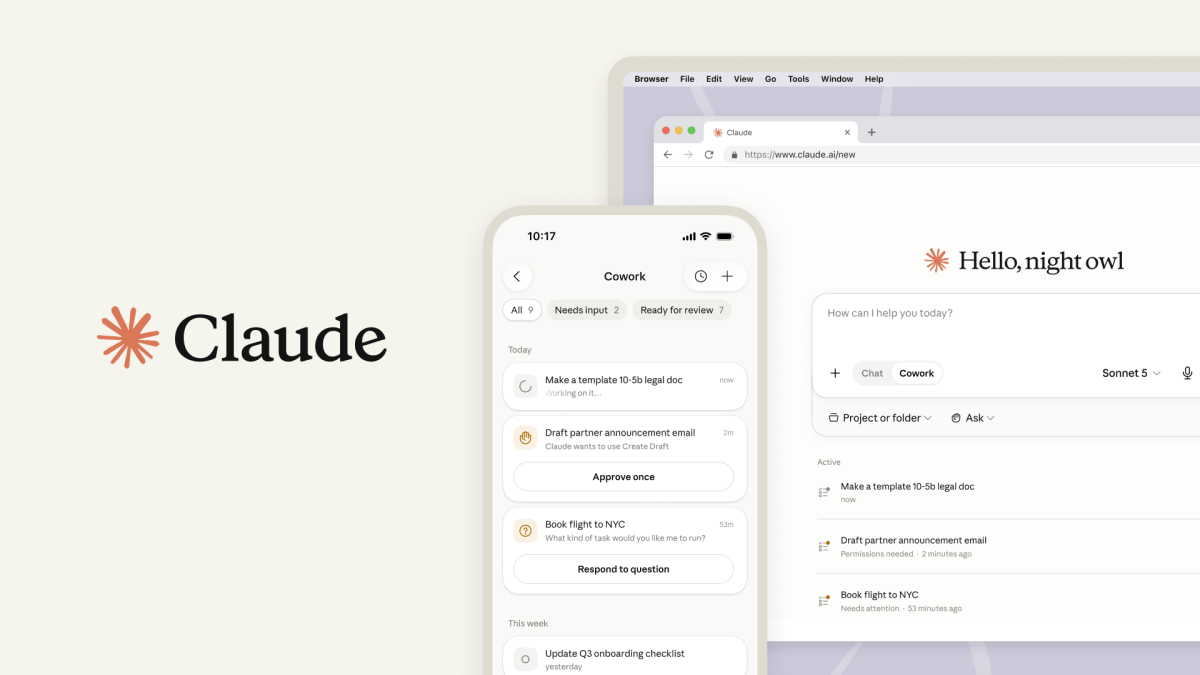
Starting Tuesday, Max subscribers can start a Cowork task on their desktop, check status on their phone, and pick up the finished output later — even if their laptop is closed. Anthropic says tasks continue running in the background without requiring a device to stay online, a crucial design choice for agents meant to feel like an administrative coworker rather than a coding helper. The desktop app remains the primary environment for deep work with local files and browser access, but the unified web and mobile experience combines chat and Cowork, with projects and artifacts living together across devices. Separately, Claude Tag (an always-on agent inside Slack) extends the same logic: the agent should be present where work actually happens, not locked inside a single interface.
The serious takeaway for builders is that the leading use of AI agents may not be coding at all. Anthropic‘s sample of 1.2 million anonymized Cowork sessions reveals that content creation and copywriting (16.4%) handily beat software development (8.7%), and business process ops dominates. This mirrors OpenAI’s Codex trajectory, which started as a developer tool but now sees heavy use from non-developers for reports, spreadsheets, and analysis. The message is clear: success in the agent era will depend less on who has the best chatbot and more on who owns the surfaces where work gets done — email, Slack, browsers, phones. For anyone building AI products, the data suggests you should optimize for the administrative grind, not just the technical breakthrough.