iFeeling Daily
Daily curated AI insights you can't miss.
Radar makes podcasts searchable and AI-usable
Radar indexes over 130,000 podcasts with semantic search and entity tracking. Its API lets AI agents and businesses access audio intelligence that was previously invisible to them.
Agent Valley: Free 5-Week Live Course on Building AI Agents
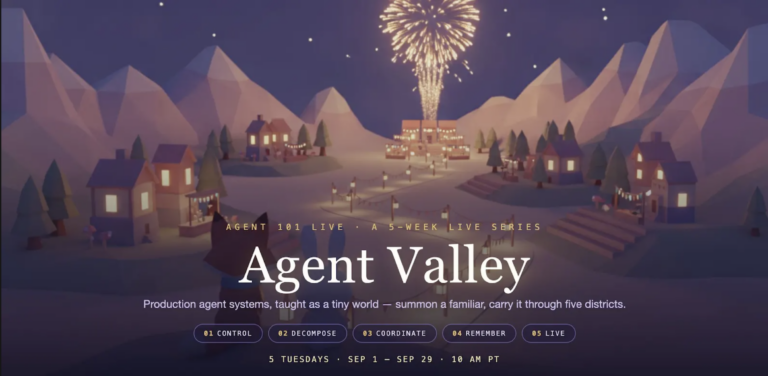
Agent Valley is a free five-week live series from Google DevRel that teaches AI agent building hands-on in a virtual world with a real-time Runtime Inspector.
Arga raises $10M to train enterprise AI agents in digital twin environments

Arga raised $10M to build digital twins of enterprise software, letting AI agents train in realistic, resettable environments—critical for handling complex, ambiguous business tasks.
Ray Sandboxing with gVisor on GKE
Google Cloud and Anyscale introduce an experimental Ray Sandboxing with gVisor on GKE, bringing native isolated execution to distributed agent workloads.
Gamma acquires design startup Lica to expand beyond presentations

Gamma acquires Accel-backed design startup Lica to build a design research lab, exploring multimodal presentations and personalized AI communication.
GPT-5.6 arrives in Kiro with 82% cost reduction on Terminal-Bench 2.1
OpenAI's GPT-5.6 family, including Sol, Terra, and Luna, is now available in Kiro, with testing showing roughly 82% cost reduction on Terminal-Bench 2.1.
Instinct AI assistant: privacy and security concerns from early testers

Instinct, an AI assistant in private testing, has drawn praise for its capabilities but raised privacy and security concerns over its terms and data handling.
Securing AI Agents: Governance and Infrastructure

A new report finds 79% of tech leaders cite security, governance, or operations as the top challenge in scaling agentic AI.
Google Cloud Launches AI-Powered Migration Center Assessments
Google Cloud's AI-powered Quick Assessments in Migration Center deliver near-instant TCO modeling and automated service mapping for faster migration planning.