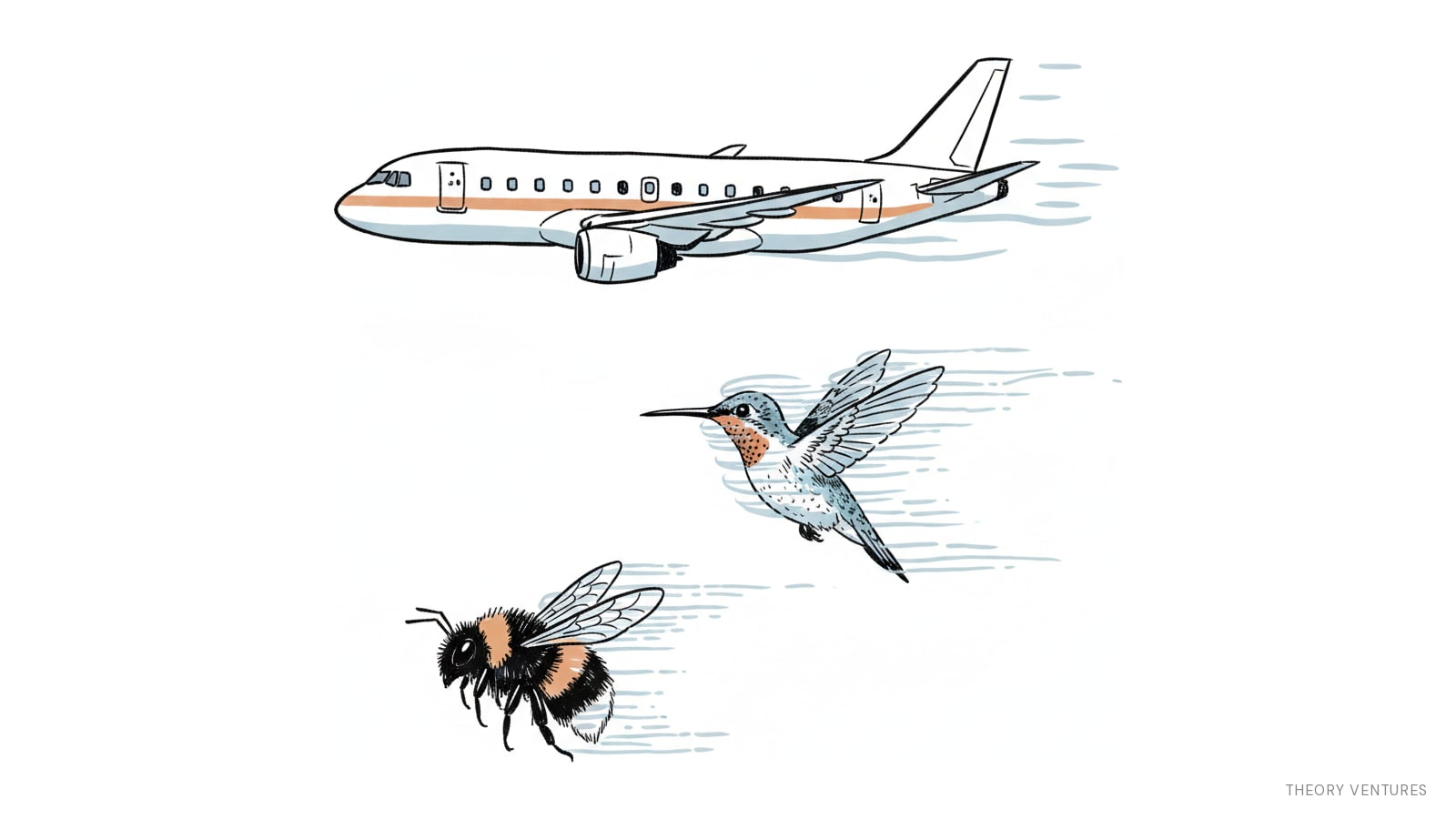
Birds Don’t Fly Like Planes. Neither Does AI.
A small local model can match a frontier cloud model on real agent work, but it gets there by a different path: more reasoning tokens, slower latency, and a different compute profile. The author swapped Qwen3.8-27B into their agent and reports it works well, noting that this Qwen model ranks #1 of 135 models on Artificial Analysis’s Intelligence Index with a score of 52, one point above GLM-5.2, the state-of-the-art open-source model from Z.ai at 753b parameters. The laptop model is roughly 28 times smaller than that cloud-class peer.
The explanation offered is that larger models can store more knowledge and skip straight to an answer, like an expert in many fields, while smaller models have less memorized and must reason more, almost from first principles, to close the gap. The author saw this firsthand when benchmarking DeepSeek V4 against two local models on 25 venture-capital tasks (researching startups, summarizing articles, transcribing podcasts), scored by a judge model.
The benchmark table shows three models with identical answer quality: deepseek-v4-flash scores 8.0 at 137.3 tok/s with 159 average tokens and 1.1s latency; qwen3.8-27b scores 8.0 at 51.9 tok/s with 369 average tokens and 7.2s latency; qwen3.6-35b-a3b scores 7.9 at 113.4 tok/s with 1,143 average tokens and 10.0s latency. The local models produce identically good answers but take different paths. The 35b model needs about 7.2x more thinking than the cloud model and crosses the line 9 seconds after DeepSeek. The newest Qwen model is three seconds faster, and the cloud is 6 seconds faster yet.
A concrete example: on one triage task, the 35B spent 993 tokens to produce six words, “Classification: Scheduling / Action: Respond.” The bumblebee needed 369 thinking tokens, buzzing along at half the speed. The author’s conclusion is that local models can achieve the same result as cloud models, but they’ll take a different flight path to get there.