Beyond LLMs: Why Enterprise AI Needs Agent Logic, Not Bigger Models
The core tension this article exposes is that powerful frontier LLMs alone are insufficient for enterprise AI adoption, because real enterprise workflows are dynamic, long-running, and tangled with hundreds of APIs, databases, and regulatory constraints. Simply expanding model context to handle these workflows creates a direct tradeoff: increased hallucinations and skyrocketing token consumption. The article argues that the missing piece is not a bigger model but an explicit agent logic layer — software primitives like knowledge graphs, program analysis libraries, and algorithms that operate between the LLM and the workflow to intentionally reduce the context space and steer the model toward policy-compliant, cost-effective outcomes. Without this, AI agents fail to operate at the core of enterprise workflows and AI pilots continue to fail at scale.
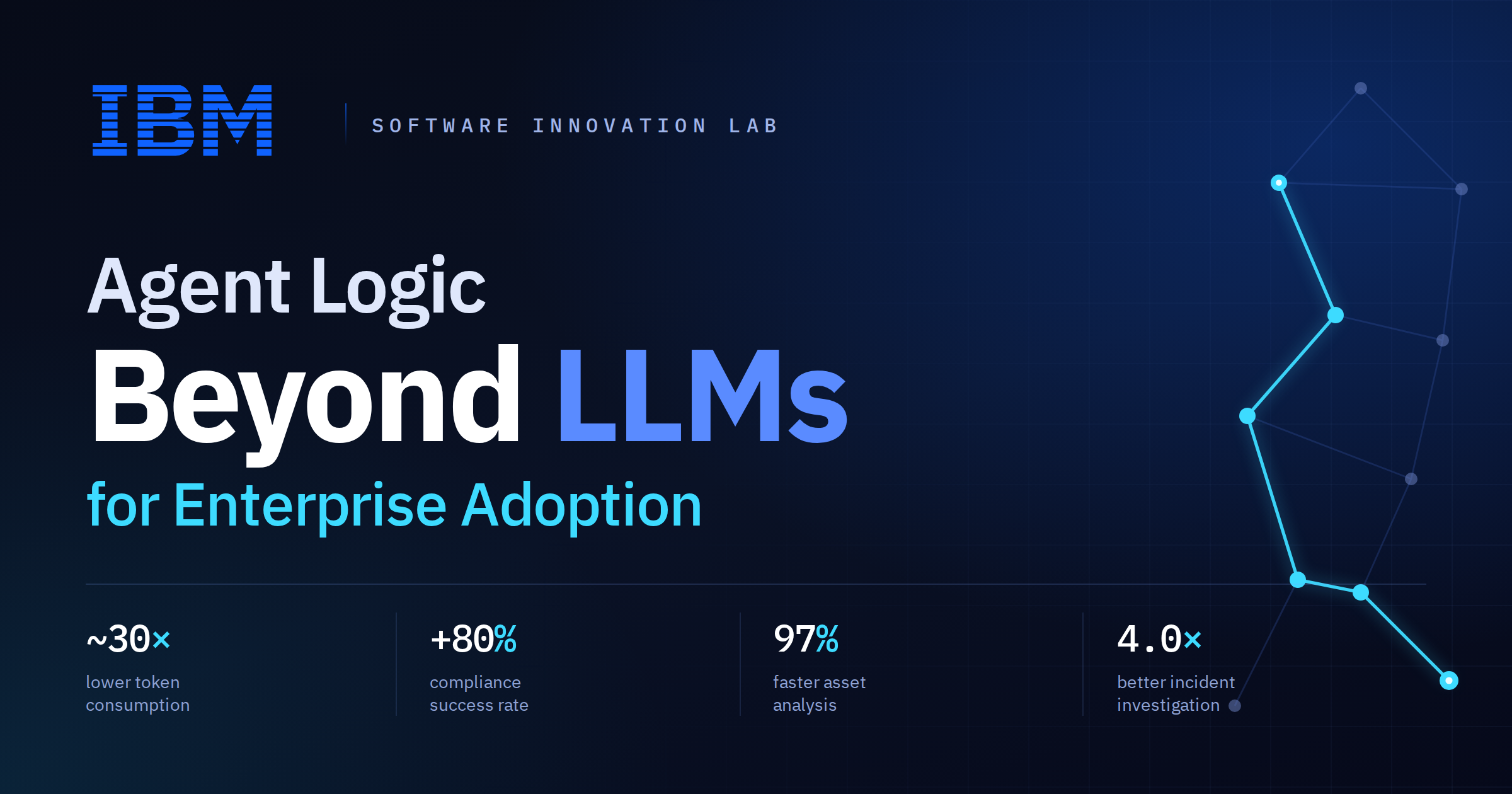
The concrete technical path demonstrated across multiple IBM solutions is to equip agents with domain-specific, structured knowledge and orchestration that offloads reasoning from the LLM. For legacy code understanding, IBM watsonx Code Assistant for Z uses pre-indexed static analysis to achieve ~30× lower token consumption than a frontier LLM-only approach. For test generation, the Aster library applies program analysis outputs and sub-agents for error remediation, yielding 20-45% coverage improvements with up to 15× fewer tokens. For incident response, the Instana I3 agent uses a knowledge graph of the full IT stack to achieve up to 4× improvement over a ReAct agent with GPT-5.1 while consuming fewer tokens. For compliance, a multi-agent system with adaptive planning boosts success rates from single digits to over 80% with Claude 4 Sonnet. All examples share the same operational insight: bind the LLM with structured guides, not more context.
The takeaway for builders is that scalable enterprise AI deployment requires investing in agent infrastructure as rigorously as in model selection. The article makes a convincing case that the bottleneck is not model capability but the absence of an intelligent orchestration layer that can constrain, focus, and validate model outputs against real business policies and data. For any team deploying agents in regulated or complex environments, the practical path forward is to build or adopt agent harnesses that incorporate program analysis, knowledge graphs, and policy-as-code enforcement — treating the LLM as a flexible reasoning engine rather than a standalone solution. The most performant and cost-effective agents are not the ones with the largest context windows, but the ones with the most tightly scoped, workflow-aware logic.