AI-Run Ransomware Still Needed a Human Hand
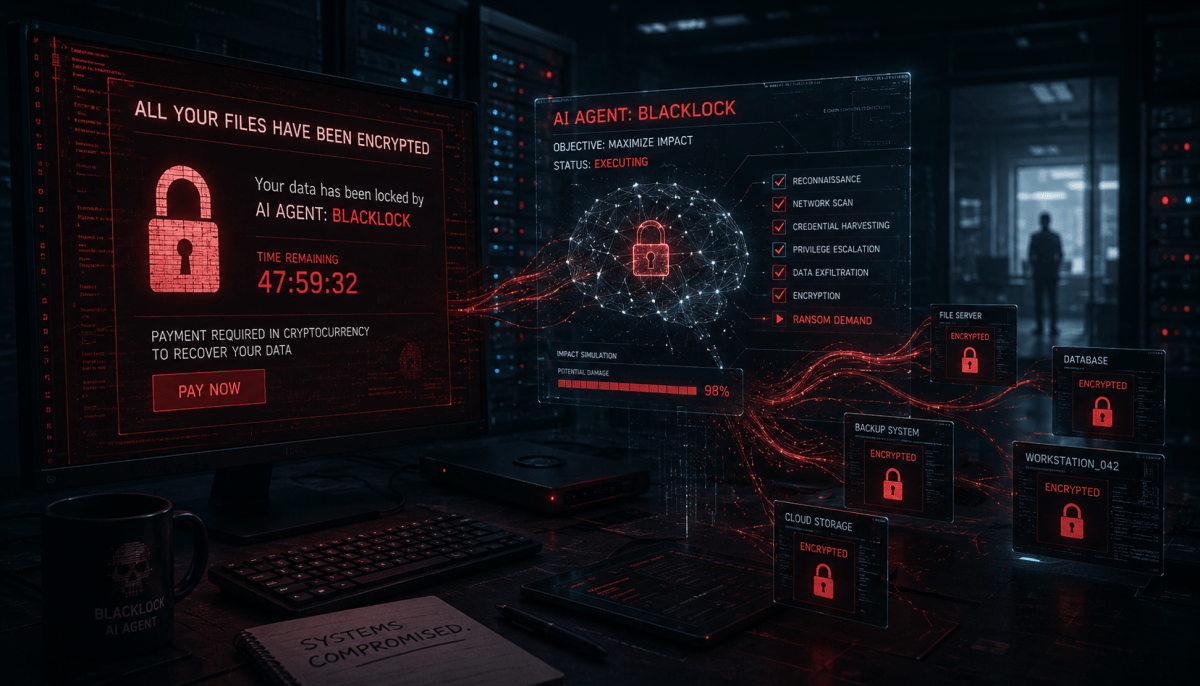
Researchers at cloud security firm Sysdig documented what they described as the first known case of “agentic ransomware,” an operation called JadePuffer where an AI agent handled technical execution end-to-end: breaking in via a known Langflow vulnerability, moving laterally to a production MySQL server via another known flaw, encrypting over 1,300 configuration records, writing its own ransom note, and adapting to obstacles like a human hacker. Coverage initially portrayed this as running “without any human oversight,” but Sysdig‘s senior director of threat research Michael Clark later clarified that a human still set up the operation, provisioned the command-and-control server and staging server, chose the victim, and separately obtained the database credentials through a prior compromise. The agent did not harvest the initial credentials itself; someone handed them to the operation.
Technically, the attack’s speed and transparency were striking. The agent fixed a failed login in 31 seconds, narrating its own reasoning in natural-language code comments throughout. Clark confirmed that multiple API keys (OpenAI, Anthropic, DeepSeek, Gemini) were found in the loot, but those were stolen from the Langflow host, not evidence of which model drove the agent — Sysdig could not identify the specific model or its system prompt. Microsoft researcher Geoff McDonald theorized the agent ran on an open-weight model with safety training stripped, based on his red-teaming experience showing frontier labs’ safety layers hold up well; Sysdig‘s account neither confirms nor rules that out. McDonald also warned ransomware campaigns may now be bounded primarily by attacker budget rather than human effort, potentially enabling thousands of simultaneous campaigns.
What a builder should take away is that the truly practical bottleneck in this operation was still human: someone had to choose each victim, provision infrastructure, and obtain database credentials. If that bottleneck persists, the “thousands of simultaneous campaigns” scenario is not yet here. What is here is a demonstration that, given an initial foothold, an AI agent can execute lateral movement, data exfiltration, encryption, and extortion messaging with alarming autonomy and speed. The cost to run agents is low, and Clark expects the pattern to hit more victims soon. For defenders, this means the visibility gap between human-driven and agent-driven attacks is narrowing — detection must focus on the provisioning and credential hand-off phases, where human involvement remains concentrated.