Predicting Fine-Tuning Job Duration on Shared GPU Clusters
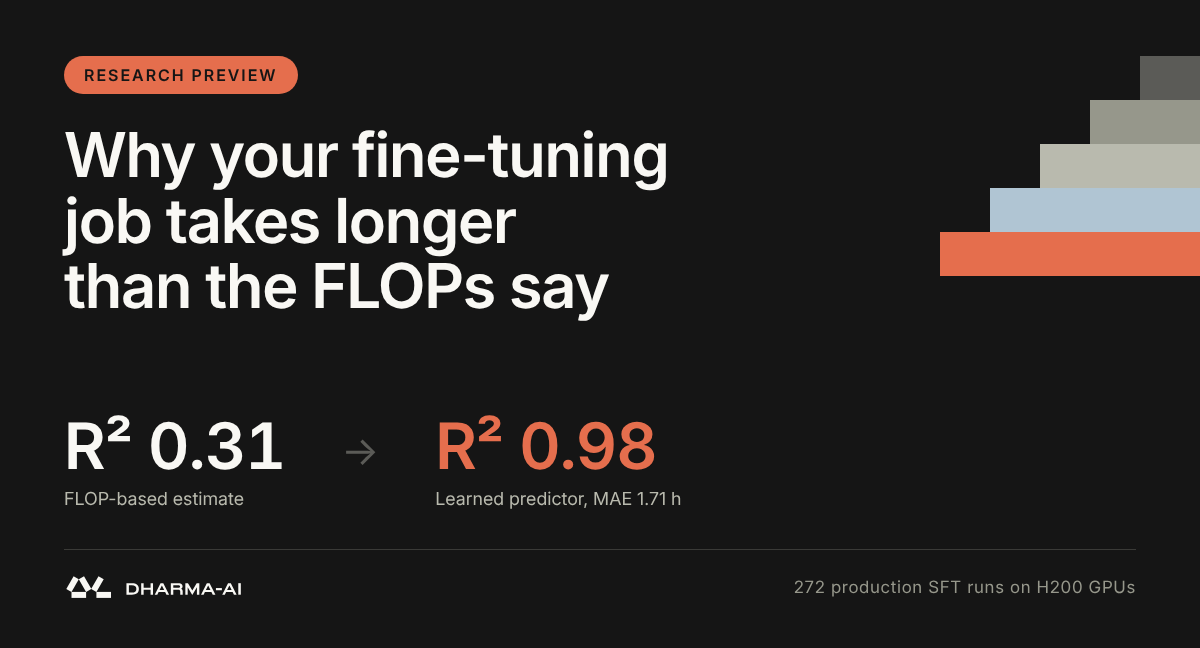
Predicting how long a fine-tuning job will run before it is dispatched is a scheduling problem that FLOP-based estimates handle poorly. The authors collected 272 supervised fine-tuning (SFT) runs from a production pool of NVIDIA H200 GPUs (about 7,382 GPU-hours) and compared the standard compute-only estimate with learned predictors that use only information available before the job starts. On jobs with a mean duration of 23.43 h, the best FLOP baseline, with MFU swept and set to 30%, achieved R² = 0.31 and MAE = 12.41 h. A CatBoost regressor with 24 features reached R² = 0.98, MAE = 1.71 h, and median error 0.51 h in stratified 5-fold cross-validation.
The usual estimate is T_theoretical = (6 · P · D) / (N_GPU · FLOPS_peak · MFU). It captures the optimization loop, but a real job also includes environment setup, model download and loading, tokenization, periodic evaluations, checkpoint uploads, final writes to object storage, and network/storage contention from other jobs on the shared cluster. These overheads depend on configuration and do not scale neatly with workload or GPU count; two jobs with the same nominal compute can finish hours apart.
The learned model treats end-to-end duration as supervised regression. Inputs are derived from the submitted configuration: hyperparameters, dataset sizes, model identifiers, GPU allocation, plus engineered features such as num_eval_data (samples processed across all evaluation cycles), num_saves and num_params_saved (checkpoint I/O), and per-GPU token volumes. The FLOP estimate itself, with MFU fixed at 0.45, is included as one feature, so the model starts from the compute-only number and learns corrections. The final CatBoost model was selected from 18 candidate feature sets using correlation filtering, mutual information, permutation importance, and grid search with MAE as the criterion.
Among the baselines, Ridge reached MAE = 7.23 h, XGBoost MAE = 1.95 h, and CatBoost MAE = 1.71 h. The authors also tested Calculon (Isaev et al., SC ’23), an analytical LLM training performance model that builds an explicit layer graph and accounts for compute, memory traffic, and inter-device communication; after extending it to LoRA, grouped-query attention, fused attention, bfloat16, and SwiGLU, its estimates still correspond to a median of only 11% of observed wall-clock time. Feature importance ranks num_eval_data first, followed by num_trainable_params, batch_eval_size_percent, num_all_params, and checkpoint-related variables. SHAP values show that high evaluation volume consistently increases predicted time, while trainable parameter count has a nonlinear effect that becomes large only for the biggest models.
Error analysis on out-of-fold predictions shows a median absolute error of 0.51 h; 80% of predictions are within 2.20 h and 90% within 4.31 h. Up to 60 hours, the median error stays at roughly one hour or less, but the 60–175 h range has only 13 runs and a median error of 5.19 h, which the authors read as a data limitation. On a fixed 20% holdout, MAE drops from 1.63 h to 1.50 h when going from 85% to 100% of the training partition, with no clear plateau.
The authors state clear boundaries: the study covers SFT only, not RLHF/DPO/RLVR; all runs used H200s, so the fitted model is calibrated to that infrastructure and should not be expected to transfer numerically without retraining; and mixed pools would need hardware descriptors such as throughput, memory, bandwidth, and interconnect topology. What transfers is the method: overhead-aware features, multicollinearity-aware selection, and the comparison protocol. The full paper is expected on arXiv soon, and the authors plan hardware-specific descriptors, validation on other GPU types, transfer learning for configurations with few observations, other training objectives, and more data on long runs.