Time-Series Models in the Streamhouse: A New Frontier and Use Cases
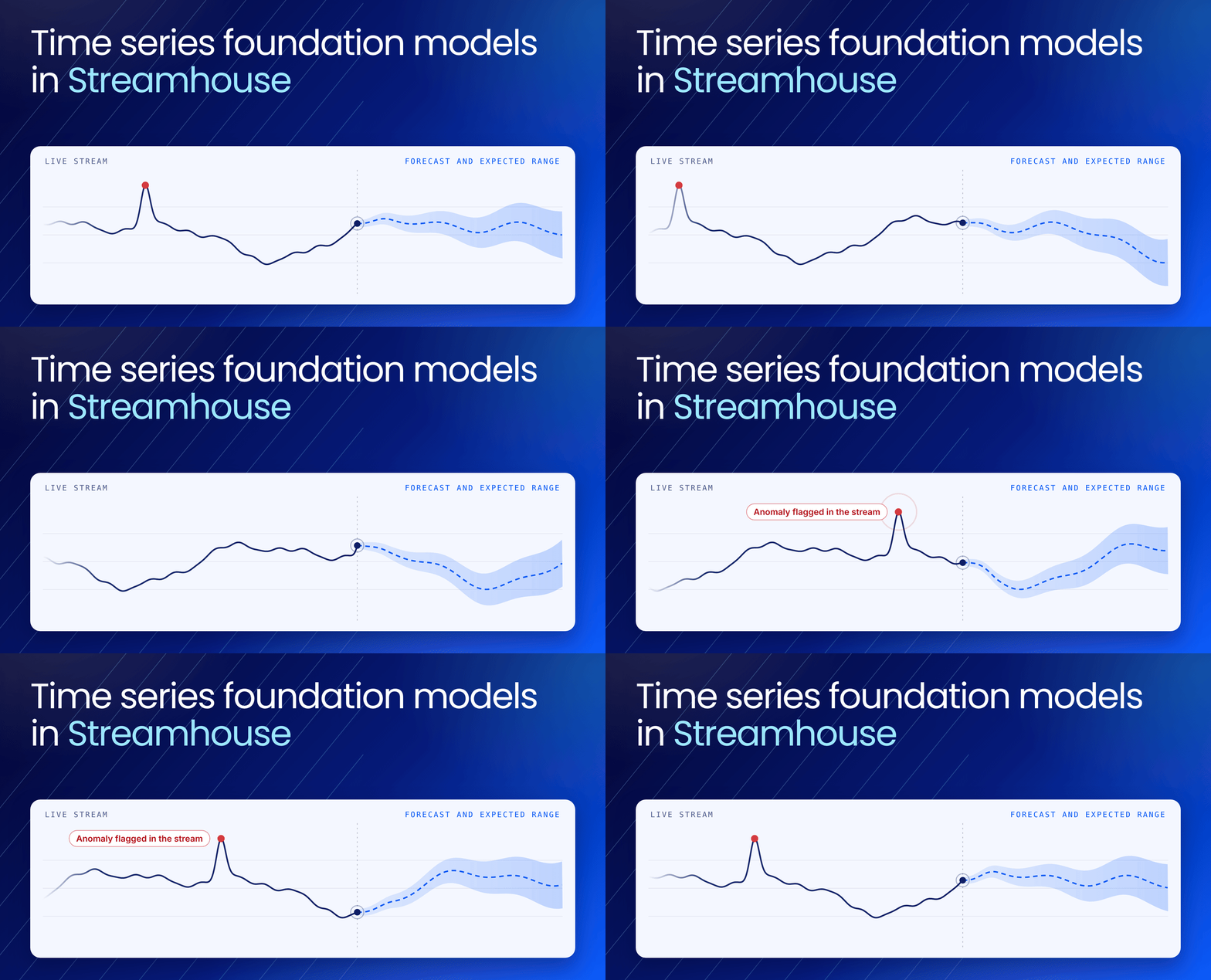
IBM and Confluent have made time-series foundation models available natively inside Confluent‘s data streaming platform, bringing forecasting, anomaly detection, and semantic search to streaming data. The models, from IBM’s Granite time-series family (with more than 50 million downloads), run on CPUs in Confluent Cloud as fully managed built-in functions and on premises through Confluent Platform for Apache Flink. Teams invoke them with SQL in Flink, for example AI_FORECAST, AI_DETECT_ANOMALIES, and TSPulse for time-series embeddings, without deploying separate infrastructure.
The motivation is timing: every order, payment, machine reading, or inventory change is a time series, but a prediction delivered after a production run, stockout, or payment authorization is too late to matter. Time-series foundation models address this by learning general patterns from diverse historical data and applying them to new series, so teams do not need to train a separate model for every series. Depending on task and deployment, a model can be fine-tuned or combined with other data and business logic. The models slot into Confluent‘s Streamhouse architecture, which continuously captures, processes, governs, and serves current business context through five capabilities: connect, stream, process, govern, and query. Apache Flink transforms and enriches data as it flows, while Lightning Tables provide low-latency access to current state; forecasts and anomalies can be produced alongside the events that generated them.
The post describes six use cases. In production optimization, a pretrained TTM model reads SCADA telemetry and QA measurements every 10 minutes to forecast the share of ice cream tubs expected to be in spec four hours ahead; when the forecast falls below target, an optimization process evaluates freezer draw temperature and airflow before the operator approves setpoints. In anomaly detection, AI_DETECT_ANOMALIES builds an expected range from each store and product sales series and flags readings outside it, avoiding fixed thresholds that miss quiet changes. For supply chain planning, AI_FORECAST produces a 28-day demand forecast with a P10-P90 range, and a planning application turns forecast, inventory, lead time, and service level into a reorder point; an agent can draft a purchase order for review. For fraud, each card payment is compared with an expected spending range from that card’s recent history, and an out-of-range transaction is passed to the bank’s existing fraud systems for step-up authentication or investigation. For trading, PatchTST-FM forecasts trading volume for the next 30 minutes on each one-minute bar, and an execution algorithm paces a large order within a participation limit, pausing or resizing slices when market activity changes. For semantic search, TSPulse produces representations of time-series windows that can be indexed for similarity search, helping engineers find similar spikes, rises, or step changes across equipment; the article notes similarity can narrow an investigation but does not establish a root cause by itself.
The same building blocks are mapped to industry workflows: industrial AI moves from sensor to setpoint, retail connects store and supply chain, banking adds card-level context to fraud and trading forecasts, and airlines apply forecasting and anomaly detection to engine, gate, and network streams. In each case, Flink runs the Granite models, Streaming Agents act on live context, and people approve exceptions. The article notes that deployment details matter: predictions can be refreshed as data changes subject to the model’s requirements and pipeline configuration, and some illustrative figures use simulated data. Semantic-search applications also require an embedding pipeline, an index, and access to relevant context.