Who Captures the Most Margin in AI?
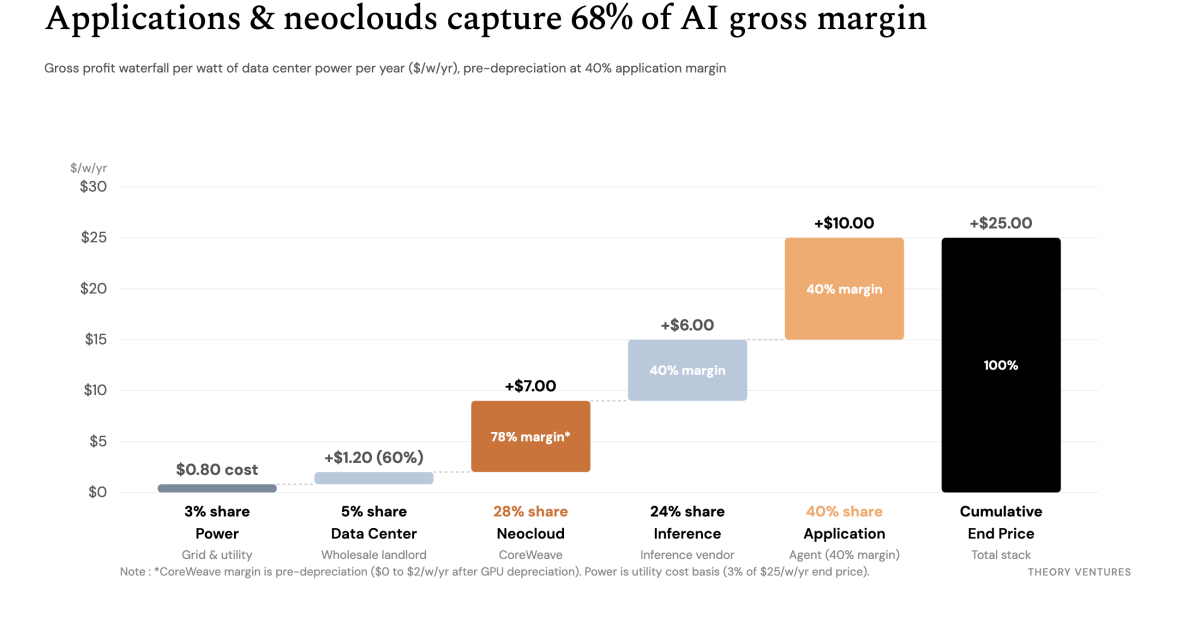
Who Captures the Most Margin in AI? analyzes the AI value chain using public filings to trace dollars from power plants to agents. It defines five layers: power plants produce electricity; data center operators build facilities and connect power; neoclouds buy and manage GPUs; inference vendors run AI software; AI applications sell software to customers. Because layers bill in different units—utilities sell kilowatt-hours, neoclouds rent GPU-hours, and applications price completed tasks—the article normalizes every step to dollars per watt per year ($/w/yr).
At a 40% application gross margin, the waterfall divides the gross profit pool as follows: power captures 3%, data centers capture 5%, neoclouds capture 28% before GPU depreciation, inference captures 24%, and applications capture 40%. Three implications follow.
First, rising compute prices will test who holds pricing power. Anthropic‘s Form S-1/A discloses short-term burst compute reaching $13 per GPU-hour. On CoreWeave‘s Q3 earnings call, CEO Michael Intrator confirmed the shift in contract rates: selling capacity at more than $40m per megawatt annually, while pricing for new infrastructure on four- and five-year contracts moves to $20m to $25m per megawatt. At $20 to $25 per watt-year, new multi-year compute contracts price at more than double CoreWeave‘s current blended fleet rate of about $9 per watt-year. If the application can charge end users more because of its effectiveness, higher compute costs cascade through; otherwise neoclouds, inference providers, and applications fight over a fixed pool.
Second, different applications will command varying pricing power as a function of their ROI. An AI that saves 30% does not command the same pricing power as one that saves 70%. Techniques like small models, fine-tuning, and routing will help sustain margins. Unlike in the SaaS era, different vertical software markets will support varying gross profit pools.
Third, vertical integration is already consolidating margin. CoreWeave acquired Weights & Biases ($1.03b), OpenPipe, Marimo, and Monolith AI ($185m) to move up into training, evaluation, and enterprise workflows. Nebius has spent more than $1b in 2026 acquiring four companies across search, model optimization, cold-start scaling, and orchestration to build its Token Factory. Owning multiple layers lets an integrated provider absorb price swings that squeeze standalone vendors.
No layer in AI is static. As market power shifts from one layer to the next, understanding these shifts will explain where competition is fiercest and where M&A will concentrate.