Compute Engine API Multi-Versioning: Date-Based Versions for Safer Evolution
Google has announced general availability of Compute Engine API multi-versioning, a date-based versioning model designed to let teams modernize their infrastructure without risking production stability. For more than a decade, the Compute Engine /v1 API has served as the control plane for millions of virtual machines, Google Kubernetes Engine (GKE) clusters, and large-scale AI infrastructure, with a promise that integrations written once would keep running year after year. As cloud architectures have grown, however, platform teams have faced a tension: mission-critical workloads demand absolute stability and strict backward compatibility, while customers want faster access to safer security defaults, stronger regional resilience, machine-readable error models, and more declarative-friendly APIs. Introducing those improvements in place on the shared /v1 surface risks breaking existing automation, and the new versioning model is intended to avoid that disruption.
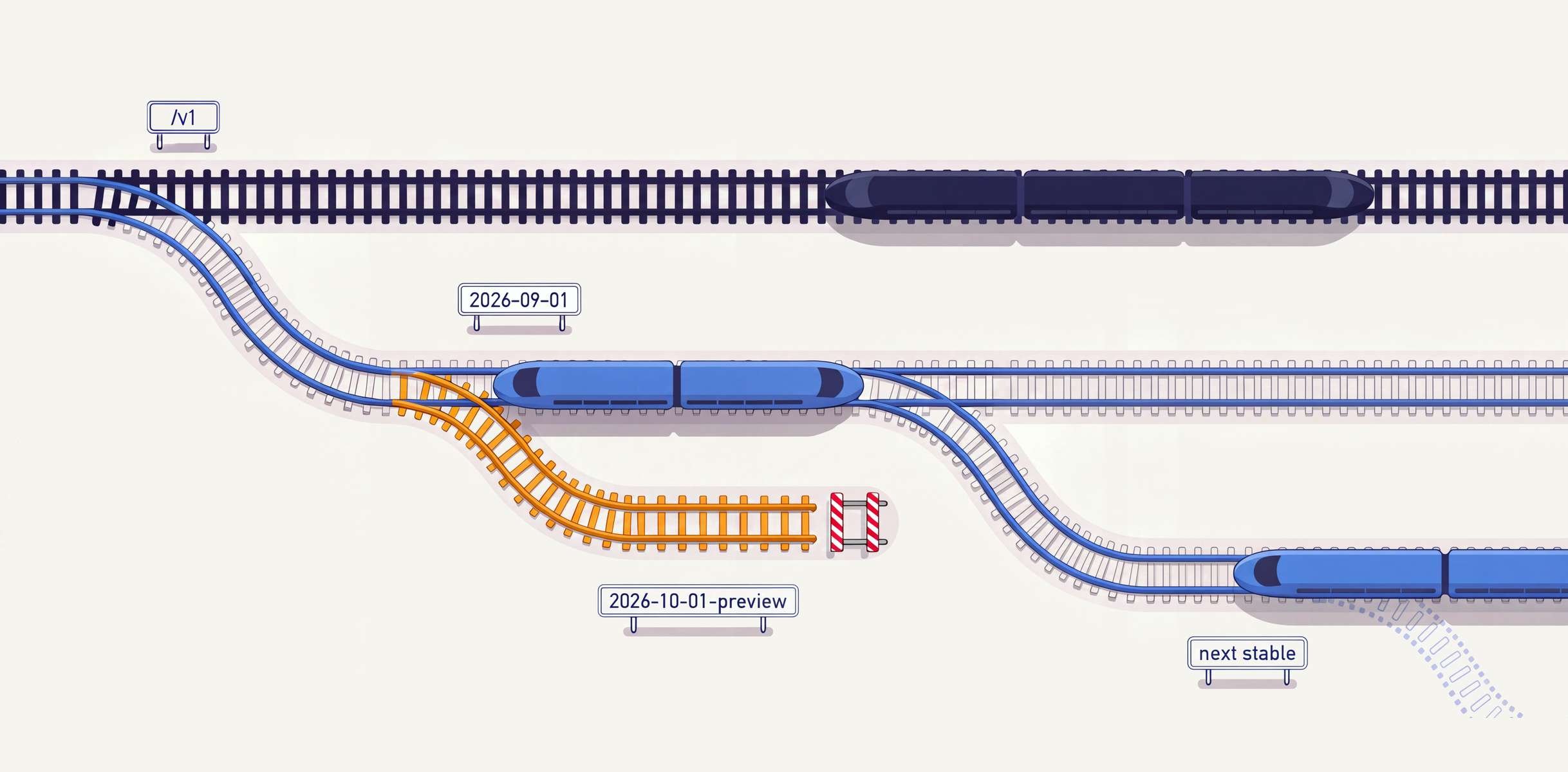
Historically, Compute Engine relied on channel-based versioning (CBV) with three long-lived channels: /v1 (generally available), /beta, and /alpha. Because /v1 was a single mutable production surface shared by every customer, any behavioral improvement, even changing a counter-intuitive default or modernizing an error format, carried the risk of breaking existing scripts or requiring multi-year migrations. The new model uses interface-based versioning (IBV), aligned with Google AIP-185, to introduce immutable, date-based API snapshots alongside /v1. Stable versions (YYYY-MM-DD) are released on a predictable quarterly cadence starting with 2026-09-01; each stable version is a locked, point-in-time contract of all generally available Compute Engine features and behavioral defaults, receives no breaking changes after publication, and has no end-of-support date today. Preview versions (YYYY-MM-DD-preview), such as 2026-10-01-preview, branch from a stable parent and carry a one-year lifespan for testing and feedback. The existing /v1 API remains fully supported and remains the default when no date-based version is specified, so existing applications, scripts, and integrations continue to work without modification.
The first benefit area is stability and customer-controlled upgrades. Callers can pin to a specific version identifier such as 2026-09-01, knowing that its request and response schemas are frozen. When a new quarterly stable version introduces updated defaults or modified resource schemas, teams can evaluate release notes, test in staging by changing a single version string, and roll out to production at their own pace. Date-based versions continue to use the /compute/v1/ base URL path; callers specify the target version via the X-Goog-Api-Version HTTP header or the $apiVersion query parameter, which keeps resource selfLink URIs uniform across tools and services.
The second benefit area is safer defaults, stronger resilience, and modern API standards. In legacy /v1, calling AggregatedList across all zones and regions defaults returnPartialSuccess to false, meaning a transient issue in a single zone could cause a global list request to fail unless callers explicitly opted in. In new date-based versions, partial success is enabled by default so global fleet queries remain resilient during localized maintenance or disruptions. Date-based versions also adopt standardized google.rpc.ErrorInfo payloads per AIP-193, with structured reason, domain, and contextual metadata such as returning the list of supported_versions when an invalid version identifier is requested, eliminating brittle regex parsing of error strings. The new versions also allow Compute Engine to tighten overly broad legacy IAM permission checks and introduce safer configuration defaults without disrupting legacy automation on /v1, and they provide a clean path to evolve complex, decade-old resource schemas toward modern Google API Improvement Proposals (AIPs).
The third benefit area is seamless adoption across client libraries, gcloud, and Terraform. Each SDK release automatically binds to a specific date-based API version while preserving the /v1 package namespace (compute_v1, apiv1), and enums are represented as strings for forward and backward compatibility, so upgrading a client library dependency requires no import path rewrites; -preview SDK releases expose preview features. In the Google Cloud CLI, gcloud compute targets the bundled stable API version, while the new gcloud preview compute command group targets the bundled preview API version; existing gcloud compute, beta, and alpha scripts continue to work as-is. The Terraform google provider targets stable date-based APIs while google-beta targets preview APIs under the hood, and no manual API version configuration is needed in HCL scripts beyond upgrading the provider. Direct REST callers can select any active version via the X-Goog-Api-Version header or $apiVersion query parameter and fetch version-specific Discovery Documents.
Compute Engine API multi-versioning is available today across all Google Cloud regions, with 2026-09-01 as the initial stable version and 2026-10-01-preview available for preview testing. The post directs users to the Compute Engine API Versioning Guide, the requests and responses documentation, the REST API reference with a version selector, and to gcloud components update to try the gcloud preview compute surface.