The Four Questions of AI
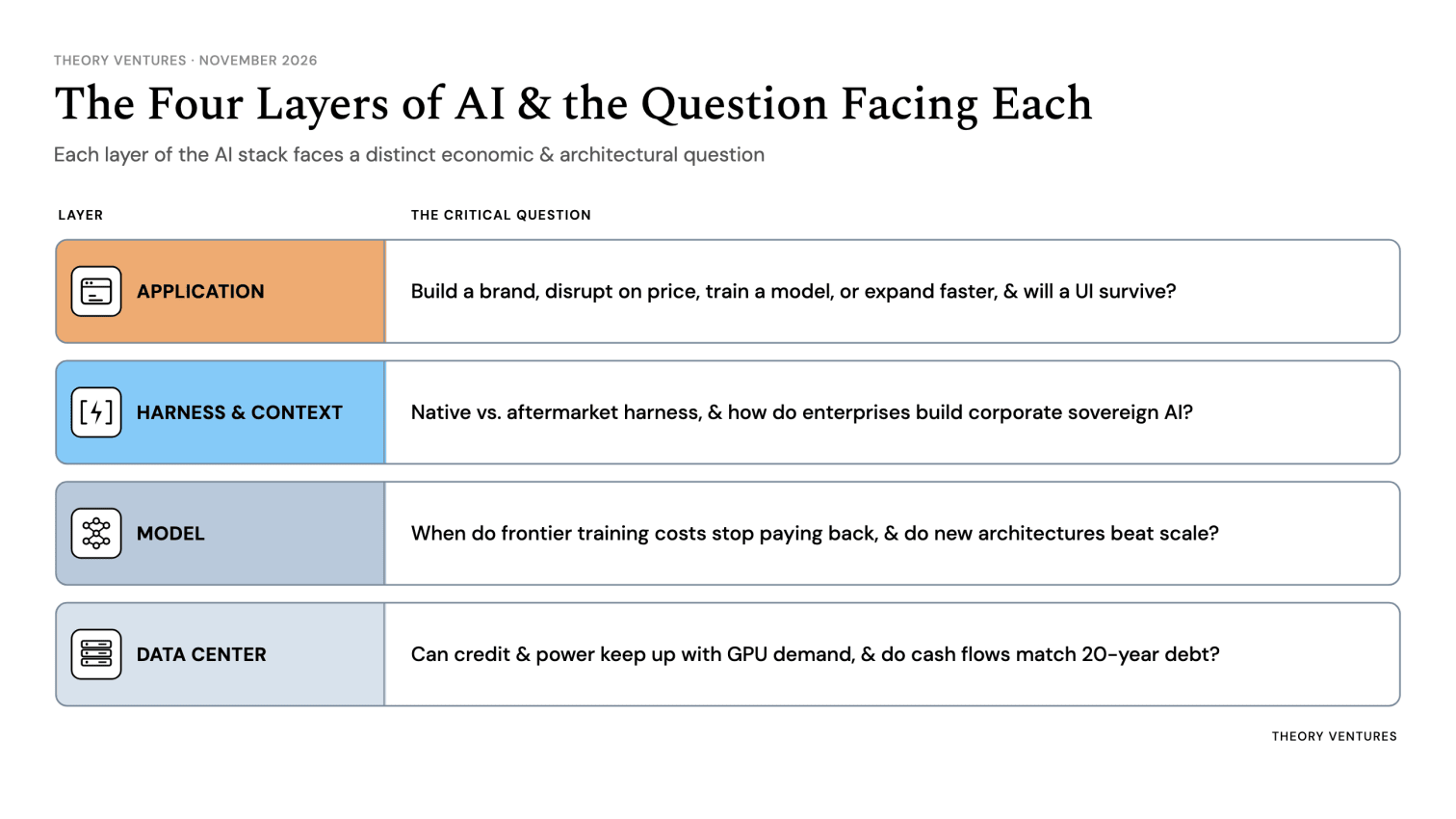
The article breaks the AI stack into four layers, each defined by one open question. At the Application layer, breakout hits appear overnight and the next model release can erase them just as fast. Thin wrappers die when the model absorbs their feature. To build a moat, app companies must choose among building a brand, disrupting incumbents through pricing, developing their own models, or expanding faster than competitors. If applications collapse into middleware, the open question is whether a user interface survives or all applications become middleware harnesses.
The Harness & Context layer determines who owns the harness. Model makers claim their native harness wins, but benchmarks disagree: in the same week, both OpenAI and Anthropic models scored higher in Cursor than in their creators’ own harnesses. Because input context can be up to 98% of all tokens, a smart harness cuts the cost of the same answer by 71% and lifts gross margin from 38% to 75%. Enterprises are also claiming the harness to build corporate sovereign AI: no CIO wants to ship company secrets out the door in a prompt, and owning the context layer lets a company keep memory and permissions in house while swapping models underneath.
For foundation models, the question is at what point training costs don’t pay back. Training a state-of-the-art model costs billions, and recursive self-improvement has not bailed out the big labs. AI writes 75% of Google DeepMind’s production code, yet Google sees no end-to-end speedup in AI research. Rich Sutton’s Bitter Lesson argues that general models scaled with massive compute always win, but SOTA models are losing token share on public gateways because they cost too much to run. About 83% of agent tasks now route to smaller or domain-specific models fine-tuned for one job at a fraction of the bill. Challengers are attacking the training bill through process and architecture: one startup used coding agents to pre-train a competitive coding model with a single researcher for under $10m, while new architectures like diffusion models and JEPA, where a 109m model beat 72b LLMs with 42x less data, bypass brute-force scaling. The bull case for scaling the frontier sits in Anthropic’s S-1: Opus 5.5 cut customer cost per task by 40%, and when Opus 4.5 delivered more capability at a lower cost per task than Opus 4.1, Jevons paradox kicked in and sequential quarterly revenue growth accelerated from 48% to 132%.
Below the models, the Data Center layer faces whether credit and power can keep up with GPU demand. With concrete prices up 3x, strained electrical grids, and backlogs on turbines, generators, and reciprocating engines, the answer for now is no. Unrestrained growth in AI requires $4t in new debt over five years, making the AI credit market larger than global private credit and equal to 91% of the US municipal bond market. Five-year credit default swap spreads have hit records from Meta at 108 bps to Oracle at 322 bps and CoreWeave at 1,090 bps. Local politics and grid delays are blocking new sites, while Ornn’s B300 index has climbed to $12.29 per GPU-hour, roughly 20% CMGR since June. Three open questions hang over the math: whether cash flows match the duration of twenty-year debt and leases, whether GPUs last five years, and whether the price of a GPU-hour will increase or decrease.
The four layers form a coupled system like a double pendulum: simple in each part, yet complex, chaotic, and unpredictable in motion. Profitable applications at the top can sustain inflation in GPU prices and higher borrowing costs at the bottom. New, more efficient architectures can decrease the need for concrete and copper. Surging GPU prices can swing the economics of the whole stack, so none of the four questions stands alone.