Crossing the Trillion Dollar Chasm
Who becomes the first $10 trillion company? The article frames the ‘trillion dollar chasm’ as the race to build a $1 trillion AI compute engine before AI erodes the legacy cash cow paying for the GPUs. It tracks each company’s cloud and AI compute engine toward $1 trillion in annualized segment revenue. Two CEOs have put trillion-dollar revenue targets on their businesses. Andy Jassy said, ‘We believe that AWS can grow north of 40% in each of 2027 & in 2028, & be a trillion-dollar revenue business in the next 5 to 10 years.’ Elon Musk said on SpaceX‘s Q3 call that ‘SpaceX could reach a $500b to $1t annual recurring revenue run rate by 2027.’
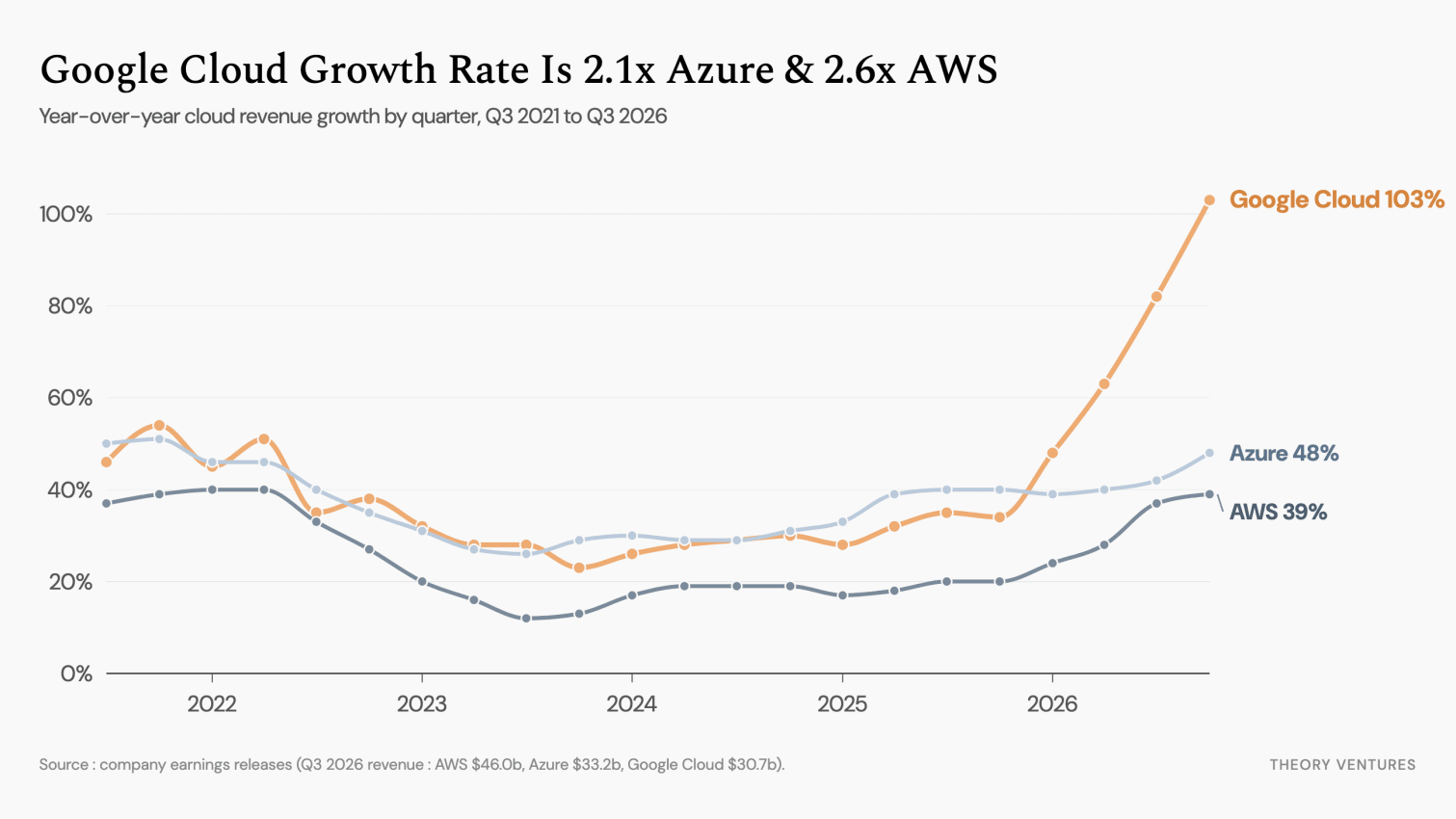
Growth rates are accelerating at every hyperscaler on businesses generating $30 billion to $50 billion per quarter. The article projects the race using current growth rates with a 15% annual decay plus Jassy’s guided 40%+ growth for 2027-2028. On that trajectory, Google Cloud overtakes Azure in mid-2027 and passes AWS by the end of 2027, becoming the largest of the three cloud businesses. Google Cloud and SpaceX both cross $250 billion in quarterly revenue—a $1 trillion annualized run rate—in 2030, and AWS follows in 2032, provided power, silicon, and balance sheets hold.
The market sold off two of the three hyperscalers on earnings day because investors worry that legacy businesses will not sustain positive cash flows long enough to continue capital spending and realize ROI. Alphabet’s Search and other advertising growth slowed to 12% year over year in Q3, reaching $63.3 billion, after 19% in Q1 and 17% in Q2, even though search and visual queries are at record highs and AI Mode queries run three times longer than traditional searches. Philipp Schindler said the strong growth in AI Mode queries had an impact ‘because of the lower monetization we were seeing in AI Mode,’ at a lower rate than classic ten-blue-link search. Amazon‘s retail and advertising machine faces the same question: Amazon Ads generates $19.6 billion per quarter, up 12% in Q3 but down from 26% in Q2. Jassy said the natural question is whether agentic shopping from external horizontal agents is meaningfully impacting Amazon Ads, and the answer is no: few customers are doing much shopping this way yet, because the experience is still not great or convenient enough.
Microsoft is the only hyperscaler whose legacy enterprise franchise is expanding ARPU through AI faster than seat growth is slowing. ServiceNow‘s market cap fell 29% on fears of AI erosion of its seat-based business. The article concludes that Google and Amazon mainly must cross the chasm by refocusing capital and product around hardware, gigawatts, and agentic compute while their historical cash cows absorb AI’s shock. The first $10 trillion company will be the one whose new compute engine reaches $1 trillion before its old monopoly pays the tab.