How Large Is the AI Circle? Comparing AI and Telecom Build-Outs
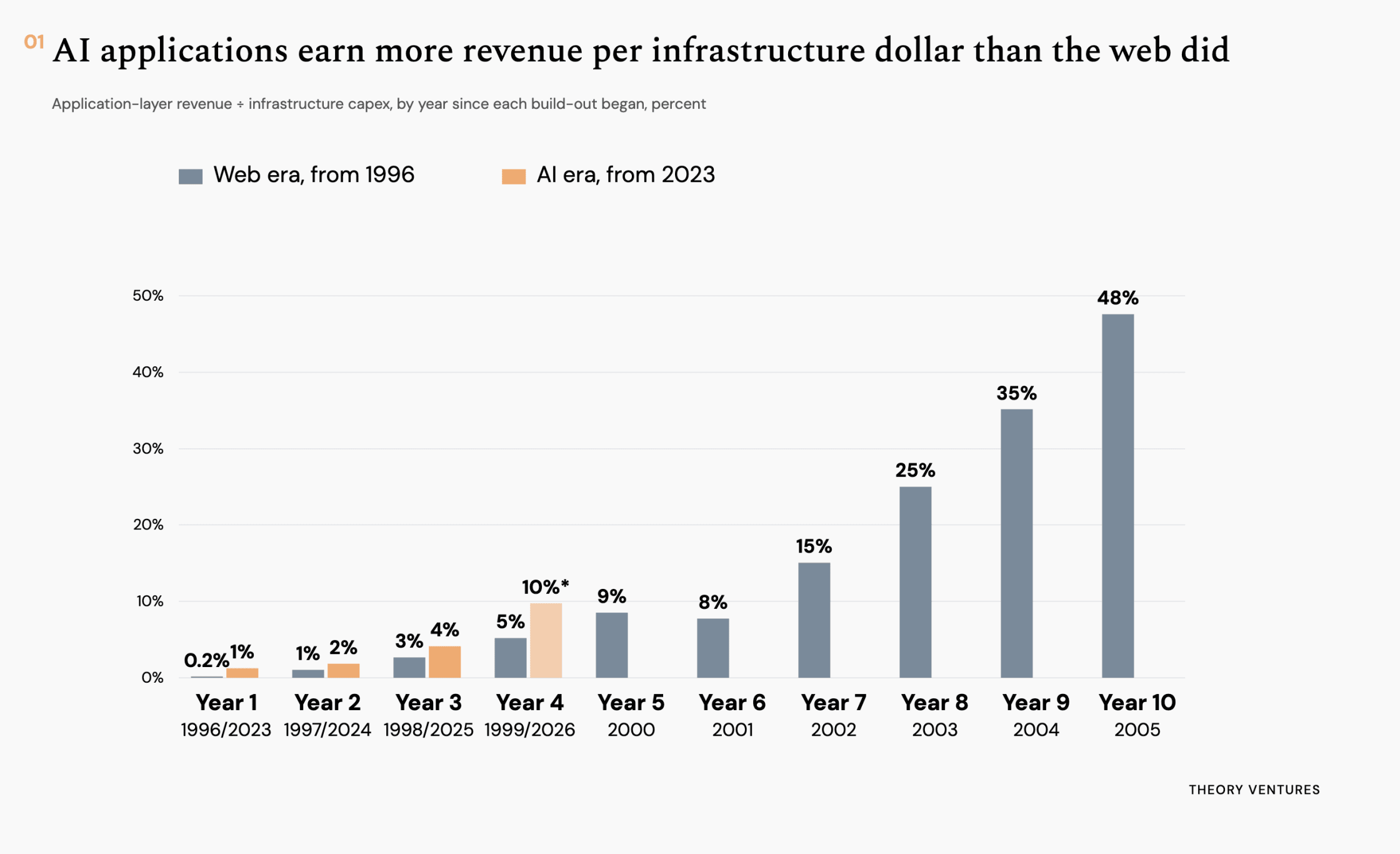
Every major technology build-out follows the pattern Carlota Perez describes: first infrastructure, then the applications whose revenue pays for it. The telecom internet build-out is the benchmark. From 1996 to 2005, American telecom companies spent $1.5 trillion building the internet in today’s dollars, while applications running on that infrastructure generated only $180 billion in revenue. At the 2000 peak, capex ran about twelve times ahead of application revenue; it then took seven years for application revenue to exceed 10% of capex and ten years to reach 48%. The point of the ratio is simple: the shorter the gap between infrastructure spending and application revenue, the sooner the infrastructure pays for itself.
AI is closing that gap faster. The article reports that AI application revenue reached double digits relative to infrastructure capex in its fourth year—roughly half the time the web era took. Where dark fiber needed about a decade to fill with application-revenue packets, AI is getting there in about half that time. Unit economics from companies like SpaceX point to short payback periods on AI infrastructure, around a year.
The investment figures are much larger than the earlier wave. US venture invested $516 billion in the first nine months of 2026, already 44% above the full-year record set in 2021. Inflation-adjusted, the current run-up in venture investment is roughly two and a half times the size of the earlier era, and cumulative venture investment in this wave is about six times the first four years of the web era.
The main risk is circularity: whether the ecosystem is an ouroboros, spending only among startups. Ramp’s data show that 80% of the largest AI spenders are venture-backed. But the article puts that circularity in context: venture-backed firms now account for more than 13% of American employment, up from about 5% during the web era. The circularity is real, but the circle is a sixth of the economy—far larger than the startup-only loop people might assume.