Benchmark’s Full Partnership Takes the Main Stage at Disrupt 2026
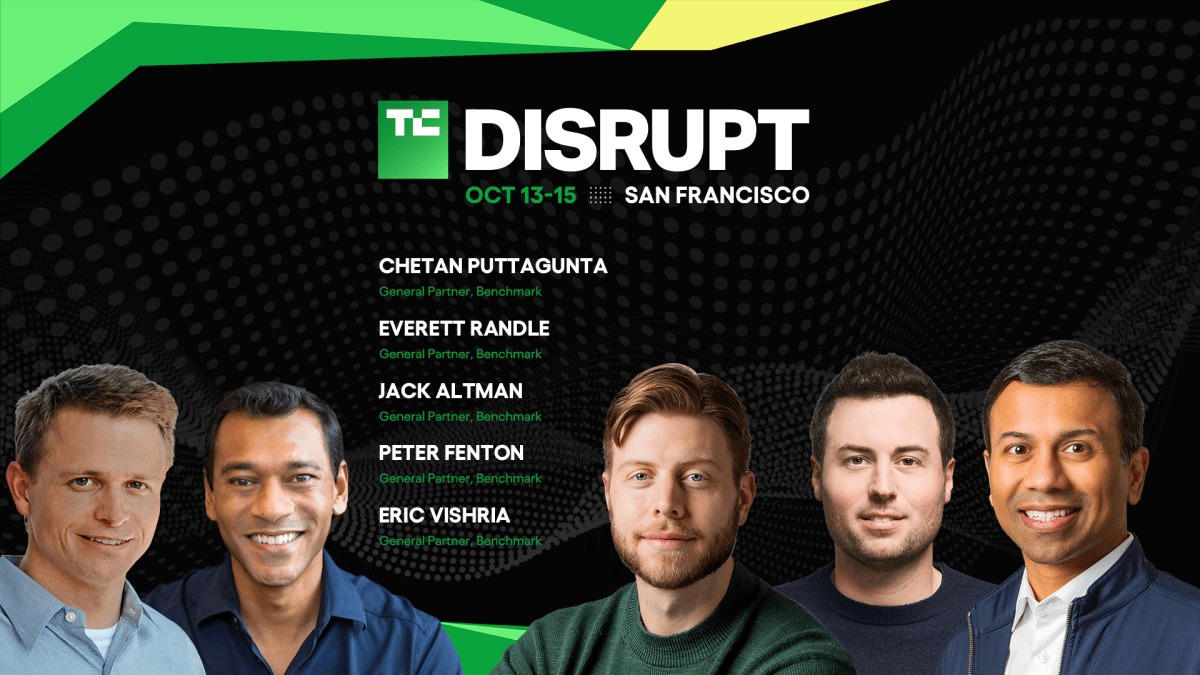
At TechCrunch Disrupt 2026, the full Benchmark partnership will take the main stage together for the first time. Jack Altman, Peter Fenton, Chetan Puttagunta, Everett Randle, and Eric Vishria are scheduled for a session called “What We Believe Now,” focused not on venture capital’s history but on where the next generation of startups will come from, which assumptions founders should reconsider, and which opportunities the partners say are still hiding in plain sight. The appearance follows a major shift in Benchmark’s own playbook: this year it raised approximately $2 billion across a $750 million flagship fund and its first $1.25 billion growth fund. The article frames that move as Benchmark responding to a changed market, and the stage discussion is meant to explore what the firm sees next.
The market context is heavily shaped by AI. According to OECD data cited by TechCrunch, AI companies captured 61% of global venture capital investment in 2025 — $258.7 billion of the $427.1 billion invested overall. That capital was very unevenly distributed: deals worth more than $100 million represented roughly 73% of total AI investment value. The result, as the article describes it, is a strange environment for founders: strong appetite for technology businesses alongside intense competition for a relatively small number of companies investors believe can become category leaders. The session is expected to address questions like whether the application layer is overcrowded, whether defensibility sits in models, infrastructure, proprietary data, or distribution, and what makes one company investable when products can be built faster than ever.
The five partners bring different routes to the firm. Altman joined Benchmark this year after founding Lattice and building Alt Capital, which had raised $425 million across its early-stage activities. Fenton has investments spanning consumer and enterprise companies, including current AI bets such as Sierra, Digits, and Sema4.ai, and has been a director through seven successful IPOs, including Twitter, Elastic, New Relic, Zendesk, and Yelp. Puttagunta focuses on early-stage enterprise software, with investments including MongoDB, MuleSoft, Elastic, Modern Treasury, Legora, and Stytch. Randle invests across stages and categories, with investments that include Anthropic, SpaceX, Rippling, Flock Safety, Gumloop, and Chainguard. Vishria focuses on early-stage infrastructure and enterprise software, with investments including Amplitude, Confluent, Fireworks.ai, and Cerebras Systems, and previously co-founded RockMelt before its acquisition by Yahoo.
A Cerebras anecdote illustrates the kind of thinking the session is meant to surface. Vishria recently told TechCrunch he almost didn’t take his first meeting with the AI chip startup in 2016 because hardware was outside Benchmark’s comfort zone and the planned product looked extraordinarily difficult. He changed his mind by the third slide. Benchmark went on to co-lead Cerebras’s $25 million Series A, and a decade later Cerebras went public with Benchmark holding a 9.5% stake at the IPO. The story is presented as an example of the best opportunities not always looking like consensus winners, and of changing your mind being more valuable than being right from the start.
The article encourages founders to come ready to disagree, not because Benchmark is automatically right, but because seeing how experienced investors assess markets, teams, and opportunities offers another way to interrogate assumptions. It also notes the discussion matters beyond venture because investment decisions are bets on which technologies, business models, and founders could shape the next decade. TechCrunch Disrupt 2026 runs October 13–15 at San Francisco’s Moscone West, with more than 10,000 founders, investors, operators, and innovators across six stages. Pass prices increase after September 25 at 11:59 p.m. PT, and group passes for four or more are eligible for an additional 30% discount.