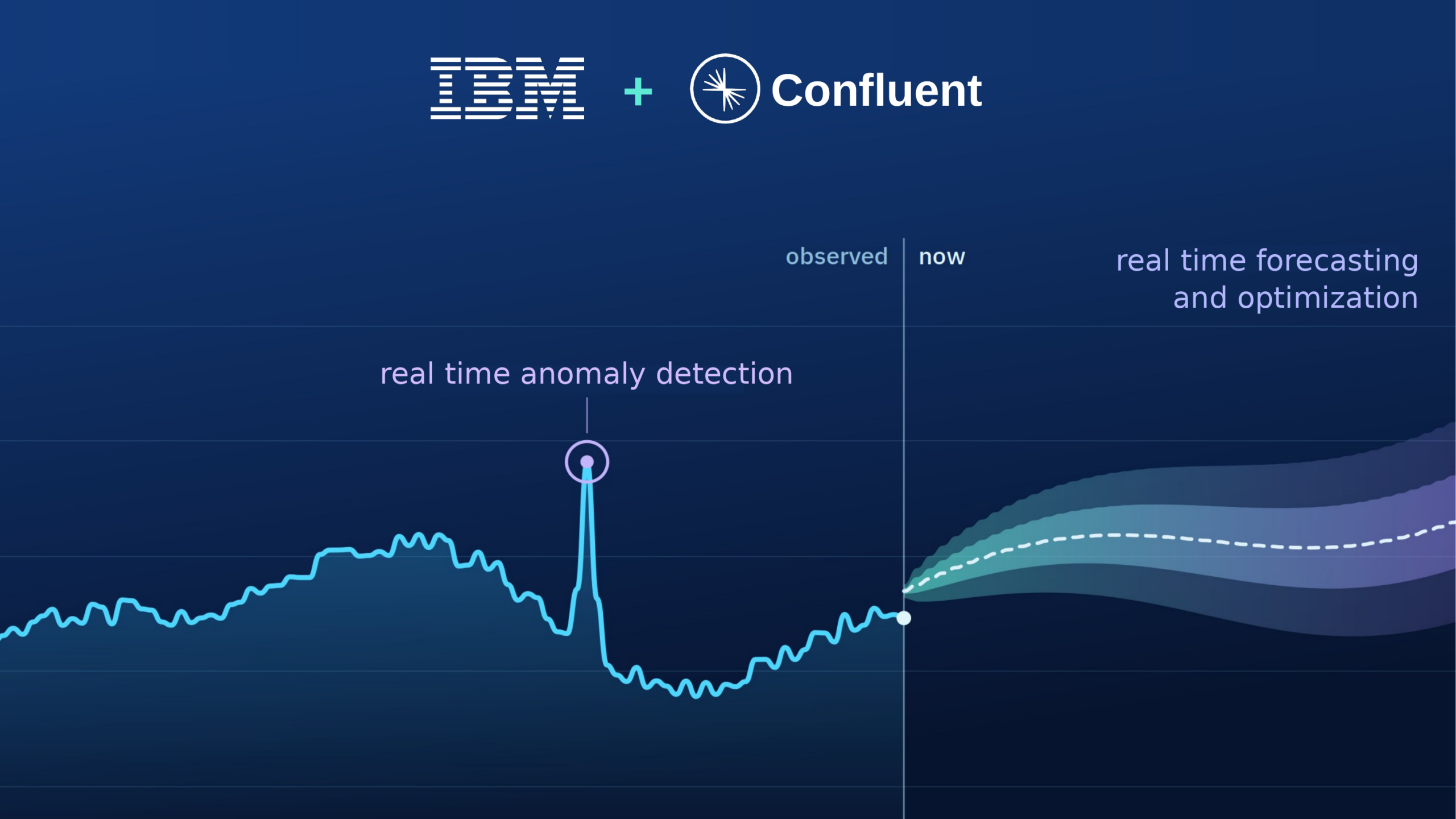
Real-Time Intelligence with IBM Granite Time Series Models on Confluent
IBM and Confluent have partnered to bring time series foundation models directly into Confluent Cloud’s streaming platform, available now in Early Access.
The core insight is that most business-critical decisions—how much to order, which payment to stop, when equipment will fail—depend on streaming data, yet have historically required months of bespoke modeling per series.
This forces teams to model only the few hundred most valuable series and cover the rest with expensive safety margins.
Time series foundation models (TSFMs) change this by generalizing across vast, varied signals to forecast, detect anomalies, find similar historical patterns, and optimize settings on unseen series without per-series training.
IBM’s Granite TSFM family includes four models: PatchTST-FM (full distribution forecast per variable), FlowState (continuous-time dynamics for varying sampling rates), TTM (efficient tiny model for large-scale CPU inference), and TSPulse (multi-task model for anomaly detection, classification, gap-filling, and similarity search).
These are called from Confluent Flink SQL via the existing AI_FORECAST and AI_DETECT_ANOMALIES functions, requiring only one parameter to switch models.
Inference runs natively in Confluent Cloud, eliminating separate ML infrastructure, GPU costs, and cloud egress/data movement. The text details four use cases.
Forecasting: a demand planner points one model at the entire catalog instead of per-SKU models, receiving distributions usable for service-level policy; results land on Kafka topics triggering replenishment, allocation, and markdown decisions, reducing stockouts and working capital.
Anomaly detection: the model maintains a per-entity sense of normal and scores every payment/event in flight; it transfers to new entities immediately and is continuously customized on the stream, enabling fraud detection that adapts to adversaries.
Production optimization: a process engineer conditions the forecast on controllable settings to run a simulator; an optimizer searches against stated KPIs and constraints, re-optimizing as inputs change, with gains of 5–10× productivity and seven-figure impacts on high-volume operations.
Semantic intelligence: embeddings from the models capture the shape of a time window; available for similarity search (“have we seen this before?
“), classification, and gap-filling, providing context for AI agents.
Key platform benefits include: zero configuration (Confluent manages serving, scaling, credentials); fresh enriched context from streaming data; built-in governance and traceability (same schemas, lineage, access controls); cost efficiency (no dedicated GPU infrastructure, no ingress/egress fees); enhanced security (data stays in Confluent Cloud); and faster time to value (minutes from streaming data to working forecast via SQL).
The partnership also provides a suite of four models selectable by a single SQL parameter, covering different trade-offs in horizon, number of series, variable count, and training need.
They are all available on Hugging Face with open weights, and IBM’s enterprise AI governance framework applies. Confluent Cloud is the starting point, with Confluent Platform (on-premises) following.
The feedback loop from design partners shapes future improvements.