Vivodyne’s robotic labs aim to fix AI drug discovery’s missing human data
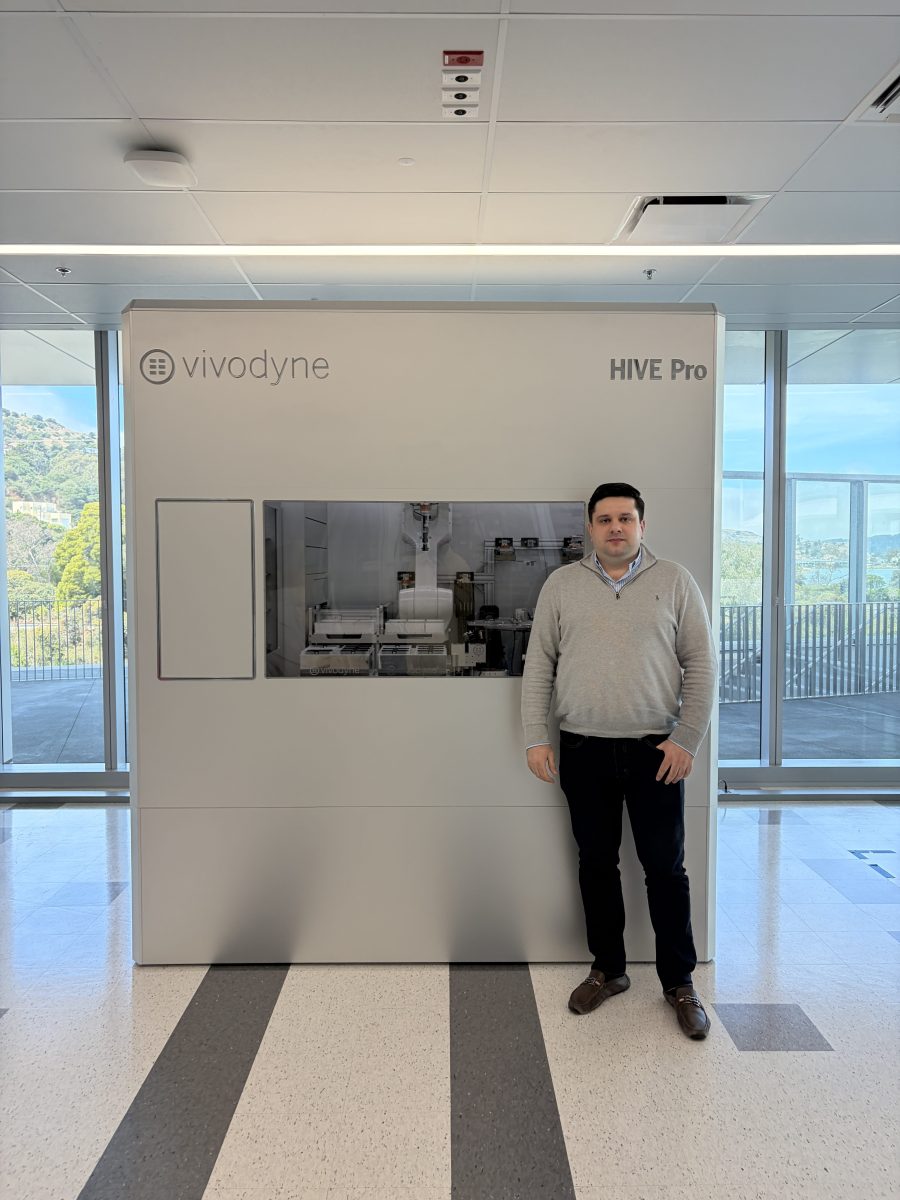
A biotech startup called Vivodyne argues that AI drug discovery is stalled by a data problem: today’s models are trained mostly on animal tests, single cells, or static snapshots of proteins, not on living human tissue. The company’s answer is HIVE, a modular robotic lab system that can grow 20 kinds of human tissue, then autonomously dose and monitor those tissues to generate causal biological data. CEO Andrei Georgescu frames the gap bluntly: absent human testing, AI models are going to cure cancer in mice. Even Anthropic CEO Dario Amodei recently wrote that claims AI will cure cancer have become more cliche than credible, adding that what will actually work is curing cancer.
The broader industry has produced few concrete wins. A handful of AI-designed drugs have entered human trials, with one reaching Phase III, but AlphaFold has not yet produced a new drug, and Isomorphic Labs now expects its first trials by the end of this year after originally planning them for 2025. Georgescu says the field needs a sanity check, noting that the pharmaceutical industry already loses 90% of drugs that succeed in animal testing when those drugs enter clinical trials and fail to win regulatory approval.
Vivodyne was spun out of the University of Pennsylvania in 2021 after Georgescu completed a PhD in bioengineering there. The company says its lab-grown tissues closely match human organ behavior: its liver cells show 94% predictive accuracy against human toxicity trials, its airway tissue matches real human tissue behavior 96% of the time, and its bone marrow achieved 100% concordance when tested against 20 chemotherapy drugs. Last week, with just under $80 million raised across two rounds led by Khosla Ventures, Vivodyne opened what it calls the world’s largest human data center outside San Francisco. Georgescu says the team is already achieving twice the throughput of all animal trials held in the US.
The near-term goal is to give drugmakers confidence before expensive clinical trials, which typically cost tens of millions of dollars. Vivodyne compares this to automotive crash testing: an automaker usually expects its car to pass NHTSA requirements, but drugmakers rarely have that same certainty before trials where most drugs fail. The company won’t name its partners publicly but says it works with multiple major pharma companies.
Longer term, Georgescu sees HIVE as a source of causal training data for new AI models. He points to a Nature Methods study from last month finding no clear data scaling laws when generative AI models are trained on existing cellular data. Existing models learn cell states but never learn that cell state B is the effect of inflaming cell state A, because the data lacks temporal causality. HIVE machines track hundreds of thousands of ongoing experiments in which diseased tissue is exposed to stimuli, which Georgescu expects will enable a form of reinforcement learning for human biology. He argues causality will matter even more for combination therapies, where the search space explodes and cannot be explored experimentally alone: to get a desired effect, you need to know what cause to invoke.