Aftermarket Harnesses: Coding Runtimes Trump Models
A new report from Endor Labs‘ Agent Security League shows that the coding harness—the runtime and tooling around a model—now affects benchmark scores more than the model itself. Running the same model through different harnesses in the same week produced large swings: OpenAI’s GPT-5.5 scored 61.5% functional correctness in its native Codex harness but 87.2% in Cursor‘s harness, a 25.7-point jump. Anthropic’s Claude Opus 4.7 scored 87.2% in Claude Code and 91.1% in Cursor. Both frontier models performed better in a competitor’s harness than in their own maker’s.
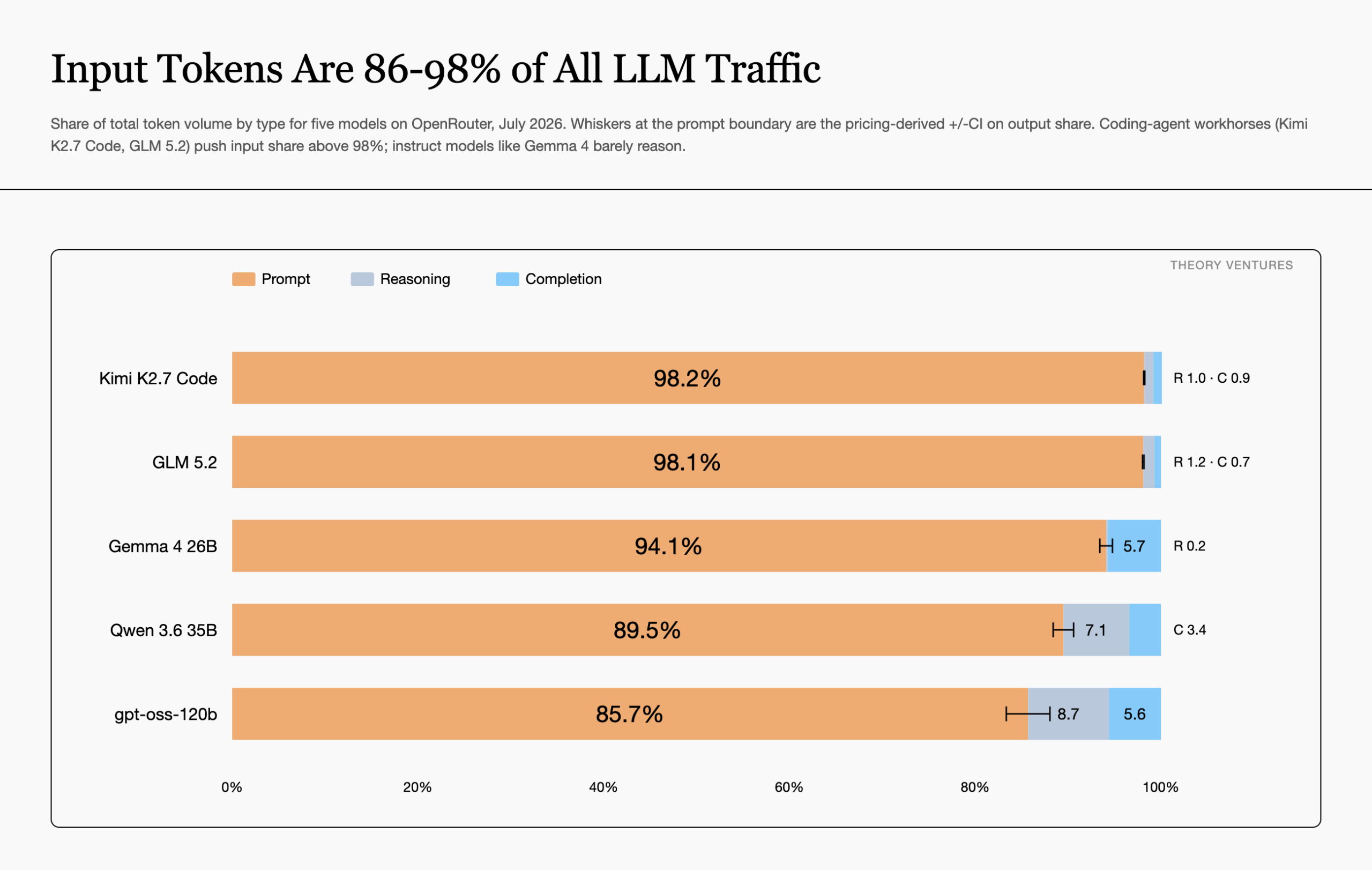
The economic impact is equally tied to the harness. Input tokens account for 86–98% of all LLM traffic on OpenRouter. Although output tokens cost 5× more per token, the sheer volume of input means it dominates the bill. Harnesses control which context is sent and how much repeats across queries. Intelligent caching can save 40–80% of input costs. A study across 500 long-horizon agent sessions found 41–80% cost reduction and 13–31% faster time-to-first-token, with savings scaling linearly from 500- to 50,000-token prompts. The best strategy was caching only the stable prefix and placing dynamic content after the cache breakpoint.
Cursor‘s harness matches Claude Code technique-for-technique: dynamic tool fetching, priority-based prefix assembly, two-tier caching. That explains why Opus 4.7 scored higher in Cursor than in Claude Code, and why GPT-5.5 nearly doubled its score outside Codex. First-party co-design—where the harness, cache API, and model are built together—can achieve real cache discipline. Claude Code, for example, treats cache hit rate as an uptime metric, hits about 96% in real sessions, shares system-prompt caches across users on the same version, and builds forked sub-agents at 99% byte-identity for 90% savings. But the discipline lives in the harness, and a third-party harness can match it, as Cursor demonstrates.
The harness has shed its reputation as a simple model wrapper. It is now a decisive layer that can push AI performance further than the model alone can achieve. For builders, choosing or designing the harness—not just the model—is becoming a primary lever for both quality and cost.