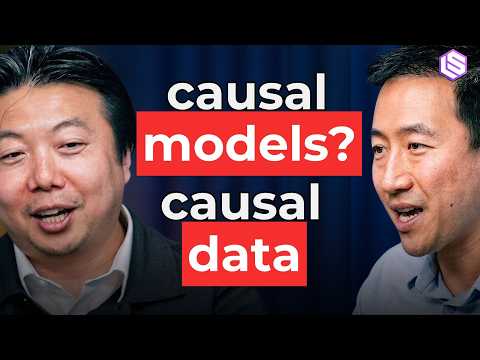
Xaira Therapeutics‘ X-Cell is a 4.9-billion-parameter diffusion language model that predicts how a cell responds to a genetic perturbation it has never seen. The model addresses a core bottleneck in cell biology: observational atlases can describe what cells look like, but they cannot predict what happens when you intervene. To train X-Cell, Xaira built X-Atlas/Pisces, the largest genome-wide CRISPRi Perturb-seq dataset ever created, spanning 25.6 million single cells across 16 biological contexts. Bo Wang (Chief AI Scientist) and Ci Chu (Chief Discovery Officer) emphasize that causal models require causal data—perturbation experiments, not just static profiles.
The architecture departs from typical autoregressive sequencing of gene expression. Instead, X-Cell uses a diffusion process: it starts from a noisy version of the perturbed cell state and iteratively refines it, a method the team analogizes to editing a rough draft rather than typing from scratch. The model is initialized from scGPT’s encoder weights, one of the first single-cell foundation models, which Wang’s lab previously pioneered.
A key result is that X-Cell can generalize from immortalized cell lines to primary T cells from real donors—a jump in cell type that linear baselines cannot match. Scaling behavior reveals an important insight: training loss follows a clean power law like large language models, but generalization is limited by the diversity of the training data, not by compute. The team built seven genome-wide Perturb-seq campaigns and found that adding more contexts improved out-of-distribution performance more than simply adding more cells per context.
The conversation also touches on future directions: incorporating spatial transcriptomics, combinatorial perturbations, and temporal sequencing of live cells (which current technology cannot do without killing the cell). Both Wang and Chu stress that the limiting factor in AI-driven biology is high-quality, systematic causal data, and they advocate for academia to focus on generating such data rather than chasing model scale. In the agentic AI era, the scientist’s role shifts from writing code to debugging AI outputs—a paradigm that demands new skills and closer integration between experimentalists and modelers.