NVIDIA NeMo AutoModel: 3.7x Faster MoE Fine-Tuning with One Import Change
Fine-tuning Mixture-of-Experts (MoE) models at scale creates a tension between model complexity and training efficiency. Routing tokens across hundreds of experts, fusing expert matmuls, and overlapping communication with computation all require infrastructure beyond general-purpose libraries like Transformers v5. While Transformers v5 added first-class MoE support through expert backends, dynamic weight loading, and tensor parallel plans, distributed training of large MoE models still struggles with memory pressure and communication overhead, especially when trying to fit a 550B parameter model onto GPU clusters.
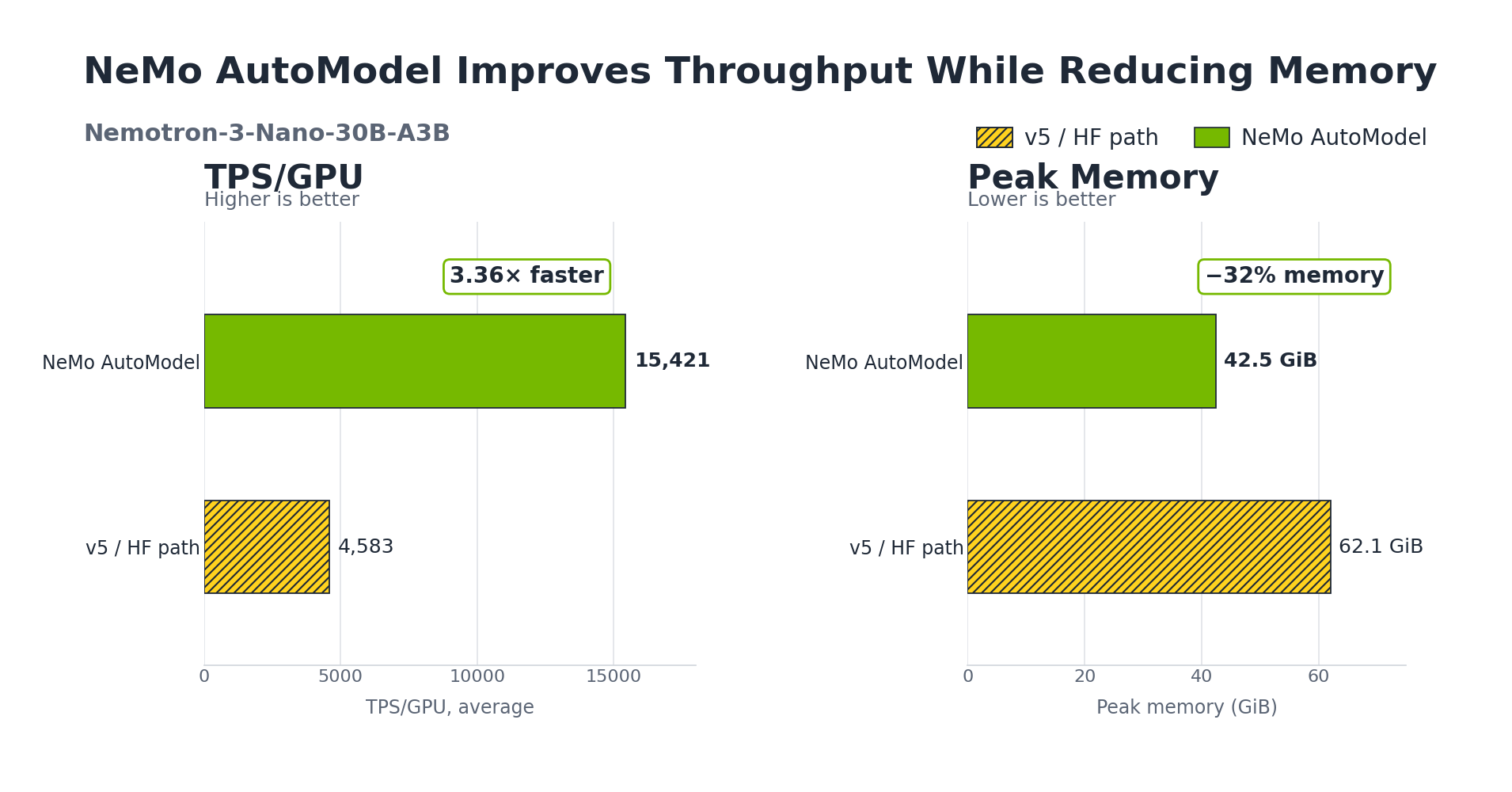
NVIDIA NeMo AutoModel addresses this by subclassing AutoModelForCausalLM and layering on Expert Parallelism, DeepEP fused all-to-all dispatch, and TransformerEngine kernels. The key innovation is making Expert Parallelism its own dedicated parallelism dimension, orthogonal to data parallelism, so every GPU trains on its own data shard while holding only 1/8 of the expert weights. On top of this, DeepEP fuses token dispatch and combining into optimized GPU kernels, overlapping communication with expert computation. The result is 3.4-3.7x higher training throughput and 29-32% less GPU memory compared to native Transformers v5. For the 550B Nemotron 3 Ultra model across 16 nodes, Transformers v5 runs out of memory entirely, while NeMo AutoModel completes the full fine-tune at 58.2 GiB per GPU.
For serious builders, the practical takeaway is that NeMo AutoModel delivers these gains through a single import line change, with no other code modifications. The API compatibility means existing HuggingFace workflows continue to work, while save_pretrained() emits standard HF checkpoints deployable on vLLM and SGLang. The progression from v4’s eager for-loop to v5’s grouped_mm to NeMo AutoModel’s DeepEP+grouped GEMM+TransformerEngine kernels represents a clean optimization stack that composes reuseable infrastructure instead of per-model plumbing. This makes Expert Parallelism practical at scale without requiring users to rewrite their training loops.