Agent Factory: 100X Engineering with AI Agents in Google Antigravity 2.0
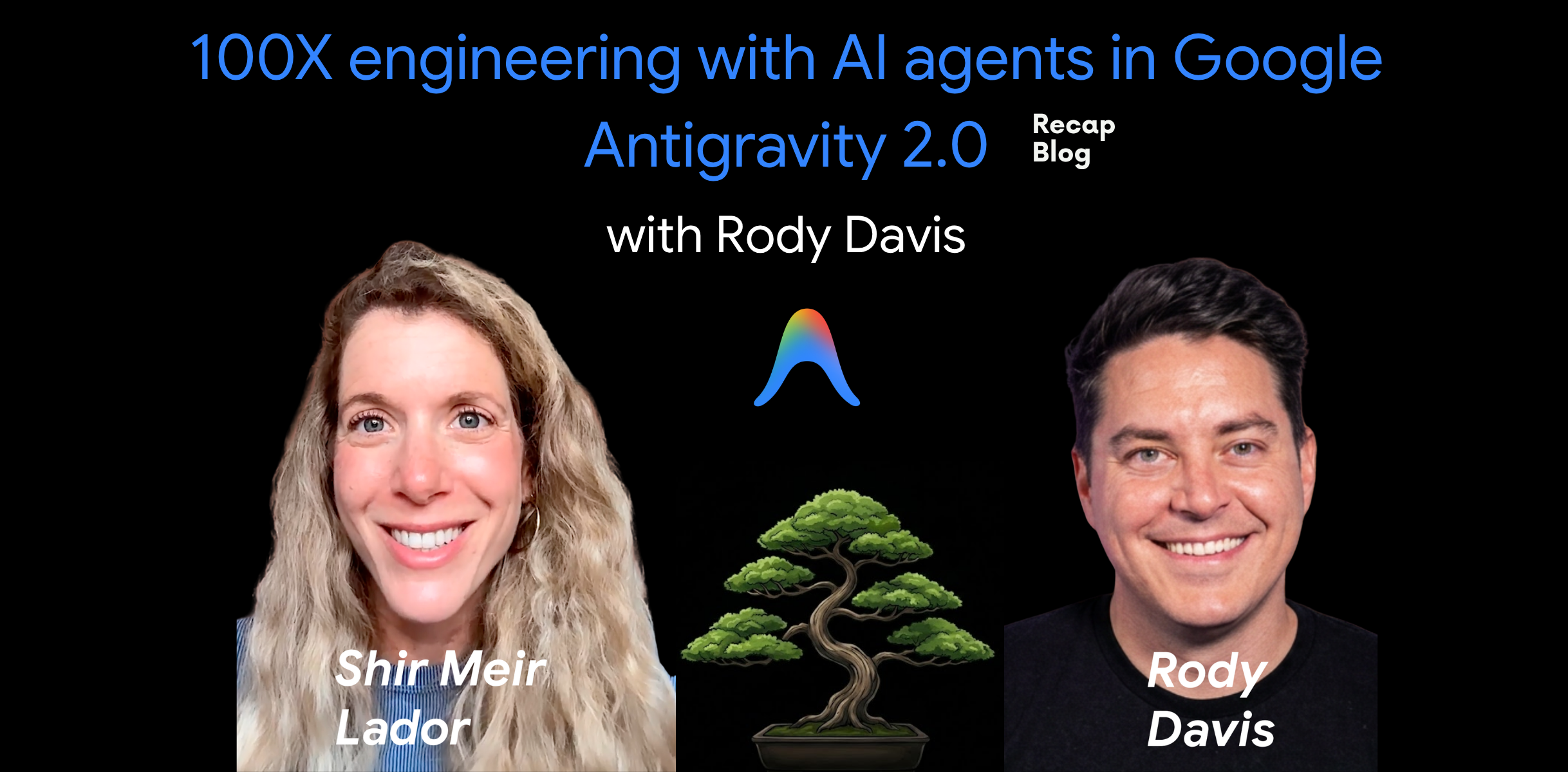
In this episode of Agent Factory, host Shir Meir Lador interviews Rody Davis, a Google agentic engineer, about the shift from traditional IDEs to agent-first platforms using Google Antigravity 2.0. Antigravity 2.0 has evolved into a full-scale agent-first platform with four core pillars: a standalone desktop Agent Manager for orchestration, a robust CLI for server-side work, an SDK for custom Python-based workflows, and a specialized IDE. This unbundled approach lets developers compose their own environment, managing multiple folders and complex project structures without being forced into a single workspace.
Rody Davis explains his strategies for 100X engineering, focusing on reducing ‘cognitive toil.’ He uses agents to accelerate the entire lifecycle, such as writing richer test suites and prototyping multiple versions before committing to a framework. A core philosophy is the use of ‘Skills’ as context cheat sheets that compress information for the model, making it faster and more accurate. He also discusses customizations like Android CLI, modern web guidance, and MCP servers for hot reloading.
On code review, Rody advocates a ‘Bonsai approach’ to maintain flat architectures with strict separation of state, UI, and data, making it easy to steer agents. For frontend tasks, he reviews visual output rather than code, but for backend logic, he focuses on API contracts and schemas. He recommends writing the first example manually so the agent can copy the pattern. Rody also demonstrates building a custom macOS Finder extension to solve daily file management friction.
Rody still writes code by hand, enjoying languages like Go, and emphasizes understanding fundamentals deeply. He showcases his personal website powered by Gemma 4 and Embedding Gemma for offline content recommendations via vectorization at compile time. The Factory Floor segment includes a live demo of multi-agent parallelism: using a single voice prompt to build a full-stack multilingual note-taking app (Vite, Go, SQLite, Docker Compose) with parallel sub-agents for DevOps and QA.
Rapid-fire predictions: Rody believes a non-technical founder will launch a company using only vibe coding by 2026, but maintenance will be challenging. He predicts vibe coding will cause significant production failures, creating consulting opportunities for engineers. He argues that poor codebase health, not context windows, is the biggest bottleneck in AI speed. His final advice: focus on solving problems, use AI for better communication handoffs, and make artifacts ready to approve upon handover.