The Minimill of AI: A Local Task Routing System
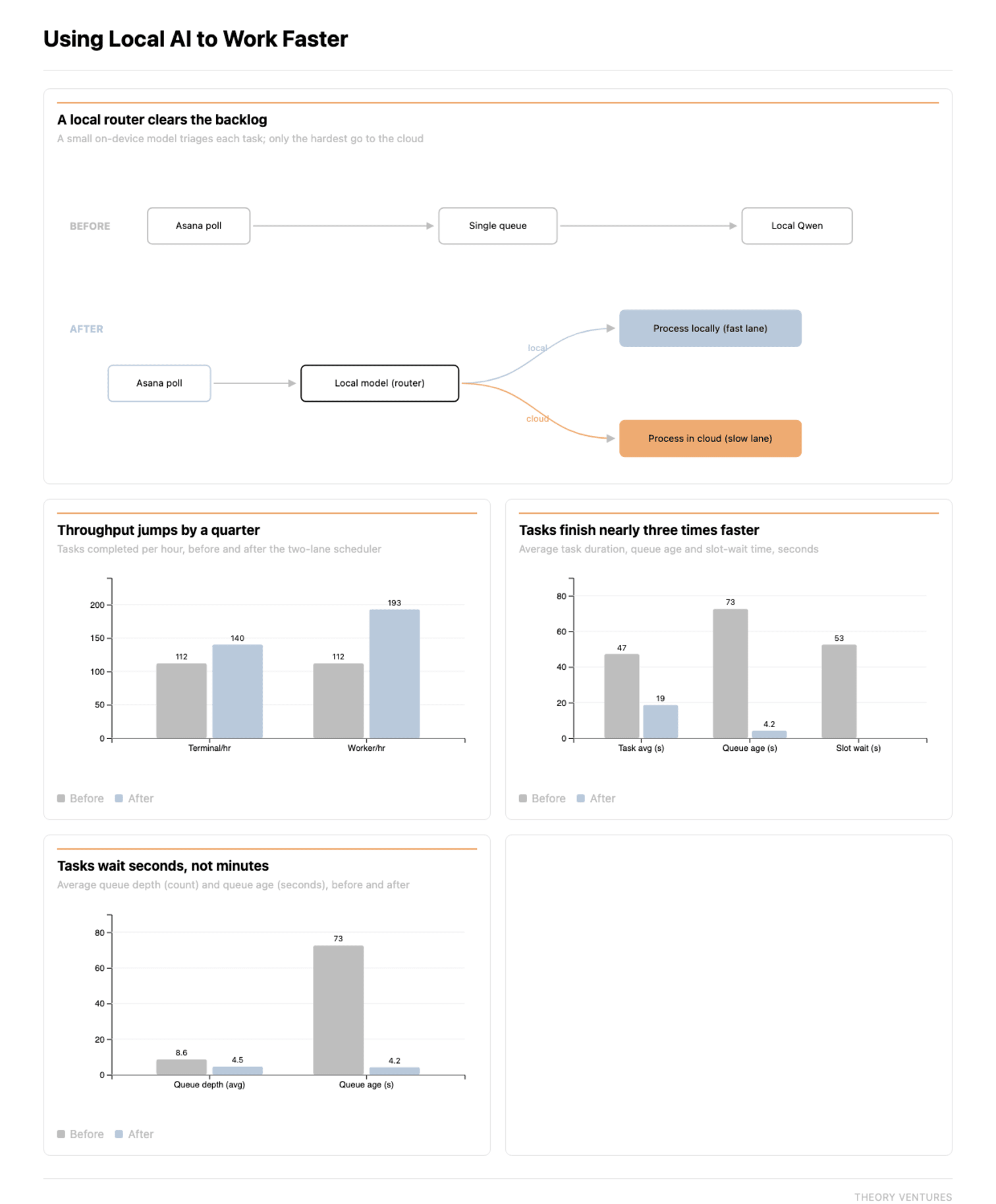
The author describes a personal AI task routing system built around skill distillation. Tasks created in Asana are classified by an agent as easy or hard.
Easy tasks are handled locally by a distilled model on a Mac laptop, while complex tasks are routed to a cloud model. Over seven days, 78% of work stayed local, with daily peaks reaching 88%.
The two-lane design improved throughput by 25%, reduced average task duration from 47 seconds to 19 seconds, and cut queue age from 73 seconds to 4 seconds—a 94% drop.
The system is likened to Nucor’s minimills: capital-light, local, and close to demand.
The author argues that any laptop, phone, or edge device with enough memory for a distilled model can become a similar minimill, handling most work locally and paying cloud rates only for the hard fifth.
The system is presented as a proof-of-concept for distributed, efficient agentic work, with the cloud reserved for the most complex tasks.