When the Central Bank of AI Changes Chairs
For the past four years, Jensen Huang ran what the article calls the Central Bank of AI. Today he resigned as chief executive of Nvidia. The article asks what the implications are for the AI economy and answers with a five-point list spanning finance, open source, trade policy, and silicon design.
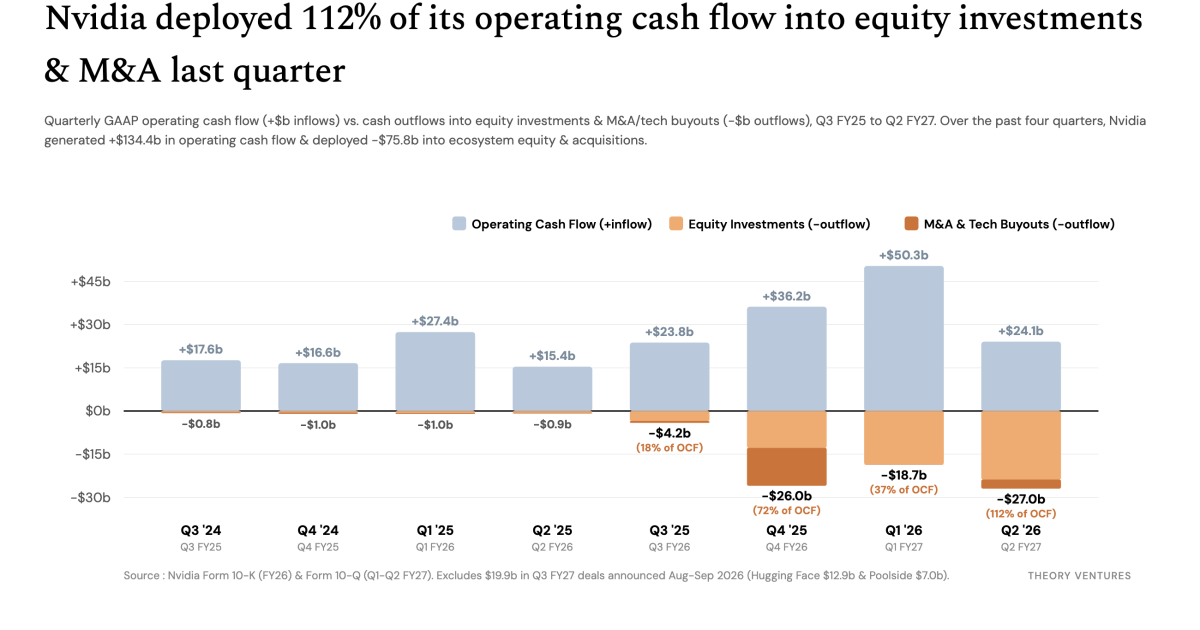
The first implication is a potential tightening of policy. Over the past two years, Nvidia committed $42 billion to M&A and technology buyouts; invested $61 billion of cash on a cost basis into equity stakes across 229 startups and 13 public companies; extended $164.5 billion in lease guarantees and cloud capacity backstops that require capital reserves; and carried $63.1 billion in customer receivables, where payment terms now stretch up to a full year. Under a more financially disciplined regime facing heightened board scrutiny, any tightening of those equity checks, payment terms, or lease backstops will slow AI buildouts just as the broader economy slows when the Federal Reserve tightens credit.
Second, Nvidia fused the startup and chip ecosystems in a way the industry has never seen. Under Huang, Nvidia acted simultaneously as chip supplier, lead venture investor, anchor cloud customer, and lease guarantor across more than 200 startups. Those deals ran on Huang’s personal conviction and relationships. Nvidia now needs a leader who can sustain these founder partnerships without the co-founder who built them.
Third, open-source startups lose their primary patron and buyer. Nvidia has been the single largest buyer and financier of American open-source AI companies, committing $22 billion to its Nemotron stack across Hugging Face, Poolside, and Essential AI. No other company has bought open-source teams at scale. Meta, Google, and at least eight US startups that have raised $100 million or more continue to train open-weight models, and they will now have to carry more of the American open-source mantle themselves.
Fourth, the episode likely increases pressure in Washington for stricter semiconductor export controls and compliance rules. Fifth, it opens an opportunity for custom silicon. Custom AI ASICs already account for 28% of AI server shipments and 15% to 20% of accelerator revenue in 2026, led by Google’s TPUs at 65% of the custom silicon market, alongside AWS’s Trainium3, Meta’s MTIA, and Broadcom’s custom XPUs. Leadership turbulence at a single-source supplier accelerates that shift.
The change of leadership at the Central Bank of AI is described as a pivotal moment for the industry. It is hard to overstate how central Nvidia has become to startup financing, M&A exits, and policy across the fastest-growing segment of the US economy. A sudden transition at the top introduces real uncertainty into the market, and especially in startups.