What FDE Means at OpenAI: Closing the Deployment Gap
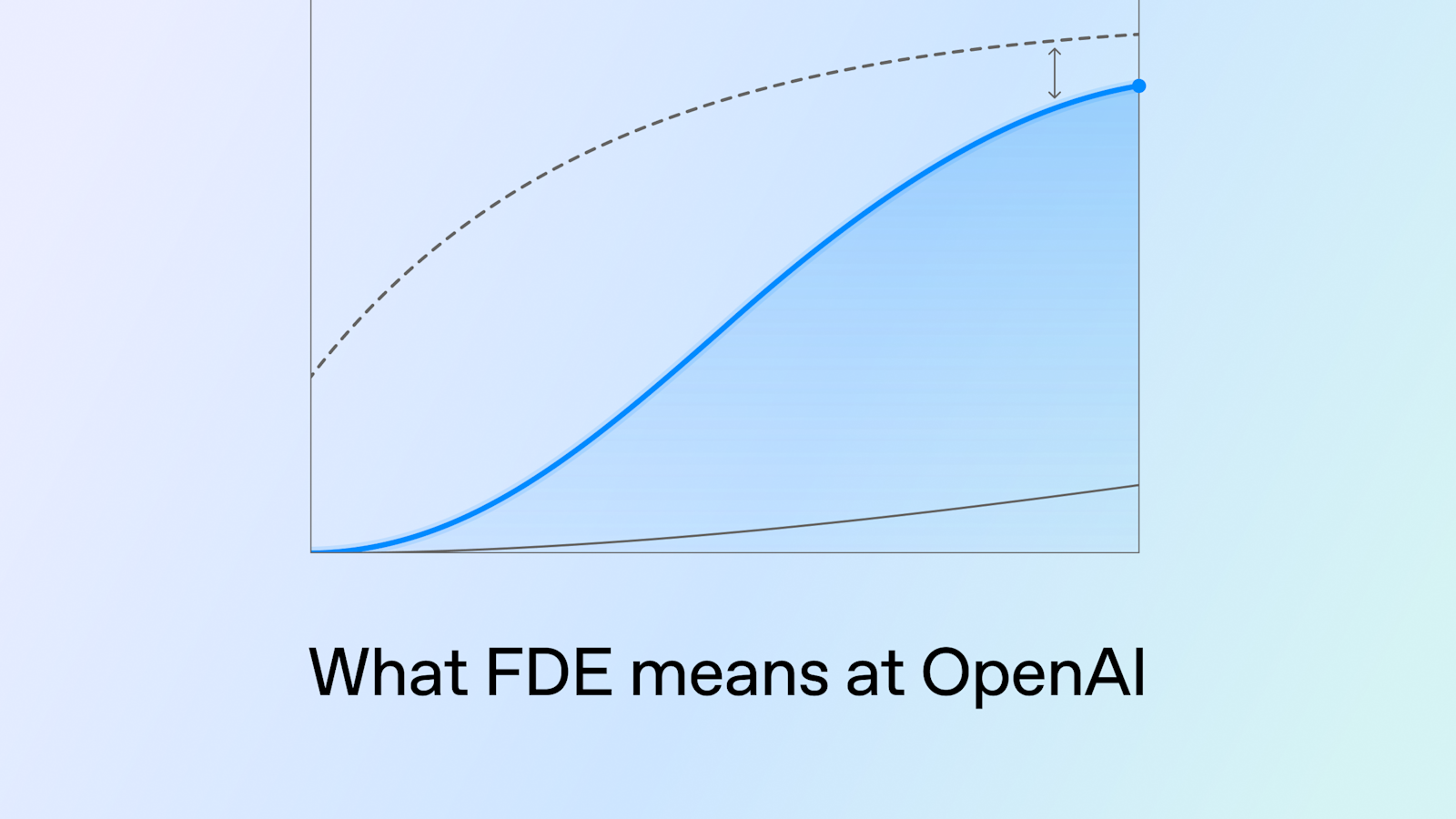
OpenAI’s Forward Deployed Engineer (FDE) team, founded in early 2025, exists to close what the company calls the ‘deployment gap’: the distance between what models appear capable of and what people can reliably use in real work. The team embeds with customers on their hardest problems, builds solutions that hold up in production, and feeds what it learns back into OpenAI’s products and Research.
With John Deere, FDEs helped make personalized farming advice scalable. See & Spray, the company’s precision weed-control technology, uses cameras and machine learning to identify weeds and spray only them rather than entire fields, reducing chemical use by up to 70%. The practical value depends on farmers configuring the technology, planning their season, and adjusting practices as conditions change. John Deere deployed OpenAI’s APIs to answer farmers’ questions in natural language, give tailored setup guidance, and help them understand the value the technology delivers.
In mid-2025, around 15 FDEs worked with a large semiconductor customer on 10+ use cases to make chip verification AI-native, covering directed test generation, root cause analysis and debugging, and an architecture assistant. Verification can take about 70% of a project’s effort in that industry. Some FDEs had joined days earlier and never worked in semiconductors; they embedded with the customer’s verification team, studied chip design, and built evals with engineers. Custom harnesses followed, and within the first 3-6 months all use cases reached production. Reported results include roughly 48% time saved through AI-based directed test generation and a 22% median performance improvement from kernel optimization, with weeks of debugging compressed into hours.
To keep those results from being one-off integrations, the team rebuilt the use cases around Codex. Custom applications became plugins and skills on common Codex primitives, and Codex replaced the separate terminal UIs and CLIs written for individual use cases. That removed roughly 90% of the custom code per project. Extending a solution from one team to another became as simple as swapping connectors or MCP servers and building fresh evals; in an August 2026 example, the initial deployment took two months and the second team came online in one day. The explicit goal is to make the FDE team obsolete for each class of problem: if the next customer doesn’t need FDEs to solve it, the engagement did its job.
OpenAI’s enterprise voice and chat product, Presence, grew out of these deployments, beginning with Swarm and the Agents API; one customer now handles more than half of its calls with AI. With Thrive Holdings, FDEs and researchers built Tax AI for accounting firms in Crete. In its pilot, Tax AI processed 7,000 tax returns and raised throughput by about 50%. Automating rental-property returns was the hardest piece, taking six weeks of engineering and practitioner review to reach 90% precision and recall, and it created reusable patterns for other complex schedules.
The team also works where today’s models fall short. A large telecommunications customer wanted to extend a customer-service platform to voice, which made up around 90% of their volume. During scoping, the model scored about 60% on key production evals. FDEs built the platform and defined what the model needed to do while Research closed capability gaps; over six months, eval performance rose to 80% and then 90%+, meeting production requirements. The resulting voice model now supports that customer’s deployment, other custom customer-service deployments, and managed deployments through Presence.
The job, as the article frames it, is to start with the outcome, do what it takes to succeed, then follow with scale. The team values simple, reliable solutions over hype and treats each engagement as a way to improve what comes next—a product that is easier to deploy, a model that can handle a harder task, or less custom work for the next customer. When Codex can one-shot the use cases the team spent months building, the response is to go find the harder problem.