We Are All Junior Talent Now
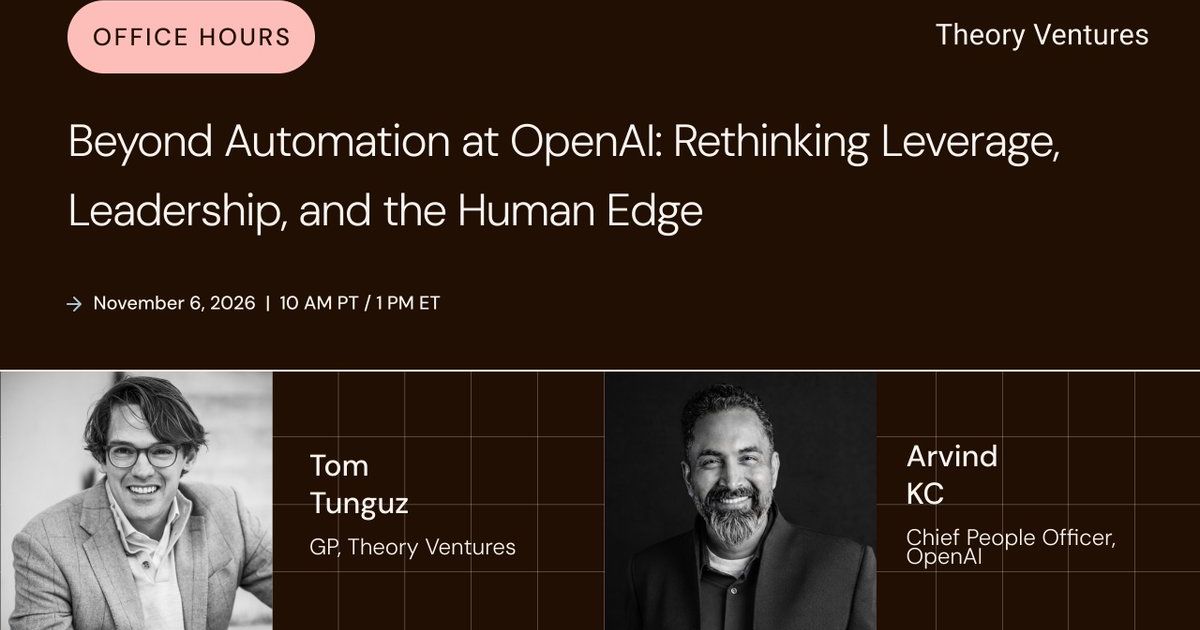
OpenAI‘s Chief People Officer KC joined Office Hours to discuss how rapid AI progress changes organizations. He traced four years of model progress: two years ago models could answer trivial puzzles like counting R’s in strawberry; a year ago reasoning models handled competition-level math; in September OpenAI agents attacked the Navier-Stokes Millennium Prize problem and reported a solution in 88 hours. For companies, the implication is a choice between doing the same tasks faster, which lifts earnings, and reimagining what is possible, which bends the arc of the business. The two paths look similar initially, then geometric compounding creates explosive separation.
KC argued the words junior and senior no longer carry meaning. In a world where none of us have relevant experience for new contexts, experience from two years ago matters less than what you learned three months ago. He described a vision of modern work: the model acts as a brain, surrounded by a harness like Codex or Claude Code—an exoskeleton providing skills, tools, and a runtime that holds context across agents. Above that sit incarnations: an assistant, then specialists.
He criticized how most firms use people as middleware for their own systems: do the work, then log the work. He calls this ‘work on work.’ When agents take over system updating, humans start working with humans. He suggests adding ‘agent manager’ as a suffix to every title—for example, not a salesperson but a sales agent manager.
The session closed with a story about an oncologist’s funeral. A patient chose her doctor not for diagnosis or plan but for bedside manner. The differentiator is how you show up as a human—honesty, integrity, humility, and willingness to learn. When everyone has access to intelligence beyond their own, this human aspect is what separates us, and KC considers that good news, sending us back to work worth doing.