Vercel’s Inbound Sales Agent: From 1,000-Line Prompt to 14 Rules
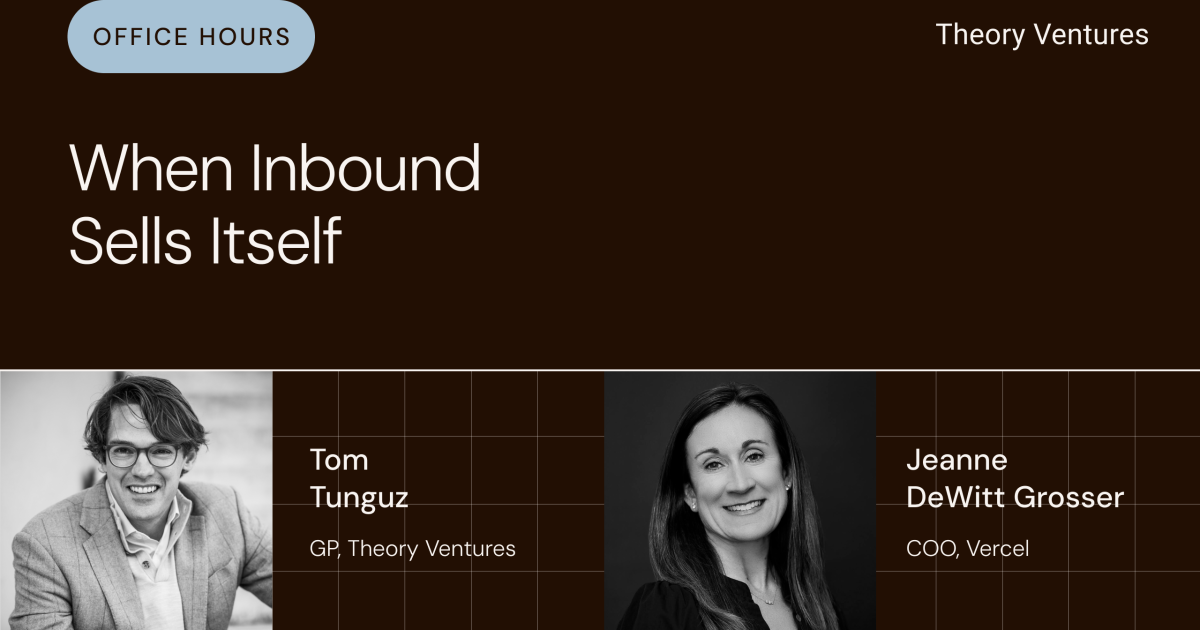
Jeanne DeWitt Grosser, COO of Vercel, described on Office Hours how Vercel built the agent that now runs the top of its sales funnel. The project started after Vercel founded a go-to-market engineering team and handed the problem to a single engineer spending roughly 20% of his time. The first version was a prompt of about 125 lines, written by the best SDR on the team, encoding Vercel‘s qualification rules. According to Jeanne, the early success came from picking a problem that was reasonably deterministic and then throwing the company’s unique context into the model: “how do you get the model to behave within Vercel‘s four walls.” The agent launched in June, kept human SDRs in the loop, and by August the human was pulled out.
In the first phase, the agent did everything except send messages: it researched, qualified, and drafted. Jeanne framed the QA process as managing a new rep. She would read 100% of a person’s first hundred emails while teaching the job, then move to a simple random sample of one in every hundred outreaches. Six weeks of that human-in-the-loop phase produced enough data and improvement to complete the effort. Over the next year, Vercel added product surface area and moved upmarket into enterprise, attracting a more diverse set of companies. The prompt, in turn, grew from 125 lines to 1,000 lines.
The larger prompt created a problem: the model would not always follow the rules embedded in it, and qualification and sales contain many steps that are genuinely deterministic. Vercel‘s response was to split the prompt into rules and judgment. Engineers encoded the rules and left only the judgment-heavy work to the model. Inbound now runs on 14 rules. For example, when a lead arrives, the system runs a Salesforce lookup to see whether an open opportunity exists on the account; if it does, the lead routes to the account executive. “The model shouldn’t get to decide, we just want that to occur,” Jeanne said. The model is used only for thinking exactly where a human would have thought previously. That design matches a pattern identified in the article “Is AI Doing Less & Less?”, where 65% of nodes in 14 production agent workflows execute as pure code and only 14% remain fully agentic.
Because the rules are explicit, Vercel added a second agent that watches for breaches. If the system breaks one of the 14 rules, the escalation agent determines whether the breach should have happened, then either fixes it or blesses the exception. The team structure also changed: the SDR team all received promotions to outbound, skipping the customary year. “The value of humans is talking to humans,” Jeanne said. The more people can be moved out of email marketing and back into conversations, the more value the BDR function delivers. She also reported the economics: the entire inbound function for a unicorn runs for about $1,000 per year in inference and infrastructure.
The takeaway from Vercel‘s experience is a clear pattern for inbound automation: choose a deterministic problem, encode company-specific rules in code, reserve the model for judgment, and monitor the rule system with an AI overseer. The actual construction cost was modest: one GTM engineer at 20% time and six weeks of human-in-the-loop QA.