The Middle of the AI Market Is Where the Price War Is
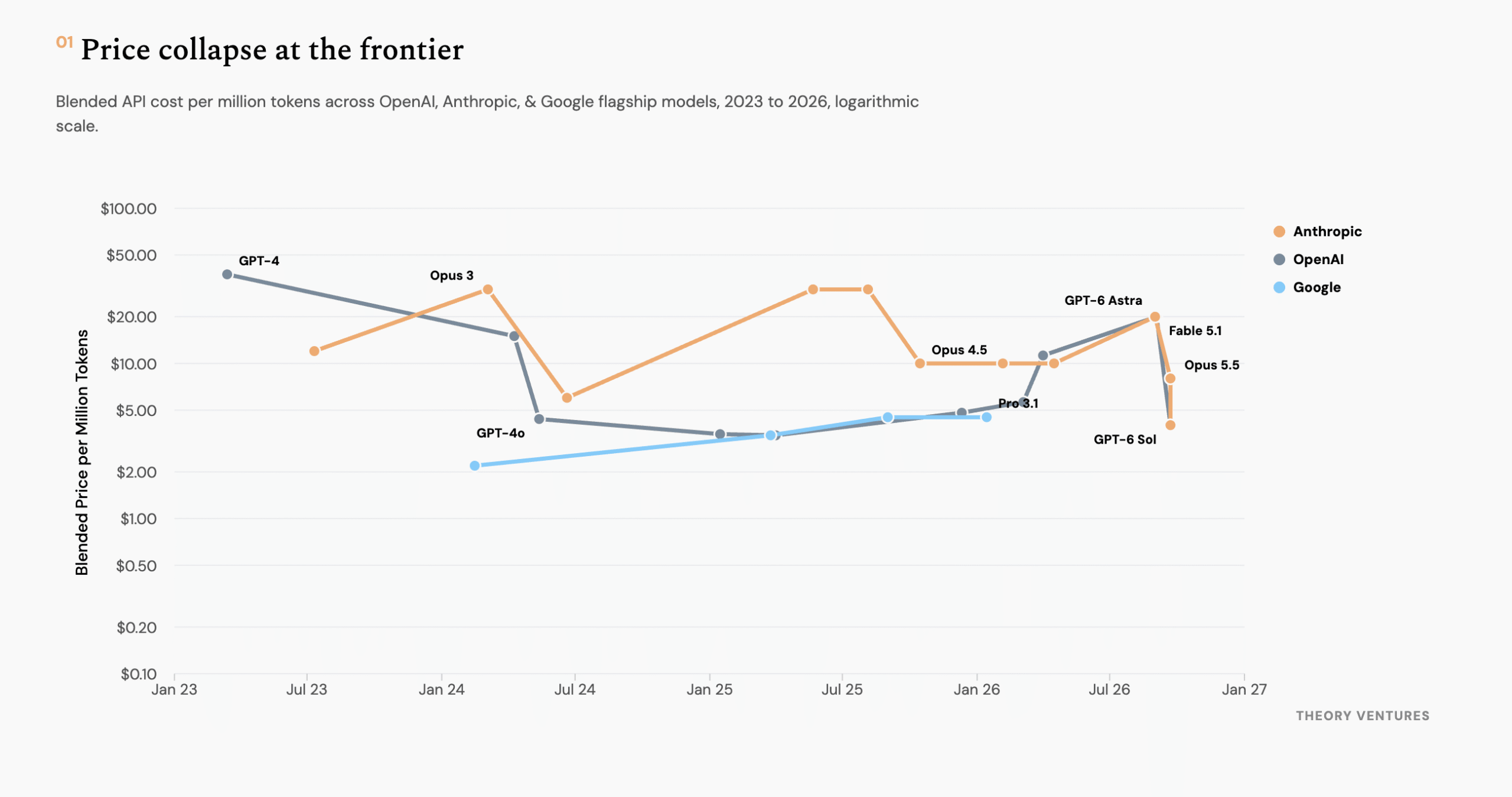
The AI market’s center of gravity is the middle, not the frontier. Price cuts are the clearest signal: Anthropic held Opus pricing at $5 and $25 per million tokens across five releases, then cut it yesterday; OpenAI cut its Luna model 80% in July and another 50% yesterday. The frontier shifted when OpenAI matched Anthropic’s June pricing of $10 and $50 with GPT-5.6 Sol at $5 and $30 in July, delivering comparable capability at roughly a third of the cost per task. Open-weight models also deflate prices: they run a majority of token volume on publishing gateways, at an 86% discount to the blended price of closed models. Fine-tuning magnifies that pressure. Cursor’s Composer 2 fine-tuned open-weight Kimi K2.5 and cut overall cost 86% versus its previous in-house model, and Harvey cut cost per cell 55% against Sonnet 5 while scoring above Fable 5.
The right tail is thinner than forecasts assumed. Fable 5.1, Anthropic’s most capable and most expensive model, captured only 3.7% of gateway spending in its first 12 days; its predecessor peaked at 13.2% in July and fell to 4.9% a month later when Opus 5 shipped at half the price. Among large corporate accounts, frontier models dropped from 53% of token consumption in early August to 45% by September. Demand is not a pyramid with a small, wealthy peak; it is a normal distribution with a fat middle. Enterprise requirements change slower than token prices, so the tier that satisfies a fixed requirement keeps getting cheaper.
If intelligence per dollar keeps exploding, the distribution of tokens may shift to commodity, and that will determine the economics of the AI market. The latest confirmation came yesterday: Anthropic released a new model and cut its price, and OpenAI followed ninety minutes later.