The Local Coding Stack: 5x Speedup for Free
A Hacker News thread with 500+ comments reveals a surprisingly mature local coding stack that is quietly replacing cloud-based AI coding assistants for many developers. The core tension is between the convenience of frontier models like Claude Opus and the practical advantages of running models locally—privacy, zero cost, and full offline capability. The thread surfaces a real tradeoff: local models require more guidance and produce less elegant architecture, but for a growing set of use cases, the gap is closing fast enough to justify the switch.
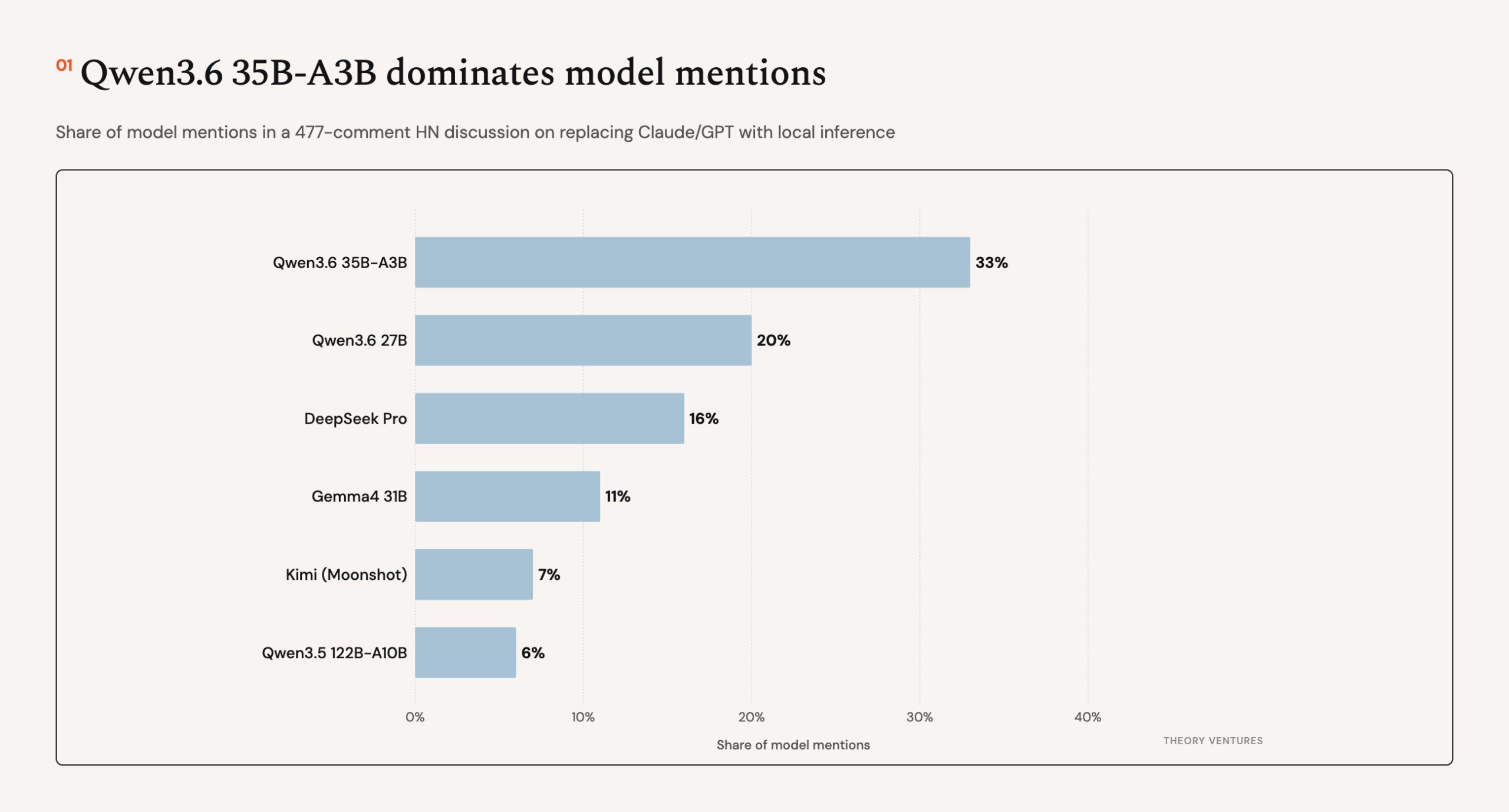
Qwen 3.6 35B-A3B dominates model mentions at 33%, followed by the 27B variant at 20%. These mixture-of-experts architectures run well on consumer hardware. On the agent harness side, Pi leads at 49% with OpenCode at 45%, both designed specifically for local inference. The benchmark data backs up the sentiment: Qwen 3.6 27B scores 77.2%, the MoE variant hits 73.4%, putting them within striking distance of Claude Sonnet 4.6 at 79.6%. The analogy one commenter draws—a junior dev you must guide versus a senior who thinks with you—captures the maturity level accurately.
The pattern here is the minimill approach playing out in real time, not just for trivial tasks but for reasonable coding work. A serious builder should recognize that local models have crossed a threshold. The tradeoff between a 15x speedup from Opus and a 5x speedup from local Qwen is increasingly acceptable when the local setup costs nothing, requires no internet, and leaks no code. The stack is maturing fast enough that betting on local inference for daily coding is no longer a fringe position.