OpenAI’s ChatGPT Work pushes AI agents beyond coding
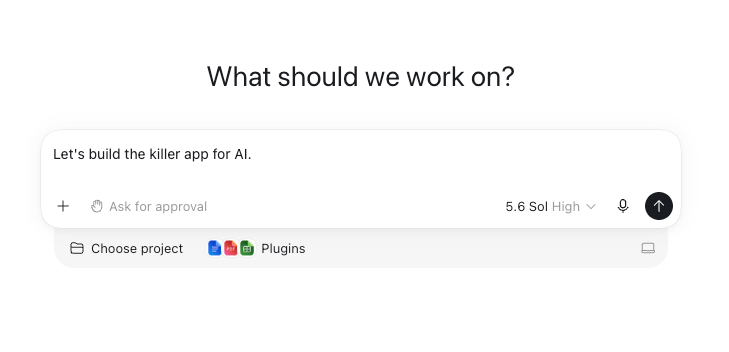
ChatGPT Work, OpenAI’s agentic desktop product released last month on the $20 subscription tier, is the company’s attempt to move AI assistance beyond software engineering. It is a modified version of Codex, the coding tool, rebuilt for white-collar workers: accountants, investors, doctors, and anyone whose day is spent in email, Slack, Notion, Figma, calendars, and SaaS platforms. Lead desktop-app engineer Andrew Ambrosino says he runs the app against his own inbox and Slack, accepting the possibility that the model could pull from a private DM it should not share. The stated mission, in product lead Thibault Sottiaux’s words, is for ChatGPT to complete complicated tasks autonomously, not just answer questions.
Commercial context matters: longer agentic runs consume more tokens, making agents more lucrative per user, and the industry needs to expand beyond developers to justify massive training and compute investment. Vertical competitors like Harvey for law and Clay for sales are model-agnostic, and a16z’s Christian Catalini warned that if labs cannot rapidly obtain the complementary assets needed to scale AI, value will accrue elsewhere. An OpenAI-backed study by Johnston et al. found that in June, 98% of OpenAI employees used Codex, versus 17% of organizational subscribers and less than 1% of individual subscribers. The joint app has about 20 million users, compared with more than a billion people OpenAI says prompt ChatGPT online.
Every agent needs a “harness”: the software around a model that decides what information it sees, which tools it can use, and how it presents results. Developers accepted a CLI, but broader users need more hand-holding. Ambrosino describes designing for the messy world of old websites and corporate tools, and argues that discoverability matters early even if buttons eventually disappear; he compares the buttons to skeuomorphism, a design crutch that helps people make a transition. The TechCrunch author’s testing showed real capability: pulling a preschool calendar from email into Google Calendar, building an auto-updating financial dashboard, and creating a queryable space-launch database. But setup was confusing, permissions were circular, important settings were web-only, and ChatGPT Work could not create new calendars. Engineers acknowledged the effort settings are not intuitive for new users.
Evaluation is harder outside code, because a presentation or strategy is not as measurable as a working program. OpenAI says it uses its GDPval benchmark, drawn from 44 occupations and hundreds of knowledge-work tests, plus user feedback; employees themselves are also early testers. On competition, OpenAI engineers were reluctant to compare their harness with Claude Cowork, saying they do not look at competing harnesses, though the reporter notes interface similarities and that ChatGPT Work immediately prompted importing Claude Cowork data. The article describes how OpenAI’s first Codex web app was “AGI-pilled,” betting on the model to handle tasks with minimal input, while Anthropic built Claude Code around back-and-forth conversation and checking in with users, an approach that proved more effective. OpenAI later added interactivity, and download statistics now show Codex has a slight lead after Claude Code led until April.
Harness design may be less important than raw model strength. OpenAI’s Joe Gershenson argues the harness is a temporary crutch: the next model can make extra tooling obsolete, so good harness engineering means giving the model precisely the context it needs. Databricks found that Pi, an open-source harness by Earendil’s Mario Zechner, outperformed Codex while using the same GPT 5.5 model; Pi has been used to build OpenClaw and Cloudflare OS. Zechner sees big-lab harnesses as lock-in and argues non-coding workflows are hard to learn from because decisions in management play out over months and are not digitized into simple traces. Cost also looms: the author consumed more than 80 million tokens in four days on a $20 subscription, worth about $65, a subsidy of more than 3x the price. Sottiaux says OpenAI is pushing efficiency and recently cut prices 80% for Luna users, but whether most workers or models are ready for agentic work remains open.